Facts
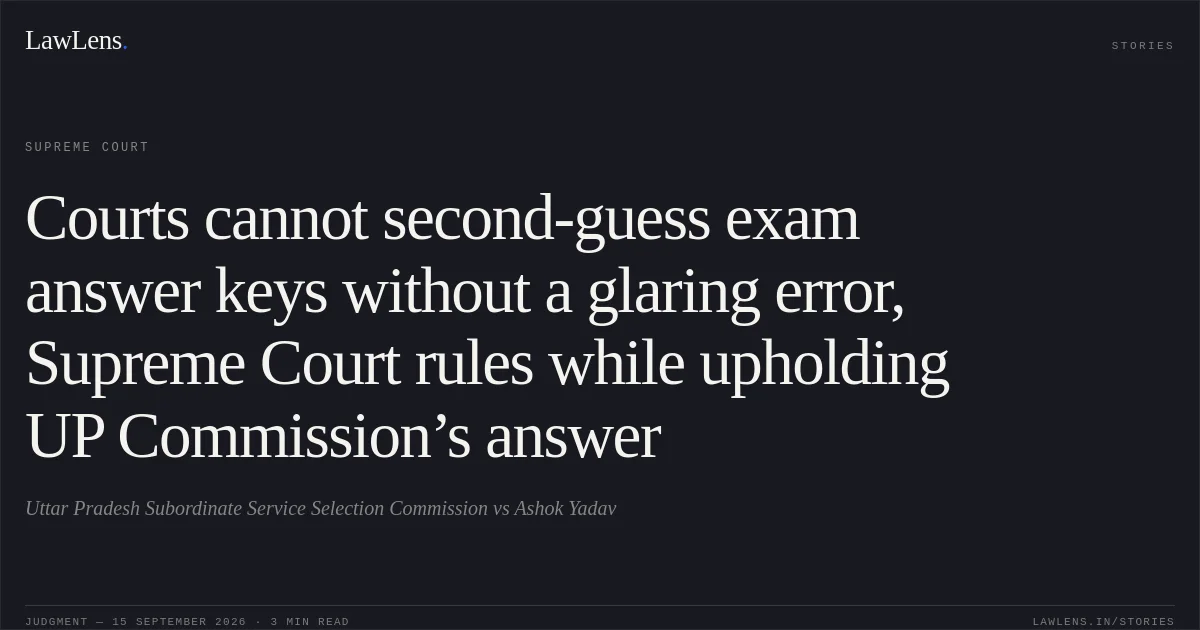
The Uttar Pradesh Subordinate Service Selection Commission conducted a recruitment examination for 3,133 Village Development Officer posts.
Source reference: paras. 5–8The examination was held on 05.06.2016, and the revised answer key was published on 30.06.2016.
Source reference: paras. 5–8For Question 68, asking which book-and-person pair was incorrect, the Commission treated Option B—“Shahjahan Nama–Mohammad Tahir”—as the correct answer, whereas the respondent selected Option C—“Humayunnama–Humayun,” contending that Humayunnama was authored by Gulbadan Begum, not Humayun.
Source reference: paras. 5–8The respondent’s writ petition was dismissed by the Single Judge on the ground of laches, with reliance on the principle that courts should exercise restraint in reviewing answer keys.
Source reference: para. 9The Division Bench initially dismissed the intra-court appeal, but subsequently allowed the respondent’s review petition on the basis of an expert report stating that Option C would be correct if the pairing was based on authorship, while Option B would be correct if it was based on the subject of the book.
Source reference: paras. 10–13The Commission challenged that order before the Supreme Court.
Source reference: paras. 3, 11–12Issues
Whether the High Court was justified in interfering with the Commission’s decision to treat Option B as the only correct answer to Question 68.
Source reference: para. 18Whether the expert report and the respondent’s authorship-based interpretation established a sufficiently patent or glaring error warranting judicial review of the answer key, particularly in review jurisdiction.
Source reference: paras. 22, 25, 30–32Law Applied
The Court applied the principles governing judicial review of examination answer keys laid down in Ran Vijay Singh v. State of U.P., including that courts should presume the correctness of the answer key, should not re-evaluate answer sheets as academic authorities, and may interfere only where an error is clearly demonstrated without an inferential process or rationalisation; in case of doubt, the benefit goes to the examining body.
Source reference: para. 20Relying also on U.P. Public Service Commission v. Rahul Singh, the Court held that the candidate must establish not merely that the key answer is arguably wrong, but that it contains a glaring and self-evident mistake.
Source reference: para. 21Judicial interference may be justified where a question is demonstrably incorrect, where more than one answer is correct although only one was prescribed, or where the correct answer is among the options but was wrongly rejected; otherwise, the examination authority’s determination should stand.
Source reference: para. 22The Court further emphasised that a question must be read as it stands, and courts cannot rewrite it based on what it ought to have asked.
Source reference: paras. 29, 31Reasoning
The Court held that Question 68 did not specify that the book-and-person pairing had to be determined by authorship.
Source reference: para. 24In the absence of such a specified parameter, the Commission’s commonsense, subject-based approach—under which Baburnama concerned Babur, Humayunnama concerned Humayun, and Tuzuk-e-Jahangiri concerned Jahangir, while Shahjahan Nama did not concern Mohammad Tahir—made Option B a rational and non-patently erroneous answer.
Source reference: paras. 14, 24, 26The expert report did not declare Option B incorrect; it merely identified Option C as the answer under an authorship-based interpretation and Option B as the answer under a subject-based interpretation.
Source reference: paras. 25, 32The respondent had therefore applied an assumption about the intended basis of pairing and effectively read an unstated requirement of authorship into the question.
Source reference: paras. 27–29Since resolving the issue in favour of Option C required inferential reasoning, and Option B could not be characterised as glaringly wrong, the matter was not amenable to judicial review.
Source reference: paras. 30, 32The High Court had consequently exceeded its jurisdiction, particularly while exercising review jurisdiction.
Source reference: paras. 30, 32Holding
The Supreme Court answered the issue in favour of the Commission and held that Option B was not patently or glaringly incorrect.
The High Court was not justified in awarding the respondent one mark for selecting Option C or in directing consequential appointment-related relief.
Source reference: paras. 30, 32The appeal was allowed, the impugned review order was set aside, and Writ A No. 10221 of 2019 filed by the respondent was dismissed.
Source reference: para. 33All pending applications were disposed of.
Source reference: para. 34Original Court PDF
Uttar Pradesh Subordinate Service Selection CommissionvsAshok Yadav
Click to open original judgment
Original judgment, available to read, download and summarize on LawLens.in