Facts
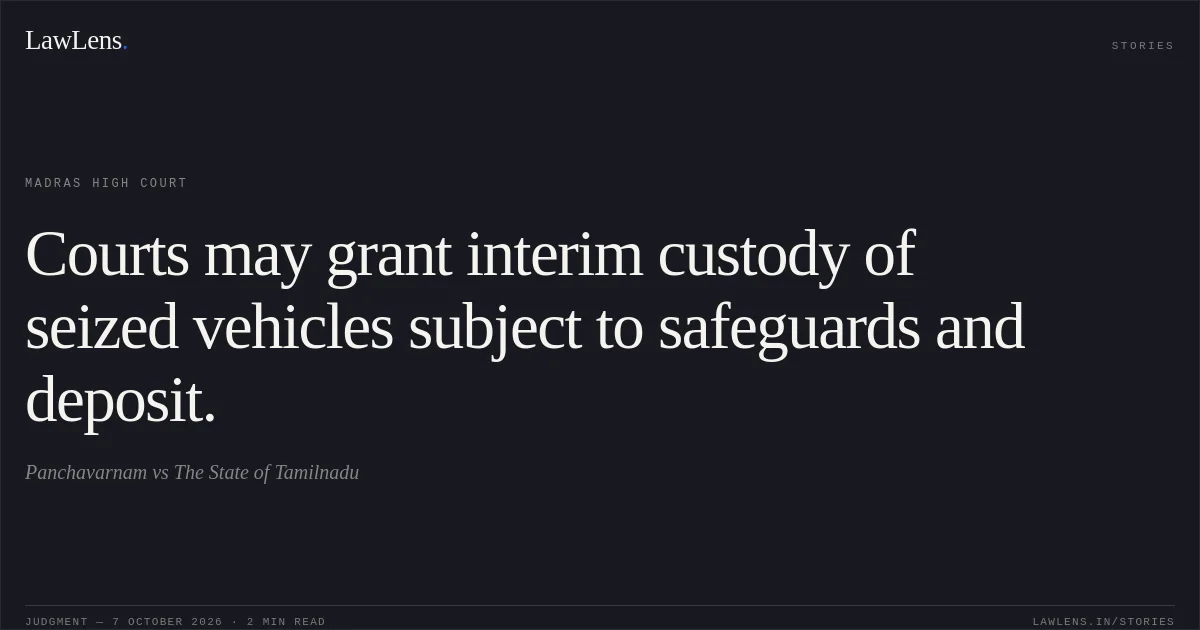
The petitioner, claiming to be the registered owner of a Hero Pleasure two-wheeler, sought its interim custody after police seized it in Crime No.37 of 2025, alleging that it had been used to possess 84 liquor bottles.
Source reference: p.2The case was registered under Section 4(1)(C) of the Tamil Nadu Prohibition (Amendment) Act, 2024.
Source reference: p.2The petitioner said the vehicle was needed for her livelihood and that continued storage in the open would cause deterioration; the State opposed release on grounds of possible alienation, alteration, or misuse.
Source reference: pp.2–3The Magistrate dismissed her custody application.
Source reference: p.3By the time the revision was considered, the charge sheet had been filed and the case taken on file as C.C.No.422 of 2025.
Source reference: pp.1, 3–4Issues
1. Whether the Magistrate’s refusal to grant interim custody of the seized vehicle should be set aside.
Source reference: pp.1, 3–42. Whether the vehicle could be entrusted to the petitioner subject to conditions that protect the prosecution’s interests and preserve the vehicle.
Source reference: pp.4–8Law Applied
The revision was brought under Section 438 read with Section 442 of the Bharatiya Nagarik Suraksha Sanhita, 2023.
Source reference: p.1The Court stated that a court granting interim custody determines who should possess the property; it does not adjudicate title.
Source reference: p.4The purpose of interim custody is to prevent the property’s decay and diminution in value, relying on Krishnan Narayana v. State of Andhra Pradesh, 2026 INSC 748.
Source reference: p.4Citing Bishwajit Dey v. State of Assam, 2025 (3) SCC 241, and S. Selvaraj v. Inspector of Police, Crl.R.C.(MD) No.374 of 2020, the Court recognised that interim custody may be made subject to appropriate conditions, including a monetary deposit.
Source reference: p.5It also relied on M/s. ABC Express v. State of Gujarat, 2026 INSC 940, and other Madras High Court decisions in granting conditional custody.
Source reference: pp.5–6Reasoning
The Court considered that the vehicle’s alleged use in the offence did not, by itself, require its continued retention, particularly as the charge sheet had been filed.
Source reference: pp.3–4It treated the petitioner’s ownership claim and the risk of deterioration as relevant to interim possession, while addressing the State’s concerns through conditions restricting alienation, encumbrance, alteration, and illegal use, and requiring production of the vehicle when directed.
Source reference: pp.2–3, 6–8A deposit, bond and sureties, proof of registration, and documentation of the vehicle’s condition before release were also required.
Source reference: pp.6–8The Court expressly confined its decision to interim custody, leaving the merits of the prosecution and any confiscation question open.
Source reference: p.9Holding
The revision was allowed, and the Magistrate’s order was set aside.
The petitioner was granted interim custody of the vehicle upon proving ownership and complying with the stated conditions, including depositing ₹10,000, executing a ₹50,000 bond with two sureties, producing registration documents, undertaking not to use the vehicle illegally, and not alienating, encumbering, or altering it.
Source reference: pp.6–10The investigating officer was directed to prepare a panchnama and make photographic and video records before release.
Source reference: pp.6–10The order was subject to any confiscation proceedings and expressed no view on the merits of the prosecution.
Source reference: pp.6–10Acts & Sections Cited
2 provisions across 1 statute referred to in this judgment. Each provision opens on LawLens.
Bharatiya Nagarik Suraksha Sanhita, 20232
Original Court PDF
PanchavarnamvsThe State of Tamilnadu
Click to open original judgment
Original judgment, available to read, download and summarize on LawLens.in