Facts
The Commercial Court allowed the respondent’s application under Section 9 of the Arbitration and Conciliation Act, 1996, directing the appellant to release specified inventory within seven days or deposit ₹3,28,66,401.87, and restraining it from dealing with that inventory
Source reference: p. 1, para. 1An arbitral tribunal had been constituted on 3 July 2026; at its first meeting on 17 August 2026, the claimant was granted time to file its statement of claim, and pleadings had not yet been exchanged
Source reference: pp. 2, 6–7, paras. 2, 9The appellant challenged the Commercial Court’s order under Section 37, arguing that Section 9(3) barred the Court from proceeding after constitution of the tribunal and that the deposit direction exceeded the relief sought
Source reference: pp. 2–3, 9–10, paras. 2–5, 15–16Issues
Whether Section 9(3) barred the Commercial Court from granting interim measures after the arbitral tribunal had been constituted
Source reference: pp. 2–6, paras. 2–9Whether the direction to deposit ₹3,28,66,401.87 was liable to be set aside because the Section 9 application did not contain that specific prayer and the proposed amendment had not been allowed
Source reference: pp. 9–12, paras. 15–18Whether the impugned order disclosed an error warranting interference under Section 37
Source reference: p. 12–13, paras. 18–20Law Applied
Section 9(3) of the Arbitration and Conciliation Act, 1996 restricts a court from entertaining an application for interim measures after constitution of the arbitral tribunal unless the remedy under Section 17 is inefficacious.
Source reference: pp. 4–6, paras. 6–8Applying Arcelor Mittal Nippon Steel India Ltd. v. Essar Bulk Terminal Ltd., 2021 (0) AIJEL-SC 67689, the Court noted that “entertain” means taking up the application for consideration and applying the court’s mind; where that process has commenced before constitution of the tribunal, the court may proceed to adjudicate the application.
Source reference: pp. 4–6, paras. 6–8The precedent also recognises that Section 17 may not be efficacious in particular circumstances and that interim applications require urgent determination to protect the subject matter of arbitration.
Source reference: pp. 4–6, paras. 6–8Appellate review under Section 37 is limited, and interference is warranted where the impugned order contains an error of law or fact going to the root of the matter.
Source reference: pp. 12–13, paras. 14, 19Reasoning
The tribunal had only recently been constituted, the statement of claim remained to be filed, and pleadings had not been exchanged.
Source reference: pp. 6–8, paras. 9–11The Court therefore found that the tribunal had not yet entered into the reference and that a Section 17 application could not then provide an equally efficacious remedy; the absence of an emergency-arbitrator mechanism and the urgency recorded by the Commercial Court supported that conclusion.
Source reference: pp. 6–8, paras. 9–11The appellant did not challenge the Commercial Court’s findings on prima facie case, balance of convenience, irreparable loss, or urgency.
Source reference: p. 7, para. 10On the deposit direction, the Court relied on the Commercial Court’s findings that the inventory was shown to be with the appellant, was not specifically denied, and was required by the respondent to complete the work; it found no ground to treat the direction as illegal merely because the proposed amendment seeking a deposit had not been allowed.
Source reference: pp. 9–12, paras. 15–18In view of the limited scope of Section 37 review, no basis for interference was established.
Source reference: p. 13, para. 19Holding
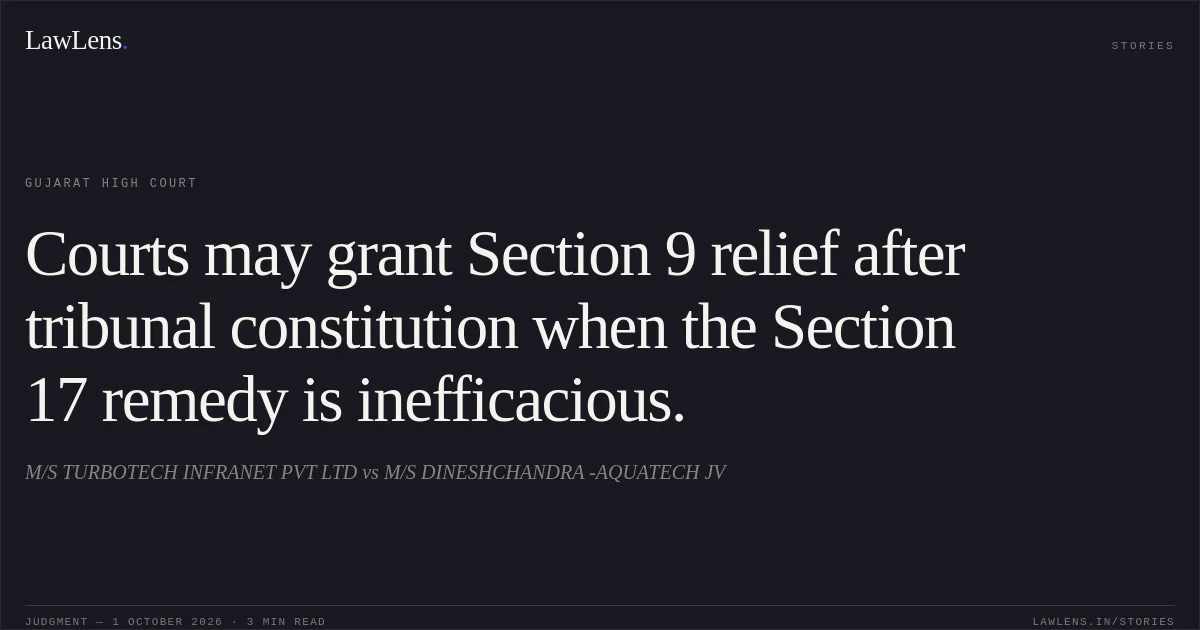
The High Court held that Section 9(3) did not bar the Commercial Court from granting relief because, in the circumstances, the Section 17 remedy was not equally efficacious.
It also rejected the challenge to the deposit direction and found no patent illegality or other ground for interference under Section 37.
Source reference: p. 13, paras. 19–20The appeal was dismissed, with no order as to costs; the connected civil application was disposed of.
Source reference: p. 13, paras. 19–20Acts & Sections Cited
4 provisions across 1 statute referred to in this judgment. Each provision opens on LawLens.
Arbitration and Conciliation Act, 19964
Original Court PDF
M/S TURBOTECH INFRANET PVT LTDvsM/S DINESHCHANDRA -AQUATECH JV
Click to open original judgment
Original judgment, available to read, download and summarize on LawLens.in