Facts
The petitioner, plaintiff in a partition suit, marked a sale agreement dated 26 September 1990 as Ex.P14.
Source reference: p. 2–3The defendants later applied under Section 34 of the Karnataka Stamp Act, contending that the agreement, executed on Rs.10 stamp paper and providing for delivery of possession, was insufficiently stamped.
Source reference: p. 2–3The trial court allowed the application and directed the petitioner to pay Rs.5,82,890 in deficit duty and penalty.
Source reference: p. 2–3The petitioner challenged that order under Article 227 of the Constitution.
Source reference: p. 2–3The High Court considered separately the trial court’s authority to impound the agreement after it had been marked and the correctness of the duty and penalty quantified.
Source reference: p. 16–18Issues
Whether the trial court could invoke Sections 33 and 34 of the Karnataka Stamp Act and impound the agreement after it had been marked as an exhibit without objection.
Source reference: p. 6–8, 16–17Whether the trial court correctly determined the stamp duty and penalty payable on the agreement, having regard to the law applicable on its execution date.
Source reference: p. 17–18Law Applied
Sections 33 and 34 of the Karnataka Stamp Act require a court to examine a chargeable instrument and impound it if it is not duly stamped; an instrument chargeable with duty cannot be admitted in evidence unless duly stamped.
Source reference: p. 6–16Section 35 bars a challenge to an instrument’s admissibility for insufficient stamping once it has been admitted in evidence following a judicial determination; mere marking without judicial consideration does not necessarily attract that bar.
Source reference: p. 6–16The Court applied the principles in G.M. Shahul Hameed v. Jayanthi R. Hegde, (2024) 7 SCC 719, concerning the court’s continuing authority where admissibility was not judicially determined, and noted that the decision had been followed by coordinate Benches in Smt. Krishnavathi Sharma v. Sri Bhagwandas Sharma & Others and Vincent D’Almeida & Another v. Laxmi Kulavathi & Others.
Source reference: p. 6–16Reasoning
The agreement had already been marked as Ex.P14 before the defendants filed their application.
Source reference: p. 16–17Relying on G.M. Shahul Hameed and the subsequent coordinate-Bench decisions, the Court held that the trial court was not precluded from examining the agreement’s stamp-duty compliance merely because it had been marked.
Source reference: p. 16–17However, the trial court had not considered the relevant provisions as they stood on 26 September 1990 or addressed the parties’ competing submissions on whether the agreement was sufficiently stamped on that date.
Source reference: p. 17The High Court therefore found it appropriate to remit the question of quantum rather than decide it itself.
Source reference: p. 17Holding
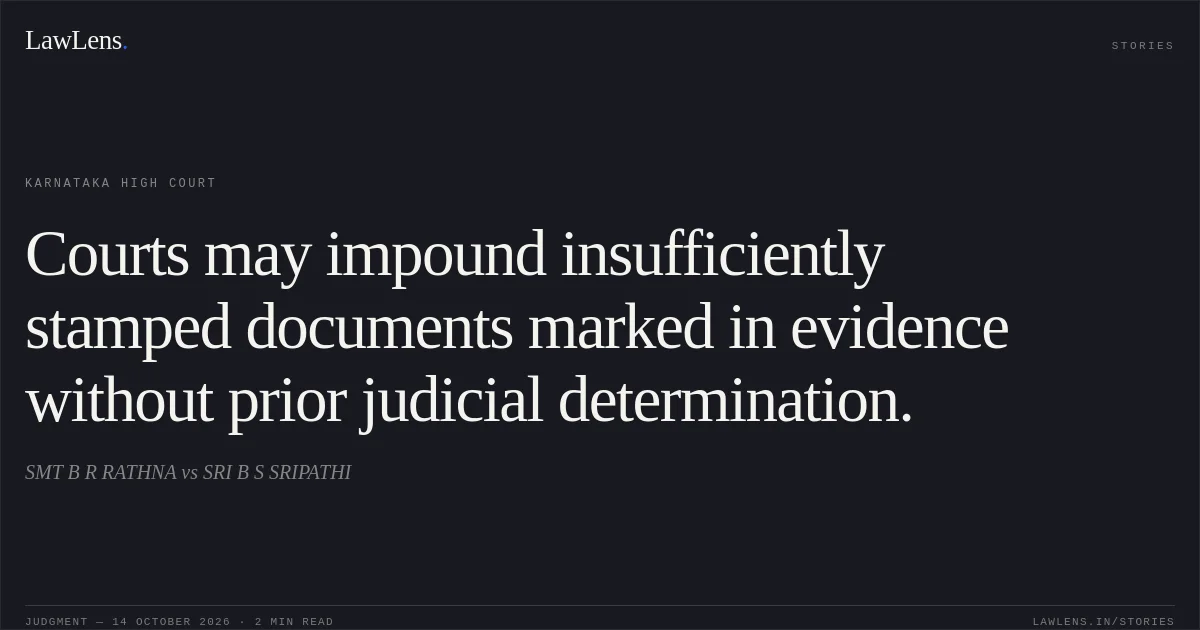
The petition was partly allowed.
The High Court confirmed the trial court’s authority to invoke Sections 33 and 34 and impound the agreement after it had been marked as Ex.P14.
Source reference: p. 18It set aside the direction to pay Rs.5,82,890 and remitted the matter to the trial court to determine the stamp duty and penalty payable under the law applicable to the agreement’s execution date, after giving both parties a reasonable opportunity to be heard.
Source reference: p. 18–19The High Court expressed no opinion on the merits of their competing contentions regarding sufficiency of stamp duty.
Source reference: p. 18–19Acts & Sections Cited
11 provisions across 3 statutes referred to in this judgment. Each provision opens on LawLens.
KARNATAKA STAMP ACT, 19577
Indian Stamp Act, 18991
Code of Civil Procedure, 19083
Original Court PDF
SMT B R RATHNAvsSRI B S SRIPATHI
Click to open original judgment
Original judgment, available to read, download and summarize on LawLens.in


