Facts
The plaintiff had sued for a declaration that he was entitled to a 1/4 share in the suit land.
Source reference: p. 7–9He claimed through his father, Doddapillappa, whose 1/4 share in the Inam land had been re-granted along with the shares of his three sons.
Source reference: p. 7–9The defendants contended that the land had been partitioned and the parties’ joint status severed.
Source reference: p. 7–9When the suit was set down for arguments, the plaintiff applied under Order VI Rule 17 CPC to add a prayer for partition.
Source reference: p. 7–9The Trial Court rejected the application, citing delay and a change in the suit’s nature and character.
Source reference: p. 7–9The plaintiff challenged that order by writ petition
Source reference: p. 7–9Issues
1. Whether the plaintiff should be permitted to amend the plaint at the arguments stage to add a consequential prayer for partition
Source reference: p. 7–8, 11–152. Whether delay and the asserted alteration of the suit’s nature and character justified refusing the amendment
Source reference: p. 7, 9, 14–15Law Applied
Order VI Rule 17 CPC governs amendment of pleadings.
Source reference: no citationAs applied by the Court, an amendment should ordinarily be allowed where it assists in determining the real controversy and avoids multiplicity of proceedings, provided it does not introduce an entirely new or inconsistent cause of action or fundamentally alter the dispute.
Source reference: no citationThe Court relied on Sampath Kumar v. Ayyakannu, AIR 2002 SC 3369, for the principle that amendments facilitating determination of the real controversy and avoiding multiplicity may be permitted where they do not fundamentally alter the dispute
Source reference: p. 13It considered M. Revanna v. Anjanamma, AIR 2019 SC 940, cited by the respondents, but held it inapplicable on the facts
Source reference: p. 7, 15Reasoning
The Court found that the proposed partition relief flowed from the plaintiff’s existing claim to a 1/4 share and did not introduce a new, inconsistent case
Source reference: p. 11–14The central dispute—whether Doddapillappa’s share had itself been partitioned and whether the plaintiff was entitled to a share in it—was already raised, and both parties had adduced evidence on that controversy
Source reference: p. 11–12The plaintiff undertook not to lead further evidence, while the defendants could file a limited written statement.
Source reference: p. 12–15These safeguards addressed prejudice from allowing the amendment at the arguments stage; refusing it could instead lead to a separate partition suit and multiplicity of proceedings
Source reference: p. 12–15Holding
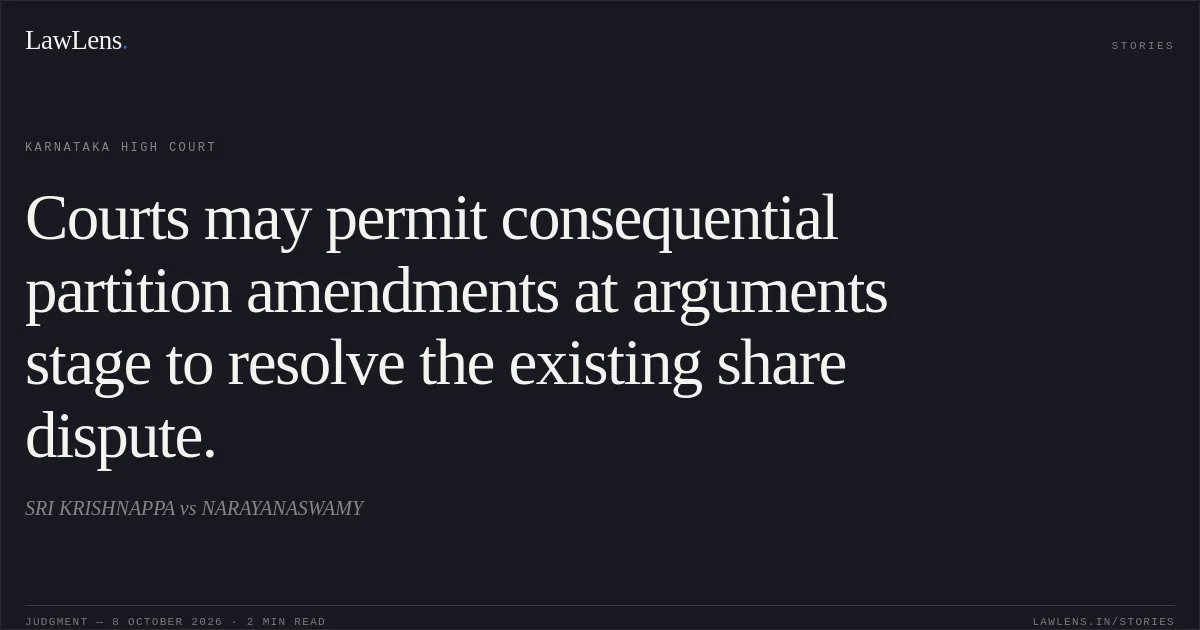
The Court answered the issues in favour of permitting the amendment and held that the Trial Court had adopted an overly technical approach.
It allowed the writ petition, quashed the order dated 14 August 2019, and permitted amendment of the plaint, subject to the plaintiff adducing no further evidence and the defendants being allowed to file a limited written statement.
Source reference: p. 15–17The Trial Court was directed to decide the suit on its merits, preferably within six months of receiving the certified order
Source reference: p. 15–17Original Court PDF
SRI KRISHNAPPAvsNARAYANASWAMY
Click to open original judgment
Original judgment, available to read, download and summarize on LawLens.in