Facts
On 11 June 2015, Railway Protection Force officials conducted a raid at the petitioner’s scrap shop at Bargawan Road, Katni, and allegedly recovered railway materials, including Pandrol Clips, Panel Seat pieces, CST-9 Plates and Tie Bars. The prosecution alleged that the petitioner disclosed that the materials had been purchased from Govind @ Gunda and Sanju Sahu, leading to proceedings under Section 3 of the Railway Property (Unlawful Possession) Act, 1966, registered as R.C.T. Case No. RLT/2032/2015.
Source reference: para. 2During pre-charge evidence, the prosecution examined two witnesses, Kamal Singh and Indrapal @ Raju. Evidence was closed on 11 May 2026, after which the matter was listed for arguments on charge. When the defence pointed out that the seized railway materials had neither been produced before the Court nor exhibited, the prosecution filed an application under Section 311 Cr.P.C./Section 348 BNSS for recall or re-examination of witnesses and production of the seized articles. The Special Railway Magistrate, Jabalpur allowed the application by order dated 10 June 2026.
Source reference: para. 3The petitioner challenged that order under Section 528 BNSS, contending that the prosecution was attempting to fill lacunae after prolonged delay and closure of evidence.
Source reference: para. 4The Union of India opposed the petition, asserting that the evidence was essential for a just decision and that the petitioner would retain full opportunity to cross-examine the witnesses and contest the material.
Source reference: para. 5Issues
Whether the Special Railway Magistrate committed a jurisdictional error in allowing the prosecution’s application under Section 311 Cr.P.C./Section 348 BNSS for recall of witnesses and production of the seized railway articles.
Source reference: para. 6Whether the prosecution’s application amounted to an impermissible attempt to fill lacunae in its case, causing prejudice to the petitioner and violating his right to a speedy trial.
Source reference: paras. 4, 10–12Law Applied
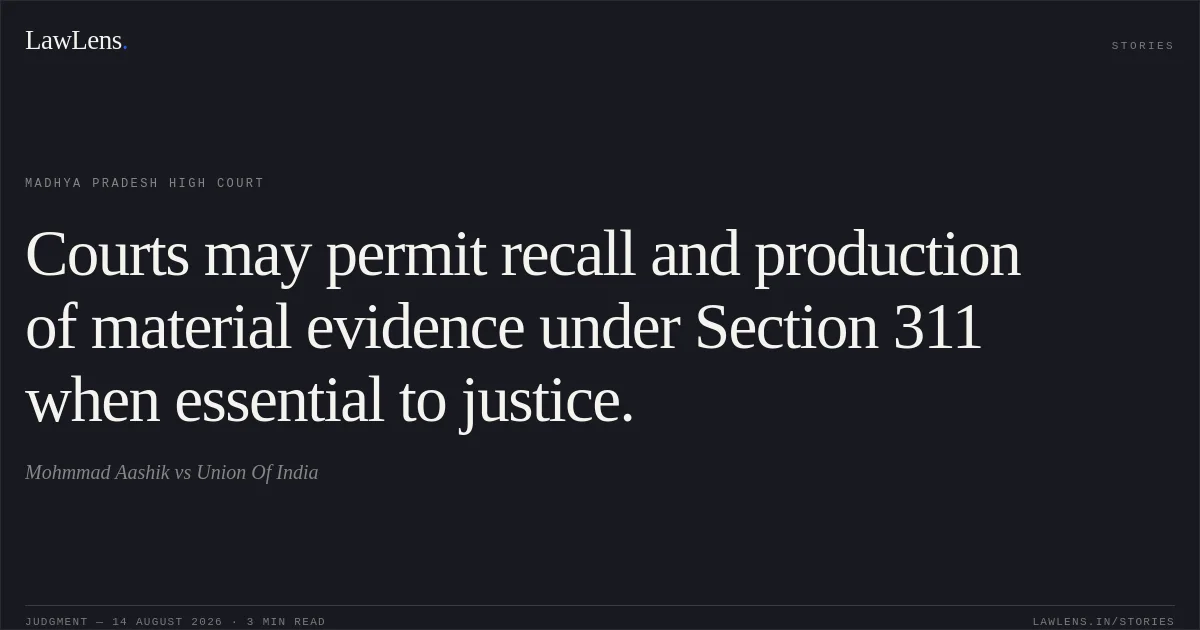
Section 311 Cr.P.C., now corresponding to Section 348 BNSS, empowers a criminal court to summon, examine, recall or re-examine any person where the evidence appears essential to the just decision of the case; its first part is discretionary, while its second part becomes mandatory once the Court forms the requisite opinion regarding necessity.
Source reference: para. 7The Court relied on Rajendra Prasad v. Narcotic Cell, (1999) 6 SCC 110, which distinguishes an inherent weakness in the prosecution case from an inadvertent omission or oversight and permits rectification of the latter where no serious prejudice is caused; this principle was reiterated in Zahira Habibullah Sheikh v. State of Gujarat, (2004) 4 SCC 158, and Natasha Singh v. CBI, (2013) 5 SCC 741, which emphasise discovery of truth and a just decision.
Source reference: para. 8The Court also exercised its inherent jurisdiction under Section 528 BNSS, corresponding to Section 482 Cr.P.C., while applying the principle that relevant and essential evidence should not be excluded merely because it was not formally produced at an earlier stage.
Source reference: paras. 6, 10–14Reasoning
The Court held that the seized railway articles were not collateral evidence but constituted the material subject matter of the alleged offence and were directly connected with the prosecution’s recovery case.
Source reference: para. 9Their non-production and non-exhibition were treated as an omission or oversight rather than an inherent defect in the prosecution case. Since the application was made before the proceedings had progressed beyond the stage of framing of charge, and the trial court had found the evidence necessary for proper adjudication, the requirements of Section 311 Cr.P.C./Section 348 BNSS were satisfied.
Source reference: paras. 9–10The Court rejected the petitioner’s argument that the application was merely intended to fill lacunae, observing that the petitioner could still cross-examine the recalled witnesses, challenge the genuineness and admissibility of the articles, and raise all permissible objections.
Source reference: para. 11Although the proceedings had been pending since 2015, the Court concluded that delay alone could not justify excluding material evidence essential to determining the truth; expeditious completion of the trial, rather than exclusion of the evidence, was the appropriate remedy.
Source reference: para. 12No perversity, lack of jurisdiction or actual prejudice was demonstrated in the trial court’s order.
Source reference: para. 13Holding
The High Court answered the issues against the petitioner. It held that the Special Railway Magistrate acted within jurisdiction in permitting recall or re-examination of witnesses and production of the seized railway materials under Section 311 Cr.P.C./Section 348 BNSS.
The impugned order dated 10 June 2026 did not warrant interference under Section 528 BNSS. Accordingly, the petition was dismissed.
Source reference: para. 14Acts & Sections Cited
5 provisions across 3 statutes referred to in this judgment. Each provision opens on LawLens.
Bharatiya Nagarik Suraksha Sanhita, 20232
Code of Criminal Procedure, 19732
Railway Property (Unlawful Possession) Act, 19661
Original Court PDF
Mohmmad AashikvsUnion Of India
Click to open original judgment
Original judgment, available to read, download and summarize on LawLens.in