Facts
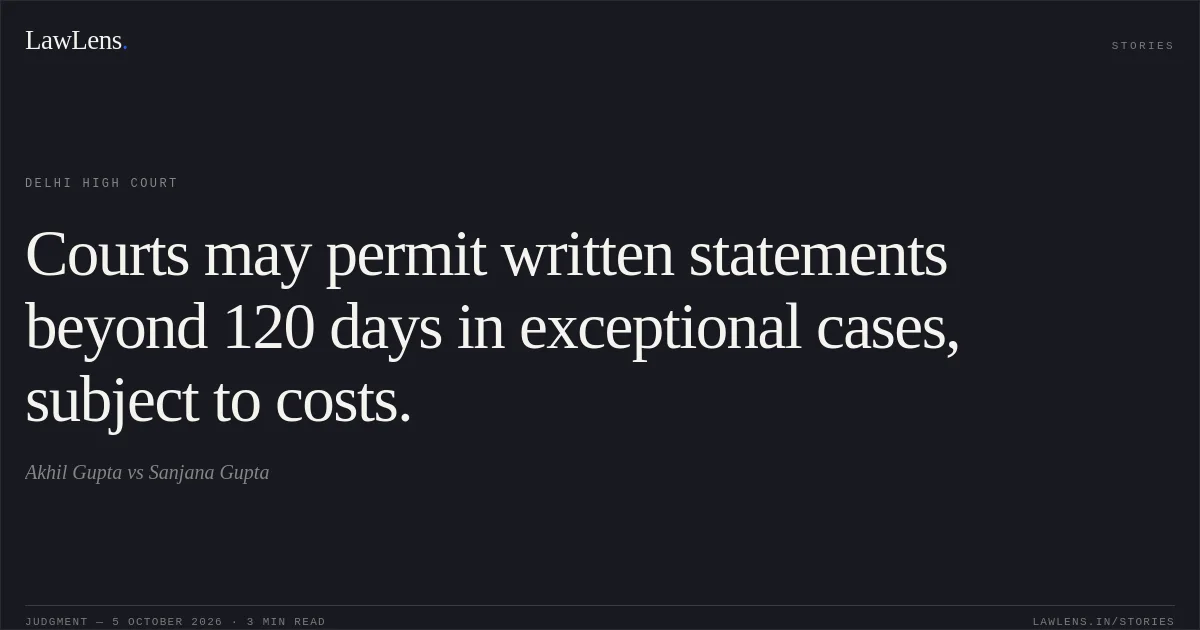
The respondent-wife filed a divorce petition alleging cruelty.
Source reference: no citationThe appellant-husband’s right to file a written statement was closed on 18 March 2026 after he failed to file it within the prescribed period. He sought recall under Order IX Rule 13 CPC, although no ex parte decree had been passed; the Family Court advised him to seek condonation of delay under Order VIII Rule 1 CPC.
Source reference: p. 2–3On 30 July 2026, the Family Court declined to take his written statement on record, noting defects in the pleading and supporting documents, and awarded the respondent interim maintenance of Rs. 25,000 per month under Section 24 of the Hindu Marriage Act, 1955. The appellant challenged that order.
Source reference: p. 3–5Issues
1. Whether the appellant should be permitted to file a written statement beyond the prescribed period, notwithstanding the closure of his right to file it and defects in the documents filed
Source reference: p. 5, 8–92. Whether the Family Court’s interim-maintenance order should be reconsidered after the appellant files a proper reply with supporting affidavit
Source reference: p. 4–5, 8–9Law Applied
Under Order VIII Rule 1 CPC, the time limit for filing a written statement is directory, and a court may extend it in exceptional circumstances, for reasons recorded and on appropriate terms; extension is not routine and may be refused for laxity or gross negligence (Kailash v. Nanhku, (2005) 4 SCC 480).
Source reference: p. 5–6Curable procedural defects should not ordinarily defeat substantive rights unless a recognised exception applies, including deliberate non-compliance or failure to cure a defect after an opportunity (Uday Shankar Triyar v. Ram Kalewar Prasad Singh, (2006) 1 SCC 75).
Source reference: p. 7The Court also noted the Division Bench guidelines in K.S. Sumi Mol v. Suresh Kumar E.K., MAT.APP.(F.C.) 127/2023, which permit filing beyond 30 days for recorded reasons but set a 120-day limit from service.
Source reference: p. 8The written statement must comply with the applicable pleading requirements, including verification under Order VI Rule 15 CPC.
Source reference: p. 4Reasoning
The Court accepted that the written statement, related applications, and reply to the Section 24 application contained defects, and noted that the appellant had used the wrong provision in seeking recall.
Source reference: p. 5, 8Nevertheless, no ex parte decree had been passed; the Family Court had left open the possibility of seeking condonation, and the dispute concerned dissolution of marriage and custody of minor children.
Source reference: p. 2–3, 8Applying the principles that procedural rules should not defeat substantive justice, the Court considered it appropriate to allow one further opportunity, subject to payment of costs and correction of the defects.
Source reference: p. 7–9Holding
The appeal was disposed of with directions that the appellant pay Rs. 1,00,000 in costs to the respondent within four weeks and, after payment, file within four weeks a proper written statement, the required affidavit of admission/denial, and a proper reply to the Section 24 application with supporting affidavit.
The Family Court was requested to reconsider the Section 24 application in accordance with law; meanwhile, the appellant must continue paying interim maintenance of Rs. 25,000 per month and clear any arrears within four weeks.
Source reference: p. 9The written statement is not to be taken on record unless the amounts directed are paid before its filing.
Source reference: p. 9Acts & Sections Cited
2 provisions across 2 statutes referred to in this judgment. Each provision opens on LawLens.
Limitation Act, 19631
Hindu Marriage Act, 19551
Original Court PDF
Akhil GuptavsSanjana Gupta
Click to open original judgment
Original judgment, available to read, download and summarize on LawLens.in