Facts
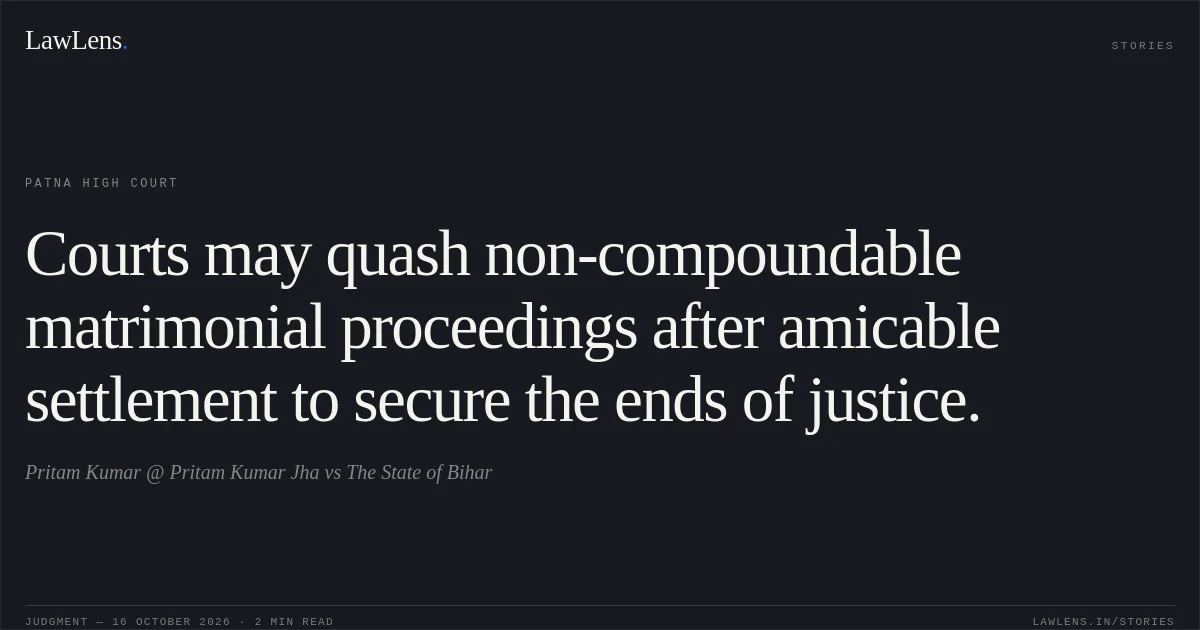
The petitioners sought to quash the order dated 6 September 2022 taking cognizance against them under Sections 498A, 341, 323, 504 and 506 read with Section 34 of the Indian Penal Code, and Sections 3 and 4 of the Dowry Prohibition Act, in Mahila P.S. Case No. 28 of 2022.
Source reference: para. 4, p. 2The FIR alleged assault over non-fulfilment of dowry demands and the birth of a female child.
Source reference: para. 5, p. 2The petitioners disputed the allegations and described the dispute as a matrimonial adjustment issue; the Court noted that the parties had reconciled in matrimonial proceedings and were living together with their child.
Source reference: paras. 6–7, pp. 3–4They filed a joint compromise petition, in which the wife stated that she had no objection to quashing the cognizance order and the criminal proceedings.
Source reference: para. 8, p. 4Issues
1. Whether the High Court should exercise its inherent jurisdiction to quash the criminal proceedings arising from the matrimonial dispute after the parties settled and resumed their conjugal life.
Source reference: paras. 8, 11, pp. 4, 62. Whether continuation of the prosecution, in light of the settlement and the parties’ reconciliation, would serve the interests of justice.
Source reference: paras. 9–11, pp. 4–6Law Applied
The cognizance order concerned offences under Sections 498A, 341, 323, 504 and 506/34 of the Indian Penal Code and Sections 3 and 4 of the Dowry Prohibition Act.
Source reference: para. 4, p. 2Relying on Gian Singh v. State of Punjab, as quoted in Mange Ram v. State of Madhya Pradesh, the Court stated that the High Court may exercise its inherent power to quash even non-compoundable offences where a genuine settlement makes conviction unlikely and continuation of proceedings would defeat the ends of justice; matrimonial and dowry-related disputes may be suitable for such relief when the victim and accused have amicably resolved their differences.
Source reference: para. 9, pp. 4–5The Court also relied on Naushey Ali v. State of U.P. for the proposition that proceeding with a trial after an amicable resolution may be futile and an abuse of process.
Source reference: para. 10, p. 5Reasoning
The Court considered the joint compromise, the wife’s express no-objection to quashing, and the parties’ reconciliation and resumed family life with their child.
Source reference: paras. 7–8, p. 4In those circumstances, it treated the dispute as having been amicably resolved and concluded that further proceedings would consume judicial time and amount to an abuse of process, rather than advance the interests of justice.
Source reference: para. 11, p. 6Holding
The Court allowed the application and quashed the order dated 6 September 2022, together with all prosecution arising from Mahila P.S. Case No. 28 of 2022, as against the petitioners.
Acts & Sections Cited
8 provisions across 3 statutes referred to in this judgment. Each provision opens on LawLens.
Indian Penal Code, 18605
Hindu Marriage Act, 19551
Original Court PDF
Pritam Kumar @ Pritam Kumar JhavsThe State of Bihar
Click to open original judgment
Original judgment, available to read, download and summarize on LawLens.in