01Facts
The appellant and respondent No. 9 were appointed as Office Assistant Grade III trainees on the same date. In the 1990 seniority list, the appellant was placed at Serial No. 181, while respondent No. 9 was placed at Serial No. 182. Despite this, respondent No. 9 was promoted to Assistant Grade II in 1991, whereas the appellant was promoted to that post only on 18 June 1997.
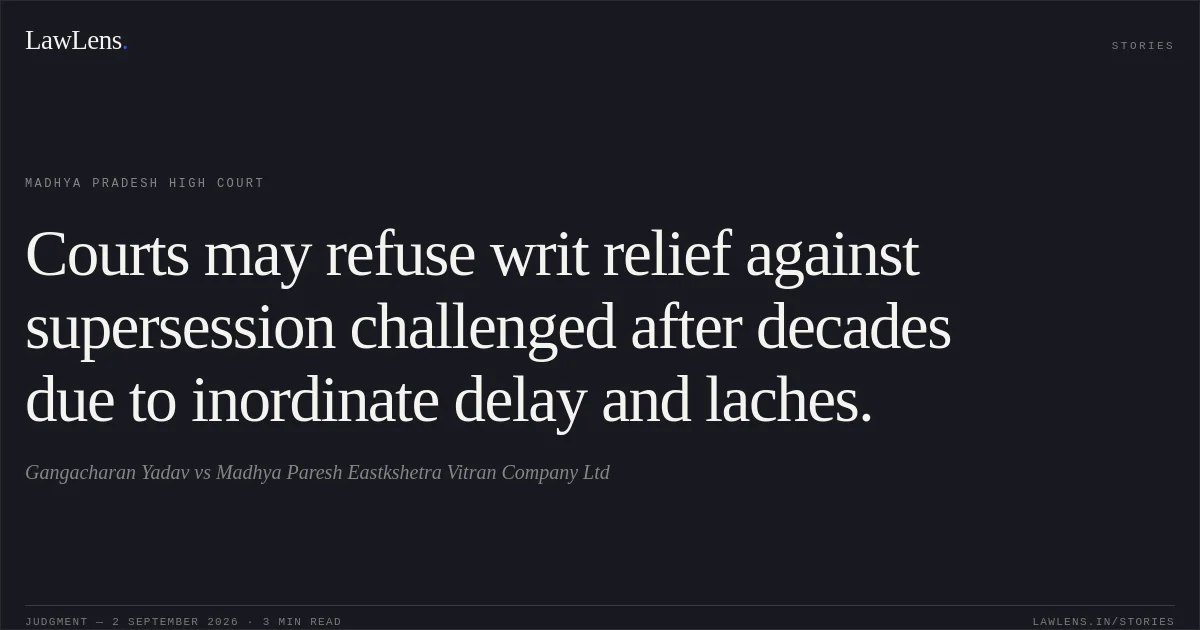
¶ 1–3Respondent No. 9 subsequently received further regular promotions. The appellant filed W.P. No. 13576 of 2021 challenging the alleged supersession, approximately 30 years after the first supersession. The learned Single Judge dismissed the writ petition on the ground of delay and laches by order dated 8 January 2026. The appellant challenged that order under Section 2(1) of the Madhya Pradesh Uchcha Nyayalaya (Khand Nyaypeeth Ko Appeal) Adhiniyam, 2005.
¶ 1–302Issues
i.Whether the writ petition challenging the appellant’s supersession in promotion was liable to be dismissed on the ground of inordinate delay and laches, where it was filed approximately 30 years after the first supersession.
¶ 3, 12–13ii.Whether the learned Single Judge erred in declining to exercise writ jurisdiction under Article 226 of the Constitution of India on the ground of delay and laches.
¶ 1, 3, 1303Law Applied
The Court applied the discretionary and equitable nature of writ jurisdiction under Article 226 of the Constitution, under which unexplained and inordinate delay may justify refusal of relief, even where a fundamental or legal right is asserted.
¶ 4–11Relying on P.S. Sadasivaswamy v. State of T.N., (1975) 1 SCC 152, the Court held that a person aggrieved by supersession must approach the Court within a reasonable time. The Court further relied on Chennai Metropolitan Water Supply and Sewerage Board v. T.T. Murali Babu, (2014) 4 SCC 108; Karnataka Power Corporation Ltd. v. K. Thangappan, (2006) 4 SCC 322; M.P. Ram Mohan Raja v. State of T.N., (2007) 9 SCC 78; Shiv Dass v. Union of India, (2007) 9 SCC 274; Nadia District Primary School Council v. Sristidhar Biswar, (2007) 12 SCC 779; U.P. Jal Nigam v. Jaswant Singh, (2006) 11 SCC 464; Jagdish Lal v. State of Haryana, (1997) 6 SCC 538; and NDMC v. Pan Singh, (2007) 9 SCC 278. These authorities establish that delay and laches, assessed with reference to the length of delay, acquiescence, prejudice, changed circumstances, and creation of third-party rights, may disentitle a claimant to discretionary writ relief.
¶ 4–11Provisions in the judgment · 1
M.P. Uchcha Nyayalaya (Khand Nyayapeeth Ko Appeal) Adhiniyam, 2005 Section 2
04Reasoning
The Court treated the appellant’s first supersession in 1991 as the material cause of action. Although the appellant was senior to respondent No. 9 in the 1990 seniority list, he did not challenge respondent No. 9’s earlier promotion until filing the writ petition in 2021.
¶ 12–13Applying the principle that challenges to supersession must be brought promptly, the Court held that a 30-year delay could not be regarded as reasonable or expeditious. The principles of equity, finality, and avoidance of prejudice arising from belated challenges therefore justified refusal to exercise extraordinary writ jurisdiction. Consequently, the learned Single Judge committed no error in dismissing the writ petition on the ground of delay and laches.
¶ 12–1305Holding
The Division Bench held that the appellant’s challenge, brought approximately 30 years after the first supersession, was hopelessly delayed.
¶ 14The dismissal of W.P. No. 13576 of 2021 by the learned Single Judge was upheld, and Writ Appeal No. 853 of 2026 was dismissed. No relief was granted to the appellant.
¶ 14Original Court PDF
Gangacharan YadavvsMadhya Paresh Eastkshetra Vitran Company Ltd
Click to open original judgment
Original judgment, available to read, download and summarize on LawLens.in