Facts
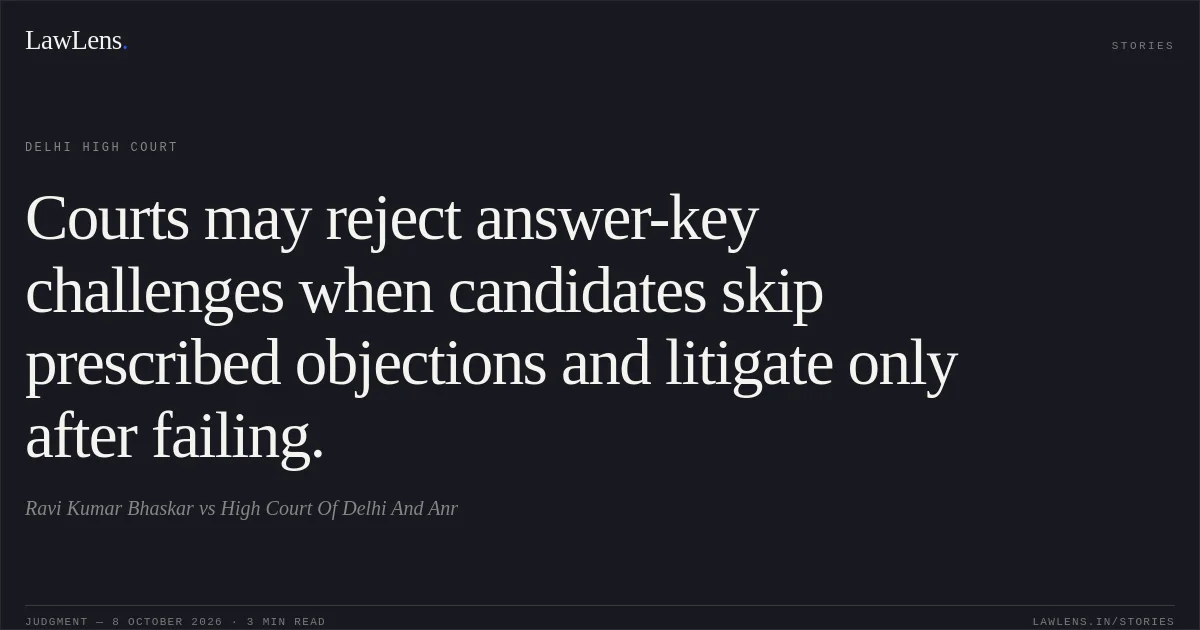
The petitioner appeared in the Delhi Higher Judicial Service preliminary examination held on 26 July 2026. After publication of the model answer key, candidates were given three days to object. The petitioner did not object, although other candidates challenged Questions 8 and 51; an expert committee considered those objections, and the competent committee accepted its recommendations, deleting eleven other questions but rejecting the objections to Questions 8 and 51.
Source reference: pp. 1–2After the result was declared on 14 August 2026, the petitioner—who had missed the qualifying cut-off by 0.25%—filed a writ petition challenging those two questions and seeking recalculation of his marks.
Source reference: pp. 6–7The petitioner argued that the answers conflicted with the law concerning testamentary capacity during intoxication and contract formation following postal acceptance and revocation.
Source reference: pp. 2, 4–5Issues
1. Whether the petitioner could challenge Questions 8 and 51 after failing to object within the prescribed period, despite other candidates having objected to them.
Source reference: pp. 2–4, 6–82. Whether the alleged errors in Questions 8 and 51 were sufficiently clear to warrant judicial interference with the expert committee’s assessment and the examination result.
Source reference: pp. 5–6, 8Law Applied
A court may interfere with an examination answer key only where an error is so obvious that it requires no inferential reasoning; the question and answer are presumed correct, and doubt is resolved in favour of the examining body.
Source reference: pp. 7–8Interference may be justified where a question is demonstrably incorrect, admits of multiple correct answers despite requiring one, or where the examining body has failed to select the sole correct answer.
Source reference: pp. 7–8Courts should be strict in condoning delay and may reject a challenge where the prescribed objection procedure and time limit were not followed. The Court applied these principles from Uttar Pradesh Subordinate Service Selection Commission v. Ashok Yadav & Ors., 2026 SCC OnLine SC 1893.
Source reference: pp. 7–8It also considered Salil Maheshwari v. High Court of Delhi & Anr., 2014 SCC OnLine Del 4563, on belated challenges by unsuccessful candidates, and Shruti Katiyar v. Registrar General, Delhi High Court, 2024:DHC:1437-DB, which held that an objection raised by one candidate may benefit candidates generally.
Source reference: pp. 3–4, 8Reasoning
The Court considered the petitioner’s arguments concerning both questions to involve analysis and inferences, rather than errors so glaring as to justify intervention. It therefore declined to substitute its view for that of the expert committee, whose recommendations had been reviewed and accepted by the Court’s committee after following the prescribed process.
Source reference: pp. 5–6Independently, the petitioner had not used the objection procedure, waited until after the result to challenge the questions, and filed the petition after learning that he had missed the cut-off by 0.25%; the Court treated this as a belated challenge by a “fence-sitter” and a sufficient reason to withhold writ relief.
Source reference: pp. 6–8Although Shruti Katiyar recognised that an objection by one candidate may have broader effect, the Court held that Salil Maheshwari remained applicable on the facts because the petitioner neither objected within time nor challenged the questions until after failing to qualify.
Source reference: p. 8Holding
The Court held that no ground had been made out for interference in writ jurisdiction.
It dismissed the petition challenging Questions 8 and 51 and seeking recalculation of marks, and disposed of the pending application.
Source reference: p. 8Acts & Sections Cited
1 provisions across 1 statute referred to in this judgment. Each provision opens on LawLens.
Indian Succession Act, 19251
Original Court PDF
Ravi Kumar BhaskarvsHigh Court Of Delhi And Anr
Click to open original judgment
Original judgment, available to read, download and summarize on LawLens.in