Facts
The respondent–plaintiff instituted O.S.No.8810 of 2019 before the First Assistant Judge, City Civil Court, Chennai, seeking recovery of money under a loan deed dated 16 November 2016.
Source reference: paras. 4–5The petitioners–defendants denied borrowing the money and disputed the signatures appearing on the loan document marked as Ex.A.1.
Source reference: paras. 4–5The defendants’ application to send Ex.A.1 for forensic examination was allowed.
Source reference: paras. 6–7As the original sale deed sought for comparison had been deposited with a bank, the defendants obtained production of the relevant thumb-impression register from the Sub-Registrar, Ambattur, which was thereafter sent to the Forensic Department through an Advocate Commissioner.
Source reference: paras. 6–7The Commissioner subsequently reported that the first petitioner’s admitted signature was required for comparison.
Source reference: para. 8The defendants therefore filed I.A.No.3 of 2025 seeking a subpoena to M/s. Repco Home Finance Limited for production of loan documents signed by the first petitioner in 2014, so that those documents could be sent for forensic comparison with Ex.A.1.
Source reference: para. 9The trial Court dismissed the application on the ground that the proposed comparison document was neither admitted nor registered.
Source reference: para. 9The defendants challenged that order under Article 227 of the Constitution.
Source reference: para. 1Issues
Whether the trial Court was justified in refusing to issue a subpoena for production of a prior loan document containing the first petitioner’s signature, on the ground that the document was neither admitted nor registered?
Source reference: para. 9Whether the proposed document could be sent for expert comparison with the disputed signature appearing on Ex.A.1?
Source reference: paras. 10–11Whether the trial Court’s order warranted interference under the supervisory jurisdiction of the High Court under Article 227 of the Constitution?
Source reference: para. 11Law Applied
The Court applied the supervisory jurisdiction under Article 227 of the Constitution of India, permitting interference where the subordinate Court’s order is perverse or results in denial of a fair opportunity to establish a material defence.
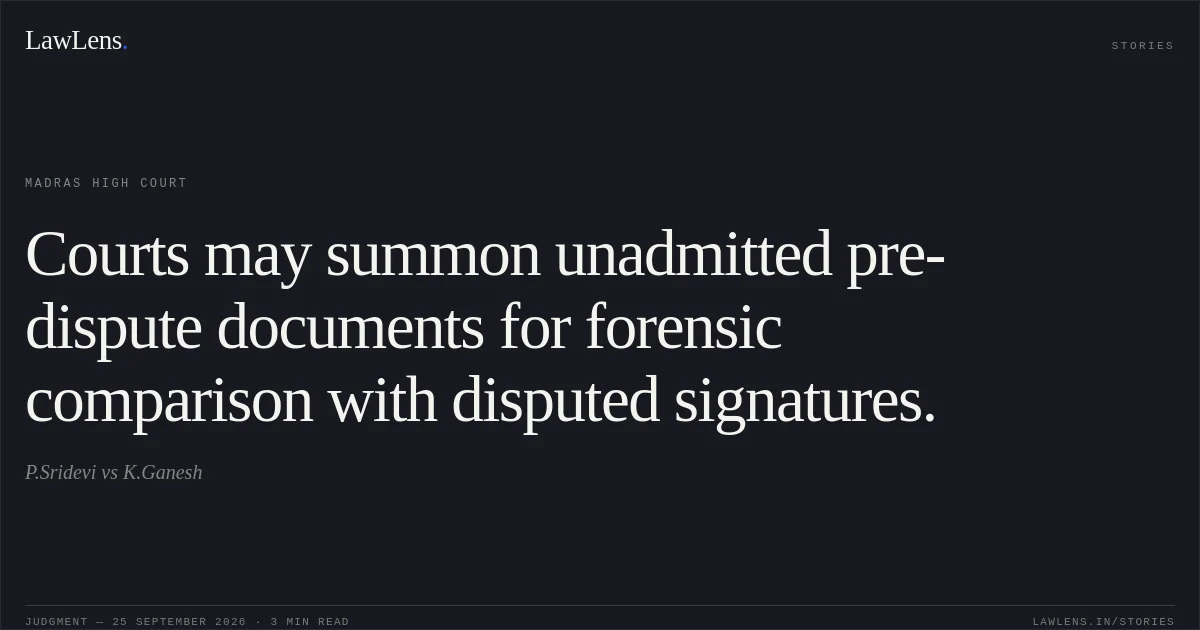
Source reference: para. 11It further applied the principle that a document containing a signature made by a party in the ordinary course of business, and before the dispute arose, may be summoned and used as comparative material for obtaining expert opinion on a disputed signature.
Source reference: para. 10The Court also recognised that the burden rested on the defendants to establish that Ex.A.1 had not been signed by them, and that they were therefore entitled to a reasonable opportunity to substantiate that defence.
Source reference: para. 11Reasoning
The High Court held that the proposed Repco Home Finance document was executed in 2014, well before the dispute commenced in 2019, and could therefore serve as relevant comparative material for examining the disputed signature in Ex.A.1.
Source reference: para. 10The fact that the document was not a registered or previously admitted document did not, by itself, justify refusing its production, particularly when the forensic process was already underway and the Advocate Commissioner had specifically sought an admitted signature of the first petitioner.
Source reference: paras. 8–10Since the defendants bore the burden of proving that the disputed document was not signed by them, denying access to potentially relevant comparative evidence would effectively deprive them of an opportunity to establish their defence.
Source reference: para. 11The trial Court’s refusal was consequently found to be perverse and liable to correction under Article 227.
Source reference: para. 11Holding
The civil revision petition was allowed, and the order dated 8 July 2026 in I.A.No.3 of 2025 was set aside.
The trial Court was directed to issue a subpoena to M/s. Repco Home Finance Limited for production of the relevant loan documents and, upon production, to send them through the Advocate Commissioner for expert comparison with Ex.A.1.
Source reference: para. 12The expert opinion was directed to be obtained at the earliest, and the trial Court was ordered to dispose of the suit within four months from receipt of the High Court’s order.
Source reference: para. 12No costs were awarded, and the connected miscellaneous petition was closed.
Source reference: para. 12Original Court PDF
P.SridevivsK.Ganesh
Click to open original judgment
Original judgment, available to read, download and summarize on LawLens.in