Facts
The appellant was convicted under Section 323 read with Section 34 of the Indian Penal Code (IPC) for assaulting the informant and sentenced to three months’ simple imprisonment and a fine of ₹200.
Source reference: pp. 4–8The trial court acquitted him of the charges under Sections 341, 294, 325, 307 and 506 IPC.
Source reference: pp. 4–8In appeal, counsel did not challenge the conviction on merits and sought relief only as to sentence, relying on the appellant’s 52 days in custody, the passage of time since the 2016 occurrence, his lack of criminal antecedents and the asserted settlement with the victim.
Source reference: pp. 8–9Issues
Whether the conviction under Section 323 read with Section 34 IPC, which the appellant did not challenge on merits, disclosed a basis for appellate interference
Source reference: pp. 8–11Whether, in light of the offence and the appellant’s circumstances, the custodial sentence should be replaced by release on probation under Section 4 of the Probation of Offenders Act, 1958
Source reference: pp. 9–14Law Applied
Section 323 IPC criminalises voluntarily causing hurt; Section 34 IPC provides for joint liability where a criminal act is done by several persons in furtherance of their common intention.
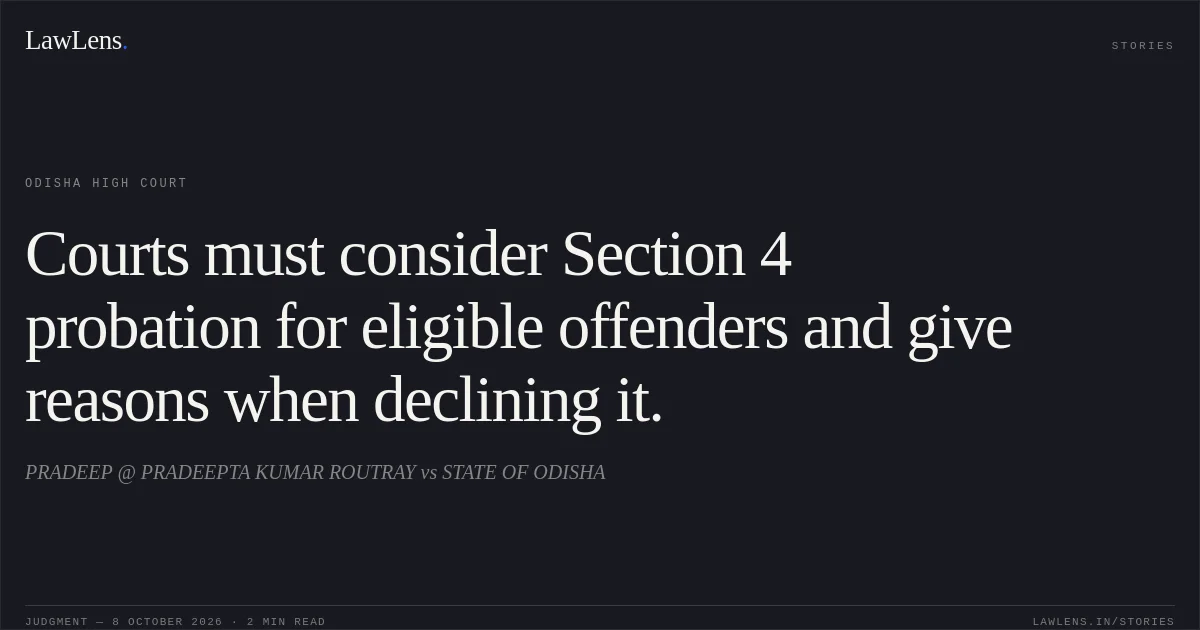
Source reference: pp. 11–13Under Section 4 of the Probation of Offenders Act, 1958, a court may release an eligible offender on probation of good conduct, and must consider that possibility where the statutory conditions apply; if it declines probation, it must record reasons.
Source reference: pp. 11–13The Supreme Court in Chellammal and Another v. State represented by the Inspector of Police, 2025 INSC 540, stated that consideration of probation is a judicial duty, though release on probation is not an offender’s right.
Source reference: pp. 11–13Section 5 of the Act permits an order for compensation, while Section 12 provides that a person dealt with under Section 4 shall not suffer statutory disqualifications attaching to the conviction, subject to the provision’s exception.
Source reference: pp. 14–16Reasoning
The Court found no reason to disturb the conviction: the injured witness’s account was consistent with his brother’s evidence and was corroborated by the medical evidence, notwithstanding the independent witnesses’ failure to support the prosecution.
Source reference: pp. 9–11It therefore upheld the trial court’s conclusion that hurt under Section 323 IPC was proved.
Source reference: pp. 9–11On sentence, the Court considered the relatively minor offence, the approximately ten-year interval since the occurrence, the 52 days already spent in custody, the absence of criminal antecedents and the appellant’s reported settled life.
Source reference: pp. 10–14Applying the principles in Chellammal, it concluded that probation was appropriate in place of further imprisonment.
Source reference: pp. 10–14Holding
The appeal was partly allowed: the conviction under Section 323 read with Section 34 IPC remained undisturbed, but the appellant was directed to be released under Section 4 of the Probation of Offenders Act for three months upon executing a ₹5,000 bond with one surety for the like amount, undertaking to keep the peace and be of good behaviour, and remaining under the supervision of the concerned Probation Officer.
Under Section 5, he was also directed to pay ₹5,000 compensation to the victim/informant within four weeks.
Source reference: p. 15The Court noted that the protection under Section 12 would follow by operation of law, subject to the statutory exception.
Source reference: pp. 15–16Acts & Sections Cited
17 provisions across 4 statutes referred to in this judgment. Each provision opens on LawLens.
Code of Criminal Procedure, 19734
Bharatiya Nagarik Suraksha Sanhita, 20231
Indian Penal Code, 18608
Probation of Offenders Act, 19584
Original Court PDF
PRADEEP @ PRADEEPTA KUMAR ROUTRAYvsSTATE OF ODISHA
Click to open original judgment
Original judgment, available to read, download and summarize on LawLens.in