Facts
The Animal Husbandry and Veterinary Department, Assam, invited tenders for construction works in Nalbari district under a two-bid system
Source reference: p. 9The appellants emerged as the lowest (L-1) bidders, quoting rates more than 15% below the Detailed Schedule Rate (DSR)
Source reference: p. 9Per Clause 2.A.(g) of the bid document, they submitted rate analyses and justifications, which were subsequently validated by a departmental engineer’s physical verification report
Source reference: p. 9-10Based on this, work orders were issued on 06.01.2024
Source reference: p. 10A private respondent (an unsuccessful bidder) challenged these allotments via writ petitions
Source reference: p. 10A Single Judge set aside the work orders, finding the verification process "pre-determined and biased" due to alleged irregularities in GSTIN quotes, identical photographs used for different sites, and lack of geo-tagging
Source reference: p. 11-12The State and the contractors appealed this decision
Source reference: p. 8Issues
1. Whether the Single Judge was justified in interfering with a public tender process after work had significantly progressed and the bid evaluation was performed by experts.
Source reference: p. 12-132. Whether technical irregularities in supporting documents (e.g., GSTIN of a supplier or non-geo-tagged photos) are sufficient to invalidate a contract awarded to the lowest bidder.
Source reference: p. 13-14Law Applied
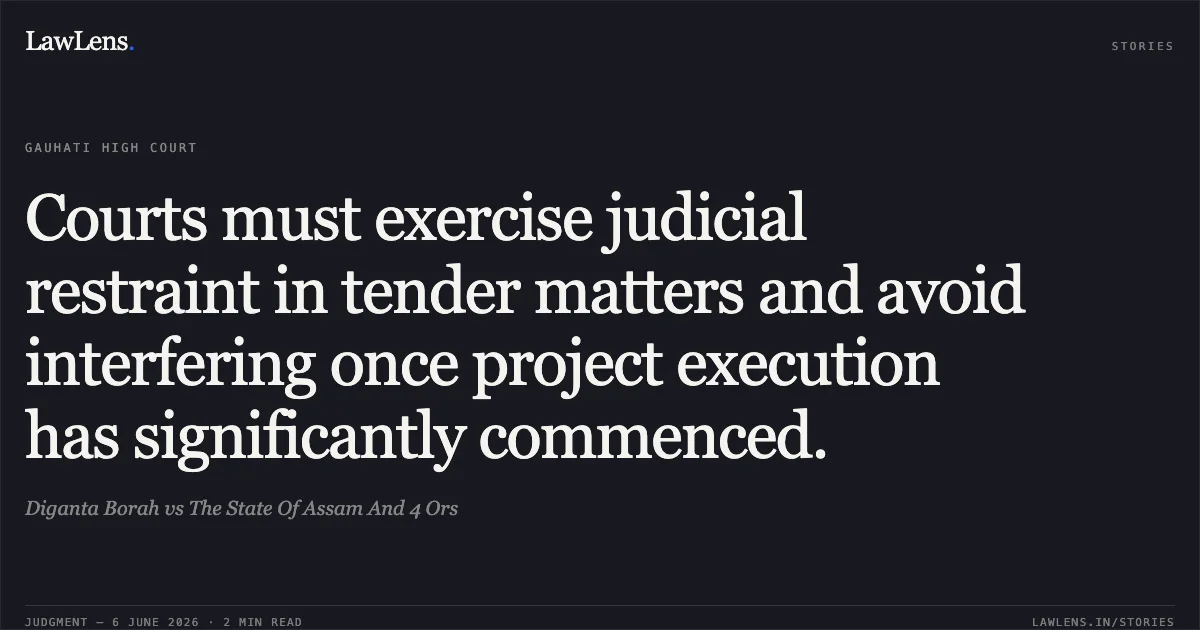
The Court applied the principle of judicial restraint in tender matters, emphasizing that courts should not sit as an appellate authority over the decision-making process of experts unless it is infested with mala fides or unreasonableness
Source reference: p. 13It relied on the precedents of Afcon Infrastructure Limited v. Nagpur Metro Rail Corporation Limited & Anr. (2016) 16 SCC 818 and Bharat Coking Coal Limited v. A.R.M. Dev Prabha & Ors. (2020) 16 SCC 759, which establish that the author of the tender is the best judge of its interpretation and that least interference is advisable in commercial matters
Source reference: p. 14Reasoning
The Court reasoned that the Bid Process Management Committee, comprised of domain experts, had followed the procedure delineated in Clause 2.A.(g) of the tender document by requiring and accepting rate justifications and physical verification
Source reference: p. 15The Court found the Single Judge’s scrutiny of GSTIN numbers belonging to third-party material suppliers (Maa Enterprise) to be irrelevant, as the supplier's registration was not a mandatory criterion for the bidder’s eligibility
Source reference: p. 13the Court noted that the challenge was raised by an unsuccessful bidder whose offer was significantly higher, and that interference at a stage where substantial construction had already commenced (allegedly 70%) was "wholly unjustified" as it halted public work
Source reference: p. 14-15The court observed that the allegations of collusion were "overarching" and lacked the requisite proof to overcome the presumption of regularity in expert committee decisions
Source reference: p. 15Holding
The Court answered the issues in the negative, holding that the Single Judge's interference was improper.
The Division Bench set aside the impugned judgment dated 27.09.2024 and upheld the original work orders
Source reference: p. 15-16The Court directed the appellants to complete the entire work as per specifications within the extended time limit ending on 30.06.2026
Source reference: p. 16All writ appeals were allowed
Source reference: p. 16Acts & Sections Cited
1 provisions across 1 statute referred to in this judgment. Linked provisions open on LawLens.
Johannesburg Declaration On Sustainable Development1
Original Court PDF
Diganta BorahvsThe State Of Assam And 4 Ors
Click to open original judgment
Original judgment, available to read, download and summarize on LawLens.in