Facts
The petitioner sought to rely on an unregistered partition deed (Watni Patra) dated 21 December 2000 in a suit concerning declaration and possession of land.
Source reference: pp. 3–5The plaintiff objected that the deed was compulsorily registrable and insufficiently stamped. The Trial Court held that it was inadmissible in evidence. The petitioner challenged that order, arguing that the Trial Court was also required to impound the deed under Section 33 of the Karnataka Stamp Act, 1957.
Source reference: pp. 3–5Issues
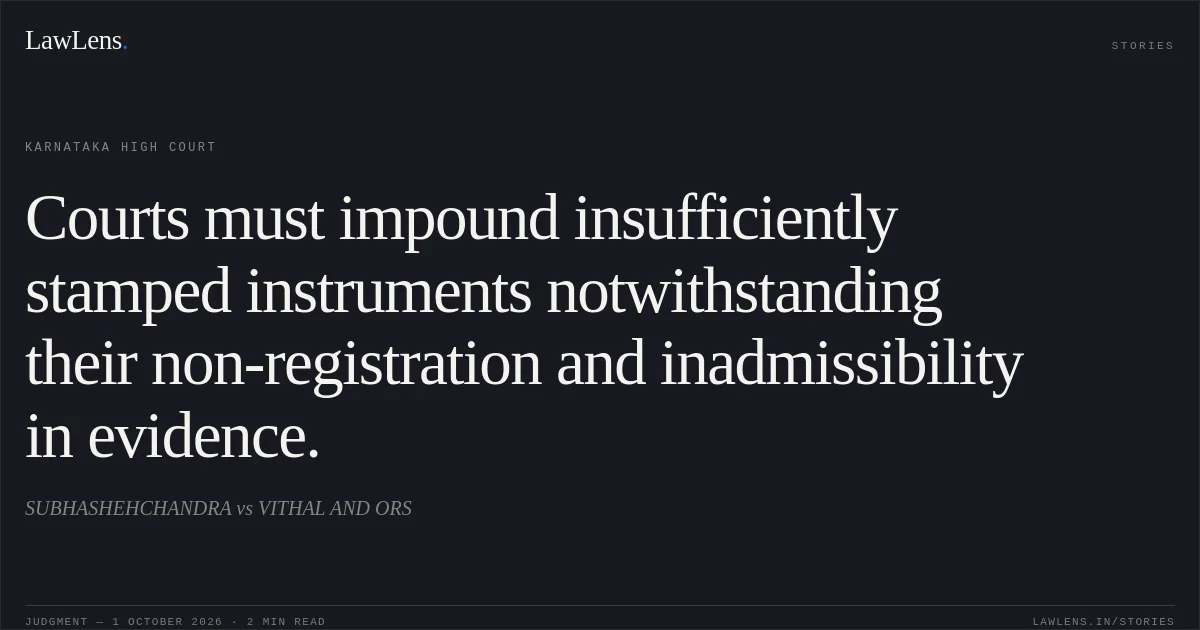
Whether the unregistered and insufficiently stamped partition deed was admissible in evidence.
Source reference: pp. 3–4, 7–8Whether the Trial Court was required to impound the deed under Section 33 of the Karnataka Stamp Act, 1957, notwithstanding its inadmissibility for want of registration.
Source reference: pp. 5, 7–8Law Applied
Section 17 of the Registration Act requires registration of an instrument that itself creates or declares rights in immovable property; the Court held that the deed in question was compulsorily registrable because it demarcated and divided the parties’ properties.
Source reference: pp. 5–7An unregistered document requiring registration is not admissible in evidence.
Source reference: pp. 5–7Separately, Section 33 of the Karnataka Stamp Act, 1957 requires a person legally authorised to receive evidence, when an instrument produced before them appears not duly stamped, to examine and impound it.
Source reference: pp. 5–7The Court applied these registration and stamp-law requirements independently.
Source reference: pp. 5–7Reasoning
The deed recorded a division of property and was therefore compulsorily registrable; because it was unregistered, the Trial Court was justified in refusing to admit it in evidence.
Source reference: pp. 5–8That conclusion did not, however, dispose of the separate obligation under Section 33.
Source reference: pp. 5–8As the deed was also insufficiently stamped and had been produced during the evidence, the Trial Court ought to have impounded it and referred it to the District Registrar for determination of the stamp duty and penalty payable.
Source reference: pp. 5–8Holding
The High Court rejected the writ petition and left undisturbed the Trial Court’s finding that the unregistered deed was inadmissible in evidence.
It nevertheless directed the Trial Court to impound the deed under Section 33 of the Karnataka Stamp Act and refer it to the District Registrar for calculation of stamp duty and penalty.
Source reference: pp. 8–9Upon payment, the Trial Court was to proceed with the suit on its merits and in accordance with law.
Source reference: pp. 8–9Acts & Sections Cited
3 provisions across 2 statutes referred to in this judgment. Each provision opens on LawLens.
Registration Act, 19082
KARNATAKA STAMP ACT, 19571
Original Court PDF
SUBHASHEHCHANDRAvsVITHAL AND ORS
Click to open original judgment
Original judgment, available to read, download and summarize on LawLens.in