01Facts
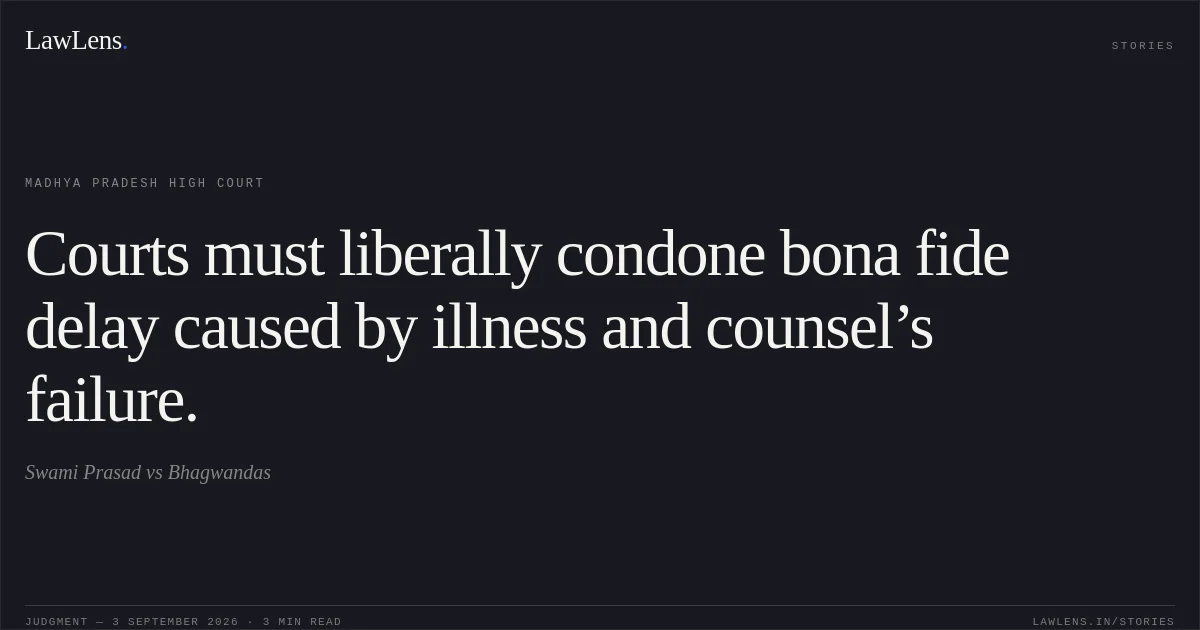
The appellant-defendant challenged the dismissal of his first appeal as time-barred after the lower Appellate Court rejected his application under Section 5 of the Limitation Act for condonation of delay.
¶ 1The appellant stated that he was aged, suffering from paralysis and heart disease, and had undergone prolonged treatment. He claimed that, due to his medical condition, he was unable to remain informed about the proceedings. He further alleged that his counsel obtained his thumb impression on a vakalatnama without explaining its purpose and failed to inform him about the judgment, decree, and execution proceedings.
¶ 5The lower Appellate Court rejected the explanation as insufficient and dismissed the appeal as barred by limitation.
¶ 6The High Court admitted the second appeal on 23 January 2012 on the substantial question of law concerning the requirement of a liberal approach in condoning delay.
¶ 302Issues
i.Whether the lower Appellate Court erred in law by rejecting the appellant’s application under Section 5 of the Limitation Act for condonation of delay despite the appellant’s illness and alleged lack of communication by his counsel.
¶ 3ii.Whether, in the absence of mala fides or deliberate negligence, the delay ought to have been condoned to advance substantial justice.
¶ 7–1003Law Applied
The Court applied Section 5 of the Limitation Act, which permits condonation of delay where the applicant establishes “sufficient cause” for not preferring the proceeding within the prescribed period.
¶ 1, 3It also applied the settled principle that applications for condonation of delay should receive a liberal and justice-oriented approach, particularly where the delay is bona fide and is not attributable to mala fides or an intention to gain an unfair advantage.
¶ 9The Court further recognised that a litigant should not ordinarily suffer for the failure of counsel to communicate material developments in the case.
¶ 8Provisions in the judgment · 3 · Linked ones open on LawLens
Code of Civil Procedure, 1908 Section 100Section 96
Limitation Act, 1963 Section 5
04Reasoning
The Court found that the appellant had produced medical documents showing that he suffered from paralysis and heart disease and had remained under treatment for a considerable period.
¶ 7In those circumstances, he was unable to properly attend to the litigation, and the Court found no basis to attribute mala fides to his failure to file the appeal within limitation. The Court reasoned that, had the appellant known of the adverse decree, he would ordinarily have challenged it because failing to do so would operate against his own interests.
¶ 7It further held that if the appellant’s counsel had not communicated the proceedings or the decree to him, the appellant could not be made to suffer for that omission.
¶ 8The lower Appellate Court therefore adopted an unduly fault-finding approach instead of applying the liberal standard applicable to Section 5 applications.
¶ 905Holding
The High Court answered the substantial question of law in favour of the appellant and against the respondents.
¶ 11It held that the appellant had shown a reasonable, sufficient, and bona fide cause for the delay and that the lower Appellate Court had acted illegally in refusing to condone it.
¶ 9–10The delay was condoned, the judgment and decree of the lower Appellate Court were set aside, and the matter was remanded to that Court for decision of the first appeal on merits.
¶ 11The second appeal was accordingly allowed and disposed of.
¶ 12Original Court PDF
Swami PrasadvsBhagwandas
Click to open original judgment
Original judgment, available to read, download and summarize on LawLens.in