01Facts
Rajendra Kumar Gaur instituted a suit for declaration of title and permanent injunction concerning certain land, a dilapidated house and a *chabutra* against Surendra Kumar Gaur and the present applicants, who were Surendra Kumar Gaur’s wife and daughter.
¶ 2An interim *status quo* order was initially passed, and the trial court subsequently granted temporary injunction in respect of the land but declined relief concerning the house and *chabutra*. On appeal, the injunction was extended to the house on 17 December 2012.
¶ 3The respondent thereafter initiated proceedings under Order XXXIX Rule 2-A CPC alleging breach of the injunction. The applicants allegedly did not file their reply and did not cross-examine the respondent’s witnesses. The trial court ultimately directed the civil imprisonment of the applicants and Surendra Kumar Gaur for two months by order dated 30 June 2016.
¶ 4Meanwhile, the trial court had decreed the suit on 28 January 2014, but the first appellate court partly allowed the appeal on 30 April 2015 and set aside the decree concerning the dilapidated house and *chabutra*.
¶ 5Surendra Kumar Gaur was thereafter arrested pursuant to the Order XXXIX Rule 2-A order. The applicants filed an appeal against that order on 14 May 2018, after a delay of nearly two years, along with an application under Section 5 of the Limitation Act.
¶ 6The appellate court rejected the application for condonation of delay on 2 June 2018 and dismissed the appeal as time-barred, leading to the present revision under Section 115 CPC.
¶ 702Issues
i.Whether the applicants had shown “sufficient cause” under Section 5 of the Limitation Act for condoning the delay of nearly two years in filing the appeal against the order dated 30 June 2016 passed under Order XXXIX Rule 2-A CPC?
¶ 6–7, 12–16ii.Whether, in the circumstances of the case, the appeal against the Order XXXIX Rule 2-A CPC order ought to be heard on merits rather than dismissed as time-barred?
¶ 12–1603Law Applied
The Court considered the revisional jurisdiction under Section 115 CPC, the appealability of the relevant order under Order XLIII Rule 1(r) CPC, and the power to condone delay under Section 5 of the Limitation Act.
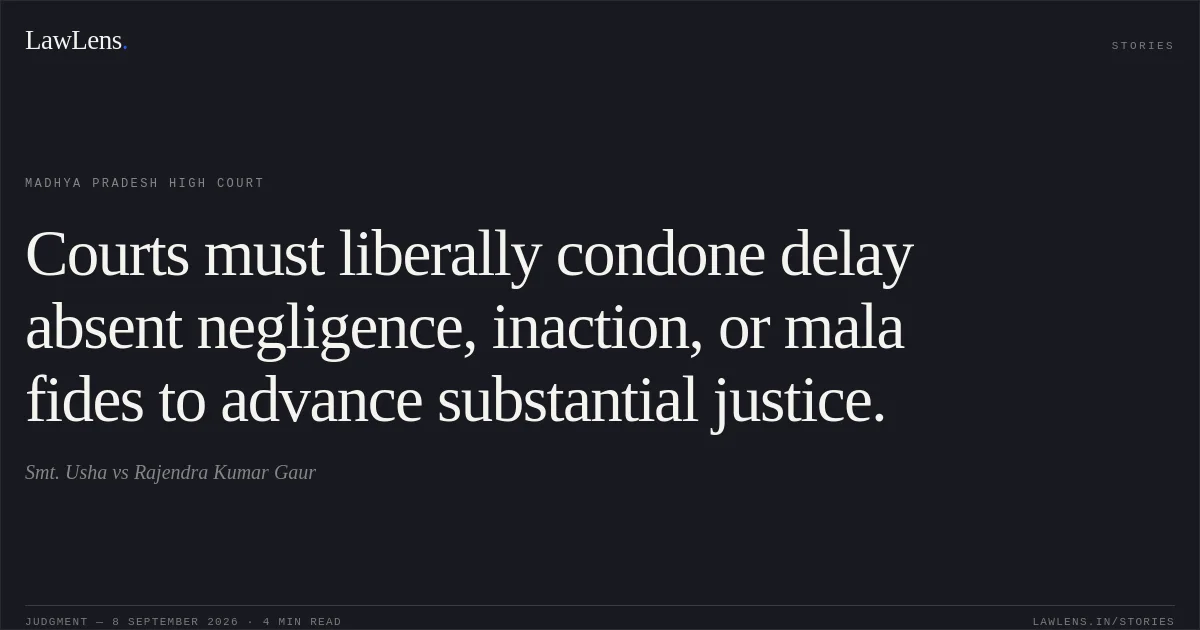
¶ 1, 6–7The expression “sufficient cause” must receive a liberal and justice-oriented interpretation where the delay is not attributable to negligence, inaction or lack of bona fides.
In Ram Nath Sao v. Gobardhan Sao, (2002) 3 SCC 195, the Supreme Court held that acceptance of an explanation should ordinarily be the rule and rejection the exception, while balancing the prejudice caused to the opposite party.
¶ 14In S. Ganesharaju (Dead) through LRs v. Narasamma (Dead) through LRs, (2013) 11 SCC 341, the Supreme Court reiterated that limitation provisions are not intended to destroy substantive rights and that matters should generally be decided on merits where the party has acted with reasonable diligence and has not been mala fide or callous.
¶ 15Provisions in the judgment · 3 · Linked ones open on LawLens
Code of Civil Procedure, 1908 Section 115Section 22
Limitation Act, 1963 Section 5
04Reasoning
The High Court found that the applicants’ explanation for the delay was not wholly unjustified.
¶ 12By the time the Order XXXIX Rule 2-A application was decided, the original decree had already been partly reversed in appeal, including in relation to the house and *chabutra*.
¶ 12The appellate judgment also contained a finding that the construction existed before the institution of the suit, a circumstance potentially relevant to the alleged breach and one that ought to have been placed before the trial court.
¶ 12The applicants’ belief that no separate challenge was necessary after the underlying decree had been set aside was considered plausible, particularly because Surendra Kumar Gaur was subsequently arrested and sent to civil prison, causing serious personal and social consequences.
¶ 12–13The Court found no apparent mala fides in the failure to file the appeal within limitation and held that the final judgment and appellate decree were material to the determination of the Order XXXIX Rule 2-A proceedings.
¶ 13, 16Applying the liberal approach mandated by *Ram Nath Sao* and *S. Ganesharaju*, the Court held that the matter should be examined on merits rather than terminated on limitation grounds.
¶ 14–1605Holding
The Court held that the applicants had demonstrated sufficient cause for condonation of the delay under Section 5 of the Limitation Act.
¶ 16It accordingly set aside the appellate court’s order dated 2 June 2018, allowed the application for condonation of delay, condoned the delay in filing the appeal, and remitted the matter to the appellate court for consideration of the appeal on merits.
¶ 16Original Court PDF
Smt. UshavsRajendra Kumar Gaur
Click to open original judgment
Original judgment, available to read, download and summarize on LawLens.in