Facts
The petitioners, plaintiffs in O.S. No. 561/2014, relied on a 1997 agreement for sale with a stated consideration of ₹12,000 in a suit for specific performance.
Source reference: para. 2When the agreement was tendered in evidence, the defendants objected to its insufficient stamping.
Source reference: para. 3The Trial Court assessed the property’s market value at ₹90,000 and directed the petitioners to pay ₹9,092.50 in deficient stamp duty together with a tenfold penalty.
Source reference: paras. 3, 7The petitioners challenged that direction by writ petition, contending that the Trial Court could not itself determine the duty and penalty.
Source reference: para. 4Issues
Whether the Trial Court could determine the market value and impose deficient stamp duty and penalty on the agreement under the Karnataka Stamp Act.
Source reference: paras. 4–6, 10Whether, in the circumstances, the agreement should instead be referred to the District Registrar for determination of the stamp duty and penalty payable.
Source reference: paras. 6–8, 10Law Applied
Under Sections 34, 35 and 39 of the Karnataka Stamp Act, the court’s role concerning an insufficiently stamped instrument is governed by the statutory impounding and referral process; the appropriate authority, rather than the court, determines the duty and penalty payable.
Source reference: no citationIn Seetharam Shetty v. Monnapa Shetty, AIR 2004 SC 5327, the Supreme Court held that where a party seeks the document’s referral for collection of deficient duty and penalty, the court must send it to the District Registrar, who determines the amount under Section 39; imposing a tenfold penalty at that stage is impermissible.
Source reference: para. 8The High Court also relied on Smt. K. Indiramma v. Smt. G. Nagarathnamma, W.P. No. 52984/2017, dated 4 March 2025, and Shakeel Pasha v. M/s. City Max Hotels Pvt. Ltd., Civil Appeal Nos. 2139–2140/2024, for the proposition that the Karnataka Stamp Act does not confer on courts the power to impose the penalty.
Source reference: paras. 5, 9Reasoning
The Trial Court determined the property’s market value and calculated the duty and penalty after the defendants—not the petitioners—raised the stamping objection.
Source reference: paras. 3, 7Applying Seetharam Shetty, the High Court held that the Trial Court should have referred the instrument to the District Registrar for adjudication rather than itself determining the amounts payable.
Source reference: paras. 8–10The Trial Court’s direction was therefore inconsistent with the statutory process and the governing precedents.
Source reference: paras. 8–10The respondents’ submission that the petitioners relied on the document to prove possession was recorded, leaving that contention open for consideration at trial.
Source reference: paras. 11–12Holding
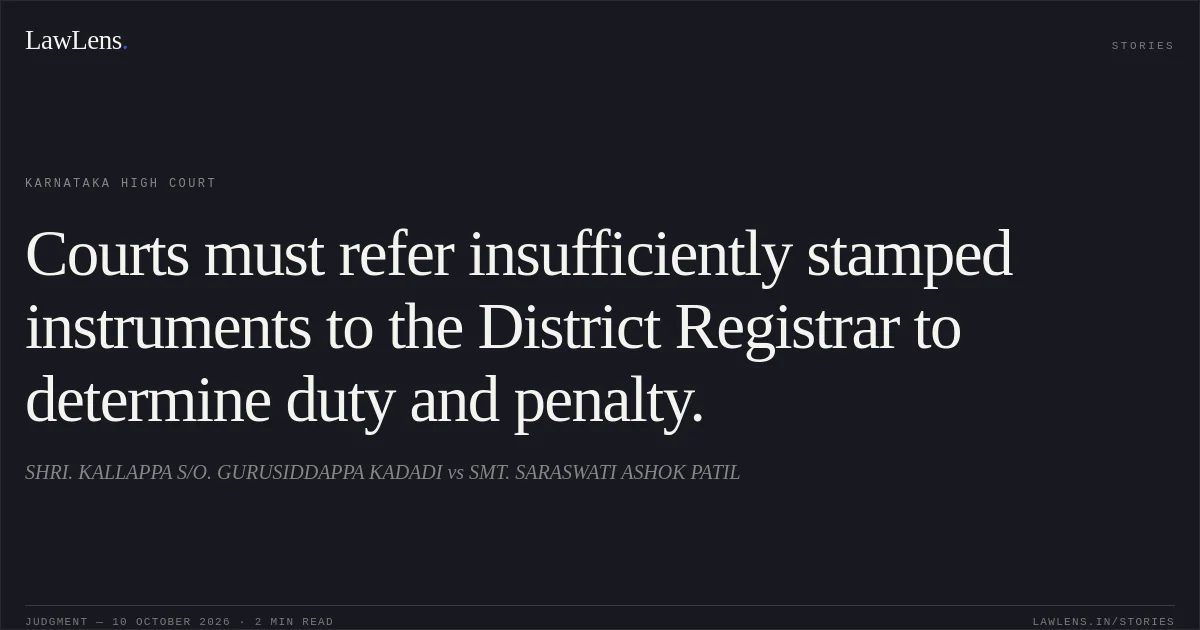
The writ petition was partly allowed.
The impugned order was quashed insofar as it determined the property’s market value and the stamp duty and penalty payable on the agreement.
Source reference: paras. 13–14The Trial Court was directed to refer the document to the concerned District Registrar for determination of the duty and penalty in accordance with law.
Source reference: paras. 13–14Acts & Sections Cited
4 provisions across 1 statute referred to in this judgment. Each provision opens on LawLens.
KARNATAKA STAMP ACT, 19574
Original Court PDF
SHRI. KALLAPPA S/O. GURUSIDDAPPA KADADIvsSMT. SARASWATI ASHOK PATIL
Click to open original judgment
Original judgment, available to read, download and summarize on LawLens.in