01Facts
The appellants applied for the Punjab State Teacher Eligibility Test, 2025, a written examination held on 15.03.2026. It had 150 single-mark multiple-choice questions with no negative marking, divided into Part-I (90 questions) and Part-II (60 subject-specific questions).
¶ 3A proposed answer key was notified and objections were invited. The objections were referred to subject experts, whose opinion was accepted by the examining agency, and results were evaluated on the approved key.
¶ 4The appellants failed and challenged certain answers, relying on subject-specific books.
¶ 5They argued that the answers should conform to NCERT books.
¶ 6The learned Single Judge declined to interfere with the expert opinion and dismissed the writ petitions on 15.09.2026.
¶ 5The dispute concerns Question No. 123 in Paper-II (Science and Mathematics), specifically whether a particular step falls in a given sequence.
¶ 14Applications CM-8204 and CM-8208 seeking condonation of 34 and 33 days' delay in filing the appeals were allowed.
02Issues
i.1. Whether the Court may interfere with an answer key where subject experts have given their opinion, which the examining authority has accepted.
¶ 10–11, 14ii.2. Whether the Court should constitute a fresh expert committee or itself evaluate the answers by reference to NCERT books.
¶ 7, 12iii.3. Whether the Delhi High Court's decision in Staff Selection Commission v. Shubham Pal supports interference with expert opinion in the present case.
¶ 8, 1303Law Applied
The Court relied on Ran Vijay Singh v. State of U.P. (SC, 11.12.2017), which holds that courts should be slow to interfere with examination results, should ordinarily defer to expert opinion, and should not disturb the internal checks of examining authorities, and that any residual "grey area" after expert review must be resolved in favour of the employer rather than the candidate.
¶ 10–11The Court relied on Haryana Public Service Commission v. State of Haryana (SC, 30.09.2019), which holds that a court should not act as an expert in the field, that a High Court's substitution of its own view on disputed answer keys undermines finality, and that the expert committee's report must be upheld.
¶ 12The Court applied Shubham Pal (Delhi HC DB, 07.10.2024) only for its limitation that such interference is confined to rare and exceptional cases and to a very limited extent.
¶ 13The Court applied the principle that a court has no jurisdiction to examine the validity of expert opinion on a subject lying exclusively within expert domain.
¶ 1404Reasoning
The appellants' only contention was that the expert-approved answer to Question 123 conflicts with NCERT and other books. The Court held that the sequence was determined by subject experts, whose opinion was accepted by the examining authority, and that the validity of that opinion lay outside judicial competence.
¶ 14Applying Ran Vijay Singh, the Court found no basis to disturb the expert view, and noted that any uncertainty on the answer would benefit the employer, not the candidate.
¶ 11Haryana PSC was treated as directly relevant: the Supreme Court there disapproved a High Court acting as an expert and an appellate court directing a fresh expert committee after an expert-approved key had been accepted.
¶ 12The appellants' reliance on Shubham Pal failed because the case was not shown to fall within the "rare and exceptional" category, and nothing in the record established such exceptionality.
¶ 1305Holding
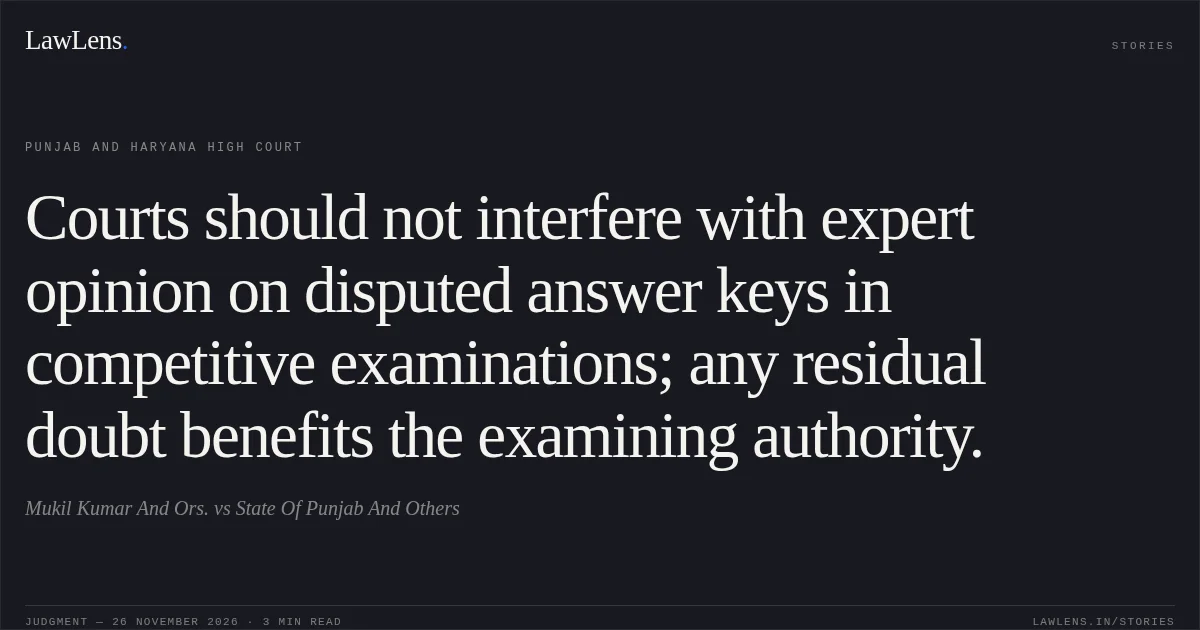
The Court answered all three issues against the appellants. Interference with an expert-approved answer key is impermissible absent rare and exceptional circumstances, and no such circumstances were shown; the Court cannot appoint a fresh committee or re-evaluate answers on the strength of textbooks. The Court held that the Single Judge had correctly declined to overrule the subject experts.
¶ 11–15The Single Judge's order dated 15.09.2026 was upheld and all four LPAs were dismissed, with pending applications disposed of. The delay condonation applications CM-8204 and CM-8208 were allowed.
¶ 17–18Original Court PDF
Mukil Kumar And Ors.vsState Of Punjab And Others
Click to open original judgment
Original judgment, available to read, download and summarize on LawLens.in