Facts
The petitioners, aspirants for public employment, challenged the scheduling of the Sub-Inspector Cadre Recruitment Mains Examination, 2025
Source reference: p. 1-2The MPPSC Preliminary Examination was scheduled for 26.04.2026
Source reference: p. 2Subsequently, the respondents scheduled the Sub-Inspector Mains Examination for 29.04.2026, leaving only a two-day gap between the two major competitive exams
Source reference: p. 3The petitioners submitted a representation seeking a postponement to ensure a fair opportunity for preparation and travel, but the respondents failed to act upon it
Source reference: p. 3The respondents contended that administrative machinery was already mobilized, admit cards were issued, and examination centers were finalized
Source reference: p. 4-5Issues
1. Whether the scheduling of the Sub-Inspector Mains Examination merely two days after the MPPSC Preliminary Examination is arbitrary, unreasonable, and violative of the petitioners' rights
Source reference: p. 2-3 / para. 1, 62. Whether the High Court, under Article 226, should interfere with the administrative discretion of an examining body regarding examination schedules
Source reference: p. 4-5 / para. 9, 12Law Applied
The court primarily applied the principles of judicial restraint under Article 226 of the Constitution of India regarding academic and administrative policy decisions
Source reference: p. 5courts should be extremely reluctant to substitute their own views for those of professional bodies possessing technical expertise, and must avoid making decisions that render an administrative system unworkable (Maharashtra State Board of Secondary and Higher Secondary Education v. Paritosh Bhupeshkumar Sheth [(1984) 4 SCC 27])
Source reference: p. 5-6Reasoning
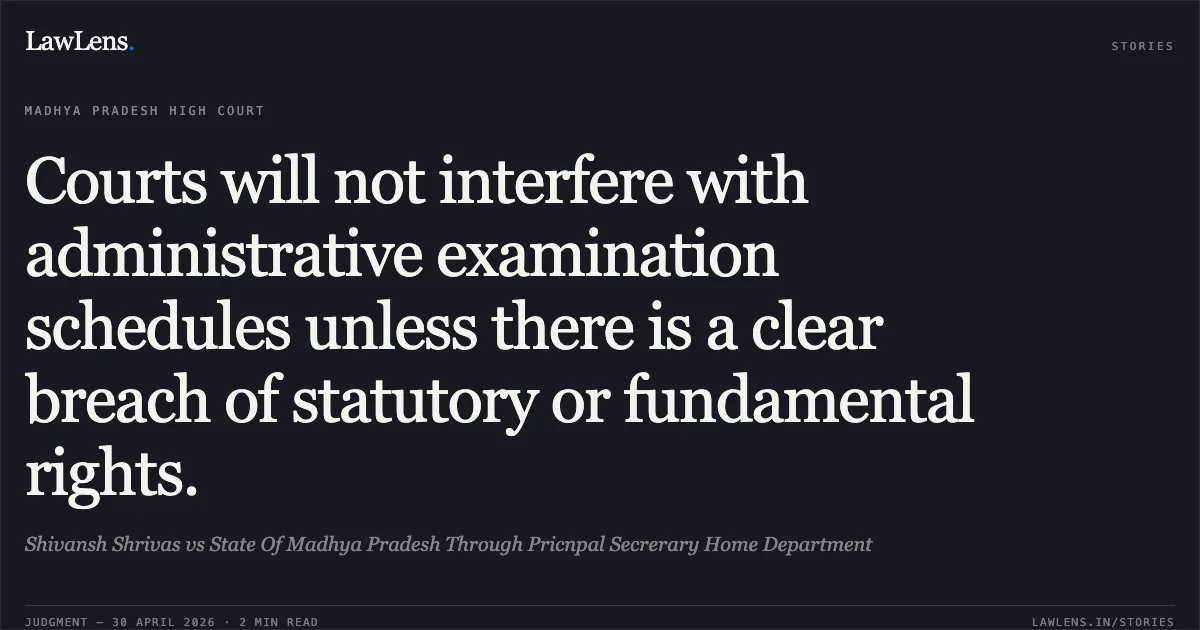
The Court reasoned that judicial review in recruitment matters is narrow, requiring immense restraint unless a clear statutory breach is shown
Source reference: para. 12Applying the Paritosh Bhupeshkumar Sheth doctrine, the Court found that because the administrative process was at its final stage—with admit cards issued and centers allotted—any interference would result in a substantial misuse of public funds and administrative chaos
Source reference: para. 14Regarding the "hardship" argument, the Court determined that a two-day gap is objectively sufficient for logistical arrangements and that personal inconvenience or candidate anxiety cannot override the public employment calendar
Source reference: para. 15The Court concluded that the petitioners failed to demonstrate a "crystal-clear breach" of any constitutional or statutory right, as examination scheduling is a matter of administrative discretion governed by the rules of the examining body
Source reference: para. 16Holding
The Court answered the issues in the negative, holding that there was no legal infirmity or arbitrariness in the respondents' actions
The Court held that the right to participate in an examination does not include a right to a specific time gap between different exams
Source reference: para. 16the Writ Petition was dismissed, and all pending applications were disposed of with no order as to costs
Source reference: para. 17-18Original Court PDF
Shivansh ShrivasvsState Of Madhya Pradesh Through Pricnpal Secrerary Home Department
Click to open original judgment
Original judgment, available to read, download and summarize on LawLens.in


![Subsequent exoneration does not retrospectively invalidate a finalized promotion select list.. UNNIKRISHNAN M vs M/o Environment And Forests. CAT - ['Ernakulam']. LawLens](/stories/thumbnails/subsequent-exoneration-does-not-retrospectively-invalidate-a-finalized-promotion-select-li-ce80a0e84f2f4887857271e8b4341c42.webp)