Facts
The Appellant acts as a debenture trustee for holders of secured optionally convertible debentures worth ₹395 crores issued by Aaditri Constructions Pvt. Ltd. (ACPL) under a Debenture Trust Deed (DTD) dated 03.08.2018
Source reference: p.3-4While the Corporate Debtor (CD), Radius Estate Projects Pvt. Ltd., was not an original signatory to the DTD, it subsequently executed a "First Supplemental Indenture of Mortgage" (IOM) on 29.03.2019 and a "Second Supplemental IOM" on 16.04.2019
Source reference: p.4-5These IOMs contained a "covenant to pay" where the CD undertook to discharge "Secured Obligations"
Source reference: p.48Following the CD's entry into Corporate Insolvency Resolution Process (CIRP) on 06.09.2021, the Appellant filed a claim for ₹874 crores as a secured financial creditor
Source reference: p.5The Resolution Professional (RP) classified the Appellant as an "Other Secured Creditor" rather than a "Financial Creditor," arguing no money was disbursed directly to the CD
Source reference: p.6, 12The NCLT upheld this classification on 07.05.2024, leading to this appeal
Source reference: p.2Issues
Whether disbursement of debt directly to the Corporate Debtor is a prerequisite for classification as "financial debt" under Section 5(8) of the IBC
Source reference: p.17 / para. 43Whether a "covenant to pay" in a mortgage deed for debt disbursed to a third party constitutes a contract of guarantee under Section 126 of the Indian Contract Act
Source reference: p.18 / para. 43(IV)Whether the Appellant qualifies as a "Financial Creditor" under Section 5(7) read with Section 5(8) of the IBC
Source reference: p.17 / para. 43(II)Law Applied
The court applied Section 5(8) of the IBC, which defines "financial debt" as debt disbursed against the consideration for the time value of money, including guarantees
Source reference: p.19It relied on Section 126 of the Indian Contract Act, 1872, defining a contract of guarantee as a promise to discharge the liability of a third person in case of default
Source reference: p.23The court heavily cited the Supreme Court precedents in Anuj Jain v. Axis Bank Ltd. regarding the distinction between a pure mortgage and a financial debt
Source reference: p.13, 29and China Development Bank v. Doha Bank Q.P.S.C., which established that a "covenant to pay" shortfall or deficiency in a security document amounts to a guarantee
Source reference: p.59, 68It also referenced Rajeev Kumar Jain v. Uno Minda Ltd., clarifying that direct disbursement to the CD is not mandatory if the transaction has the commercial effect of borrowing
Source reference: p.30Reasoning
The Tribunal reasoned that the statutory language of Section 5(8) does not explicitly require funds to be transferred into the CD's account to constitute "disbursement," provided the transaction carries the "time value of money"
Source reference: p.28-29Analyzing the First and Second Supplemental IOMs, the court found that Clause 2.1 (Covenant to Pay) and Clause 2.2 (undertaking not to allow obligations to fall into arrears) must be read jointly
Source reference: p.66The NCLAT observed that by signing these indentures, the CD voluntarily stepped into the shoes of an "obligor" and assumed a secondary liability to discharge ACPL's debt
Source reference: p.57-58Distinguishing this from Anuj Jain, the court noted that the present case involved an express "covenant to pay" rather than a simple third-party mortgage
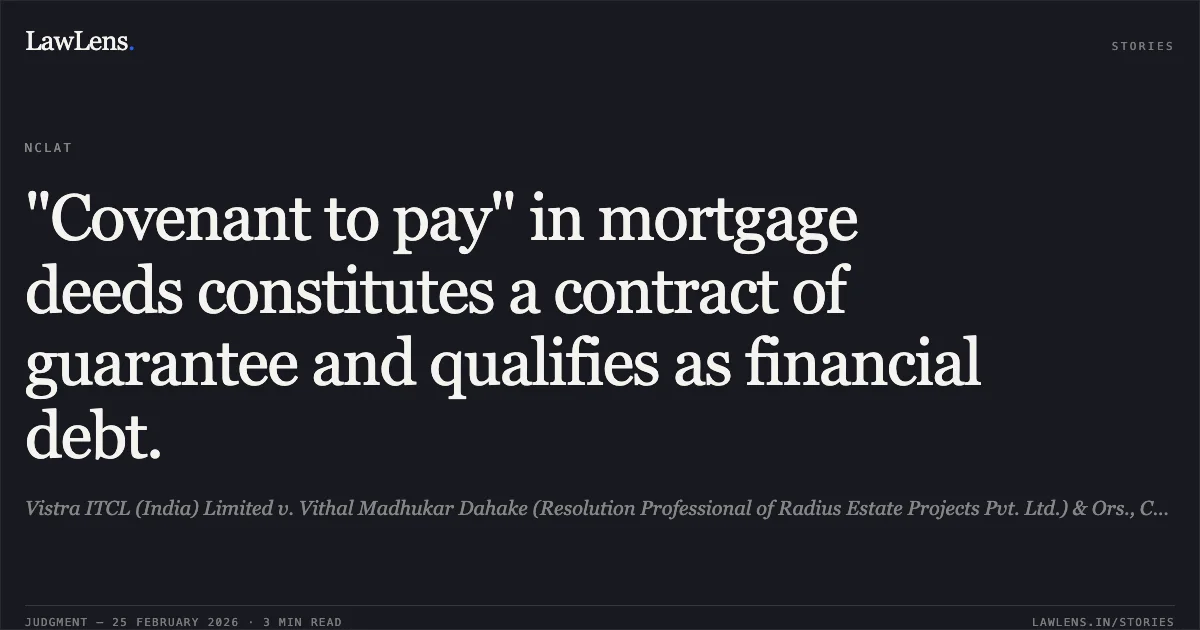
Source reference: p.63-64Applying the China Development Bank principle, the court held that such a contractual undertaking to pay the debt of a third party satisfies the criteria of a guarantee under Section 126 of the Contract Act, thereby falling within the ambit of Section 5(8)(i) of the IBC
Source reference: p.69-70Holding
The Appellate Tribunal allowed the appeal and set aside the Impugned Order
It held that: (i) direct disbursement to the CD is not a sine qua non for financial debt
Source reference: p.31(ii) the "covenant to pay" in the IOMs created an enforceable guarantee
Source reference: p.65-66and (iii) the Appellant is a "Secured Financial Creditor" of the CD
Source reference: p.64The RP was directed to reclassify the claim accordingly, and the matter was remanded to the Adjudicating Authority for further proceedings
Source reference: p.71Original Court PDF
Vistra ITCL (India) Limited v. Vithal Madhukar Dahake (Resolution Professional of Radius Estate Projects Pvt. Ltd.) & Ors., Comp. App. (AT) (Ins) No. 1110 of 2024.
Click to open original judgment
Original judgment, available to read, download and summarize on LawLens.in


![Subsequent exoneration does not retrospectively invalidate a finalized promotion select list.. UNNIKRISHNAN M vs M/o Environment And Forests. CAT - ['Ernakulam']. LawLens](/stories/thumbnails/subsequent-exoneration-does-not-retrospectively-invalidate-a-finalized-promotion-select-li-ce80a0e84f2f4887857271e8b4341c42.webp)