Facts
The appellants challenged a judgment and decree dated 24 February 2020 passed in Civil Appeal No. 43-A/2012 by the Additional District Judge (F.T.C.), Surajpur.
Source reference: p. 1Their second appeal was delayed by 1,771 days. They sought condonation, relying on disruption caused by the COVID-19 pandemic, their residence in a rural area, and difficulties communicating with counsel and obtaining case information and legal advice.
Source reference: pp. 1–3, 6Respondent No. 1 opposed the application, contending that sufficient cause had not been shown; the State submitted that the substantive dispute was between the appellants and respondent No. 1.
Source reference: p. 4Issues
Whether the appellants had shown sufficient cause to condone the 1,771-day delay in filing the appeal
Source reference: pp. 5–6Whether, in the circumstances, the appeal should be permitted to proceed for consideration on its merits rather than be rejected as time-barred
Source reference: pp. 6–7Law Applied
The Court relied on the principle that the length of delay is not determinative; the acceptability of the explanation and whether the delay resulted from deliberate inaction or lack of bona fides are the relevant considerations.
Source reference: p. 5Under N. Balakrishnan v. M. Krishnamurthy, (1998) 7 SCC 123, the explanation for delay, rather than its duration alone, is material.
Source reference: p. 5Under Esha Bhattacharjee v. Managing Committee of Raghunathpur Nafar Academy, (2013) 12 SCC 649, courts should adopt a liberal, pragmatic, justice-oriented, and non-pedantic approach, while examining the party’s bona fides and conduct.
Source reference: p. 5The Court also noted that the Supreme Court had passed orders extending or excluding limitation during the COVID-19 pandemic.
Source reference: pp. 5–6Reasoning
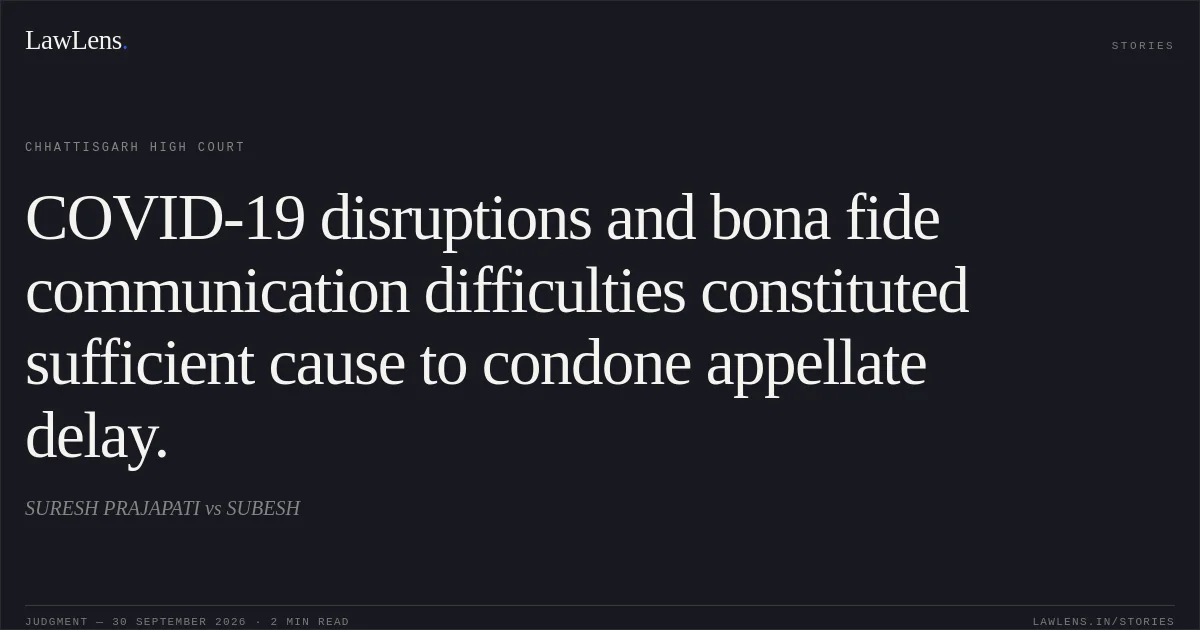
The Court considered the pandemic’s disruption to court functioning and daily life, the appellants’ rural residence, and their stated difficulty maintaining communication with counsel and obtaining information and legal advice.
Source reference: p. 6It found that the appellants took steps to file the appeal after obtaining the necessary information, and that the record disclosed neither deliberate delay nor mala fides or a dilatory strategy.
Source reference: pp. 6–7Applying the cited principles and noting that the appeal concerned rights in the suit property, the Court concluded that the explanation was sufficient to allow the dispute to be considered on its merits.
Source reference: p. 7Holding
The Court allowed the application for condonation of delay and condoned the 1,771-day delay, subject to the appellants paying costs of ₹5,000 to respondent No. 1.
The application was disposed of, and the appeal was directed to be listed the week after next for admission.
Source reference: p. 7Original Court PDF
SURESH PRAJAPATIvsSUBESH
Click to open original judgment
Original judgment, available to read, download and summarize on LawLens.in
![Termination founded on impersonation is punitive and requires an inquiry and an opportunity to respond.. SUNIL KUMAR vs COMPTROLLER AND AUDITOR-GENERAL OF INDIA. CAT - ['Chandigarh']. LawLens](/stories/thumbnails/termination-founded-on-impersonation-is-punitive-and-requires-an-inquiry-and-an-opportunit-273dc59ea6dc43d39c6e48275fd09246.webp)
![Tribunal upholds removal of Chandigarh teachers named as beneficiaries in recruitment paper-leak probe, despite their not being charge-sheeted in the case. Sonia vs Education Deptt., Ut Chandigarh. CAT - ['Chandigarh']. LawLens](/stories/thumbnails/tribunal-upholds-removal-of-chandigarh-teachers-named-as-beneficiaries-in-recruitment-pape-3f061884a7cc4bab9996e2cb58c5b0db.webp)
![A decades-late challenge to alternative absorption and pay fixation is barred by limitation.. PRANAB KUMAR GHOSH vs EAST CENTRAL RAILWAY. CAT - ['Kolkata']. LawLens](/stories/thumbnails/a-decades-late-challenge-to-alternative-absorption-and-pay-fixation-is-barred-by-limitatio-4687b7e84bf84893a401e61b221dcaa7.webp)