Facts
The respondent/plaintiff filed a suit for recovery of ₹1 crore with interest, alleging that the petitioner/defendant’s father had borrowed the amount in October 2018 for establishing a business and that the liability thereafter devolved upon the defendant following his father’s death on 11 May 2021.
Source reference: pp. 2–3, paras. 3–4Despite repeated demands and a demand letter dated 12 July 2023, payment was not made, and the suit was instituted on 9 October 2023.
Source reference: pp. 2–3, paras. 3–4The petitioner/defendant sought rejection of the plaint under Order VII Rule 11 CPC on the ground that the suit was barred by limitation.
Source reference: p. 3, paras. 5–7The Trial Court held that the ordinary limitation period would have expired during the COVID-19 period, and that the balance limitation period available as on 15 March 2020 became available from 1 March 2022.
Source reference: p. 3, paras. 5–7Issues
Whether the suit for recovery instituted on 9 October 2023 was barred by limitation despite the Supreme Court’s COVID-19 limitation directions in In Re: Cognizance for Extension of Limitation, Suo Motu Writ Petition (C) No. 3 of 2020?
Source reference: pp. 15–16, paras. 12–14Whether, where the limitation period expired between 15 March 2020 and 28 February 2022, the litigant was restricted to 90 days from 1 March 2022, or whether the entire balance period of limitation was available after exclusion of the COVID-19 period?
Source reference: pp. 16–21, paras. 17–27Whether the plaint was liable to be rejected under Order VII Rule 11 CPC as being barred by limitation?
Source reference: p. 2, para. 2; p. 22, para. 30Law Applied
The Court applied Order VII Rule 11 CPC, under which a plaint may be rejected where the suit appears from the plaint to be barred by law.
Source reference: p. 2, para. 2It relied principally on the Supreme Court’s COVID-19 limitation directions in In Re: Cognizance for Extension of Limitation, which excluded the period from 15 March 2020 to 28 February 2022 for computing limitation and provided that the balance limitation available would become available from 1 March 2022.
Source reference: pp. 3–7, para. 8The Court relied on Prakash Corporates v. Dee Vee Projects Ltd., 2022 SCC OnLine SC 180, for the principle that exclusion of a prescribed period results in enlargement of time “over and above” the ordinary limitation period.
Source reference: pp. 8–10, paras. 9.2–9.2.1It also considered Arif Azim Co. Ltd. v. Aptech Ltd., (2024) 5 SCC 313, which calculated the balance limitation remaining on 15 March 2020 and made it available from 1 March 2022, and followed the reasoning in Shri Jai Prakash Tayal v. Smt. Sunita Aggarwal, 2026:DHC:7031-DB, regarding exclusion of the COVID-19 period.
Source reference: pp. 12–15, paras. 9.4–9.4.1, 11.2The Court distinguished Sagufa Ahmed v. Upper Assam Plywood Products Pvt. Ltd., Civil Appeals Nos. 3007–3008 of 2020, as concerning condonation of delay rather than exclusion of the limitation period.
Source reference: pp. 7–8, paras. 9.1–9.1.1Reasoning
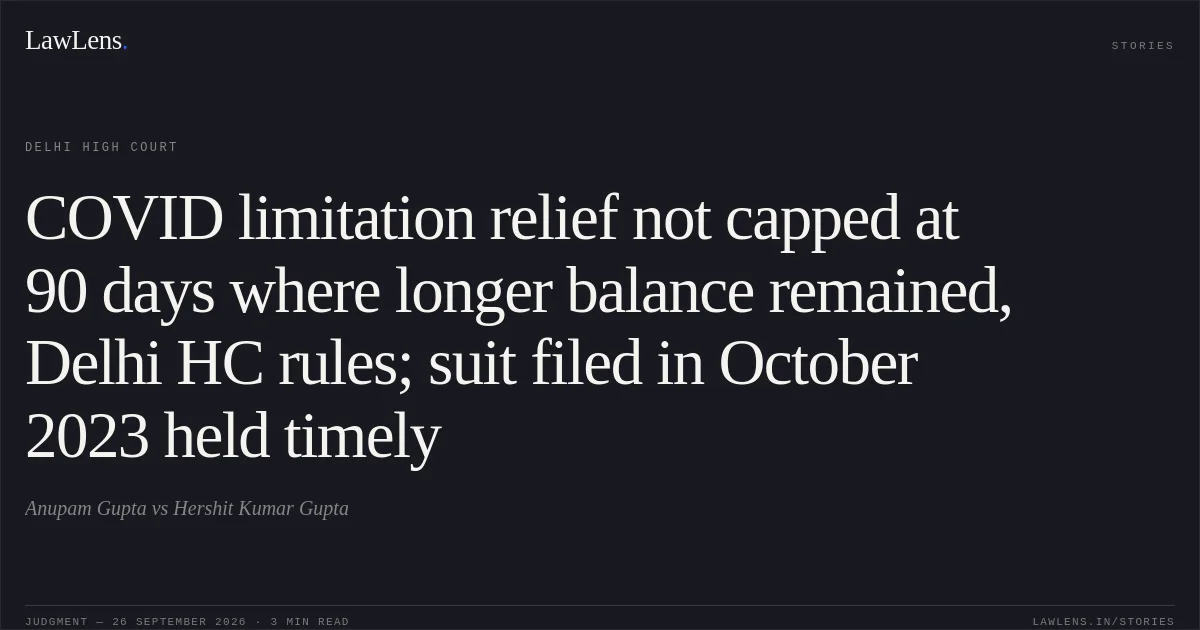
The Court held that the limitation period for the plaintiff’s claim would ordinarily have expired in October 2021, during the period covered by the Supreme Court’s fourth COVID-19 directive.
Source reference: p. 15, para. 12It interpreted the directive as requiring the entire period from 15 March 2020 to 28 February 2022 to be excluded while computing limitation.
Source reference: pp. 16–18, paras. 17–20Consequently, the period that had elapsed during the COVID-19 period was not treated as lost; instead, the balance period became available from 1 March 2022.
Source reference: pp. 16–18, paras. 17–20The Court rejected the petitioner’s argument that only 90 days were available in every case.
Source reference: pp. 19–21, paras. 21–27It reasoned that the 90-day provision operated as a minimum protective period where the remaining limitation was less than 90 days, while any longer balance period was preserved under the directive.
Source reference: pp. 19–21, paras. 21–27Applying that interpretation, the Court calculated that 19 months and 11 days of limitation became available from 1 March 2022, expiring on 11 October 2023.
Source reference: p. 22, para. 29Since the suit was filed on 9 October 2023, it was within limitation.
Source reference: p. 22, para. 29Holding
The Court held that the suit was not barred by limitation.
The Supreme Court’s COVID-19 directions excluded the period from 15 March 2020 to 28 February 2022 and preserved the entire balance limitation period, subject to the 90-day minimum safeguard where applicable.
Source reference: p. 22, paras. 29–31The Trial Court correctly dismissed the petitioner’s application under Order VII Rule 11 CPC.
Source reference: p. 22, paras. 29–31The revision petition was dismissed, and the pending applications were rendered infructuous.
Source reference: p. 22, paras. 29–31Acts & Sections Cited
9 provisions across 4 statutes referred to in this judgment. Each provision opens on LawLens.
Arbitration and Conciliation Act, 19962
Negotiable Instruments Act, 18811
Limitation Act, 19635
Prevention of Money-Laundering Act, 20021
Original Court PDF
Anupam GuptavsHershit Kumar Gupta
Click to open original judgment
Original judgment, available to read, download and summarize on LawLens.in