Facts
On March 15, 2025, police discovered cow remains in a sugarcane field in District Shamli
Source reference: para 3The incident triggered significant public unrest, involving blockades by various Hindu organizations, traffic disruptions, and the deployment of additional police forces to restore normalcy
Source reference: para 5-6On March 16, 2025, the petitioner, Javed, was apprehended following a police encounter where he was found in possession of an illicit firearm
Source reference: para 8Javed confessed to slaughtering two calves and a cow for financial gain
Source reference: para 9While Javed was in judicial custody and after he had secured bail from the High Court, the District Magistrate (DM), Shamli, passed a detention order on June 5, 2025, under Section 3(2) of the National Security Act (NSA), 1980
Source reference: para 11, 23The DM cited intelligence reports suggesting that Javed intended to resume cow slaughter upon release
Source reference: para 12-14The State Government approved the order on June 16, 2025, and confirmed it for twelve months on July 29, 2025, following a personal hearing before the Advisory Board
Source reference: para 23, 25Issues
1. Whether the detention order was passed mechanically without the application of mind by the detaining authority.
Source reference: para 302. Whether the acts attributed to the petitioner constitute a mere breach of "law and order" or a disturbance of "public order" justifying preventive detention.
Source reference: para 28, 333. Whether the petitioner’s constitutional and statutory right to representation under Article 22 of the Constitution and Section 8 of the NSA was infringed.
Source reference: para 36Law Applied
The Court primarily applied Section 3(2) of the National Security Act, 1980, which empowers the government to detain individuals to prevent acts prejudicial to the maintenance of public order
Source reference: para 2It relied on the "three concentric circles" doctrine from Ram Manohar Lohia v. State of Bihar, distinguishing between law and order, public order, and the security of the State
Source reference: para 28The Court further applied the "even tempo of life" test from Arun Ghosh v. State of W.B. to determine if a criminal act affects the community at large
Source reference: para 29Precedents such as Shaukat Ali v. Union of India and Tauqeer v. State of U.P. were cited to establish that cow slaughter in India possesses an inherent potential to incite communal tension and thus impacts public order
Source reference: para 31-32Reasoning
The Court rejected the petitioner’s contention of non-application of mind, noting that the DM’s grounds were founded on specific police reports and a subjective satisfaction regarding the petitioner's likelihood of repeating the offense upon release on bail
Source reference: para 30On the distinction between "law and order" and "public order," the Court held that cow slaughter is a sensitive issue that spontaneously evokes violent reactions and communal disharmony
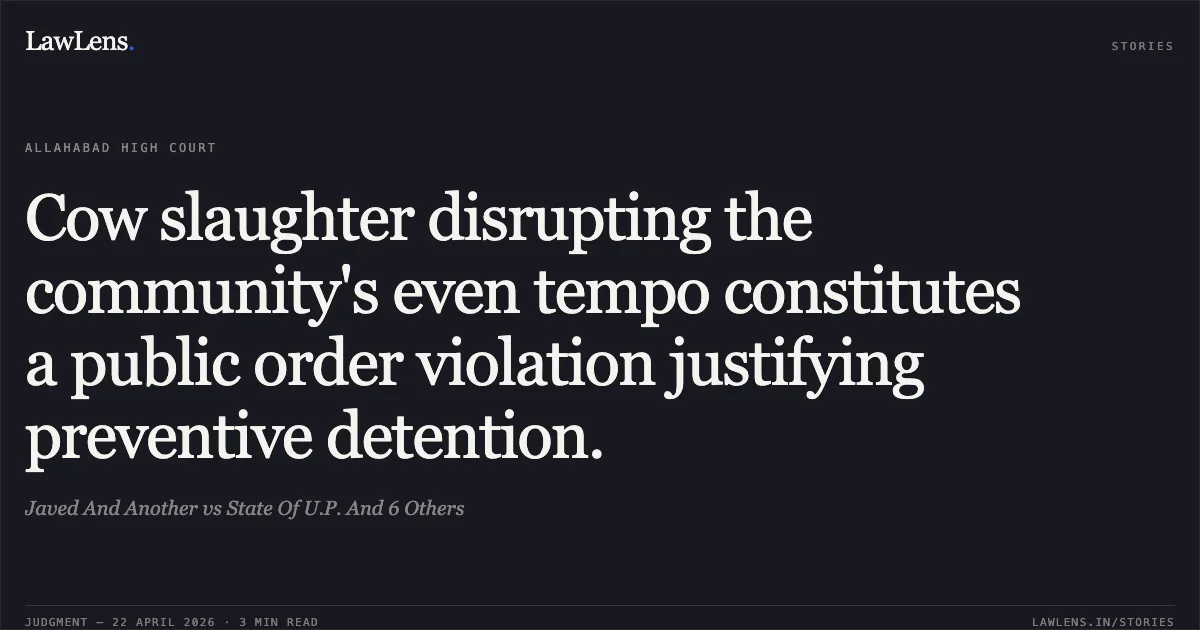
Source reference: para 33-34The Court observed that the specific incident led to road blockades and the necessity of summoning additional forces, which clearly disrupted the "even tempo of life" in the locale
Source reference: para 35-37Regarding the alleged infringement of the right to representation, the Court found no evidence that the petitioner ever submitted a representation; the State and Jail authorities denied receipt, and the petitioner failed to provide dates or copies of such documents in his pleadings
Source reference: para 38-41Holding
The Court answered all issues in the negative. It held that the incident significantly prejudiced public order, the detaining authority applied its mind properly, and there was no procedural lapse regarding the petitioner’s right to representation
Consequently, the detention order dated June 5, 2025, was upheld as legal. The Habeas Corpus writ petition was dismissed
Source reference: para 44Acts & Sections Cited
8 provisions across 3 statutes referred to in this judgment. Each provision opens on LawLens.
National Security Act, 19804
Bharatiya Nyaya Sanhita, 20231
Arms Act, 19593
Original Court PDF
Javed And AnothervsState Of U.P. And 6 Others
Click to open original judgment
Original judgment, available to read, download and summarize on LawLens.in


