Facts
The petitioners, an association of BSF veterans and individual retirees, sought a direction for the correct fixation of pension for Constables, Sub-Inspectors, and Inspectors with effect from January 1, 2006
Source reference: p. 1-2Under the 5th Central Pay Commission (CPC), the pay scales for Central Police Organization (CPO) personnel were initially set at lower replacement scales
Source reference: p. 3On October 10, 1997, the Ministry of Home Affairs issued a notification rationalizing these scales to bring them at par with the Delhi Police w.e.f. January 1, 1996, but paragraph 5 of said order restricted the benefit of the upgraded scales to those in service on October 10, 1997
Source reference: p. 3-4Consequently, personnel who retired between January 1, 1996, and October 10, 1997, were denied the upgraded replacement scales for pension calculation
Source reference: p. 5, 9Petitioner No. 2, an Inspector, had his claim for revision rejected via an impugned order dated January 6, 2017
Source reference: p. 2, 12Issues
1. Whether the members of the petitioner association (Constables, Sub-Inspectors, and Inspectors) who retired before October 10, 1997, are entitled to the upgraded replacement pay scales as per the notification dated October 10, 1997, for the purpose of fixing their pension w.e.f. January 1, 2006
Source reference: p. 12 / para. 252. Whether the classification of pensioners based on a cutoff date (pre- vs. post-October 10, 1997) for granting upgraded pay scales is discriminatory
Source reference: p. 8 / para. 16Law Applied
The Court applied the principles of Article 14 and 16 of the Constitution regarding non-discrimination among a single class of pensioners, as established in D.S. Nakara v. Union of India, which prohibits micro-classification of pensioners through arbitrary eligibility criteria
Source reference: p. 8It further relied on the precedent in Lal Bahadur Singh v. Union of India, which quashed Para 5 of the October 10, 1997 order
Source reference: p. 5Bhoop Singh v. Union of India, which held that even pre-1996 retirees are entitled to pension revision based on the upgraded scales of Rs. 6500-10500 for Inspectors
Source reference: p. 15-16Ajit Singh v. Union of India, which mandated that 5th CPC replacement scales be granted from January 1, 1996, instead of October 10, 1997
Source reference: p. 13-14Reasoning
The court reasoned that the issue of "cutoff dates" for the implementation of rationalized pay scales is well-settled.
Source reference: para. 28-29It noted that past judgments, specifically Jagmal Singh and Ajit Singh, established that once the government decided to implement replacement scales under the 5th CPC, those benefits must be extended from the effective date of the Commission (January 1, 1996) rather than the date of the executive order (October 10, 1997)
Source reference: para. 28-29The court found no distinction between the petitioners and the successful litigant in Bhoop Singh, noting that the denial of upgraded Grade Pay (Rs. 4600 instead of Rs. 4200 for Inspectors) solely because of the retirement date was "clearly erroneous"
Source reference: para. 31-32Since the petitioners' ranks (Constable, SI, and Inspector) were covered by the rationalization notification, they formed a single class with those who retired later and could not be deprived of equal pension benefits
Source reference: para. 32-33Holding
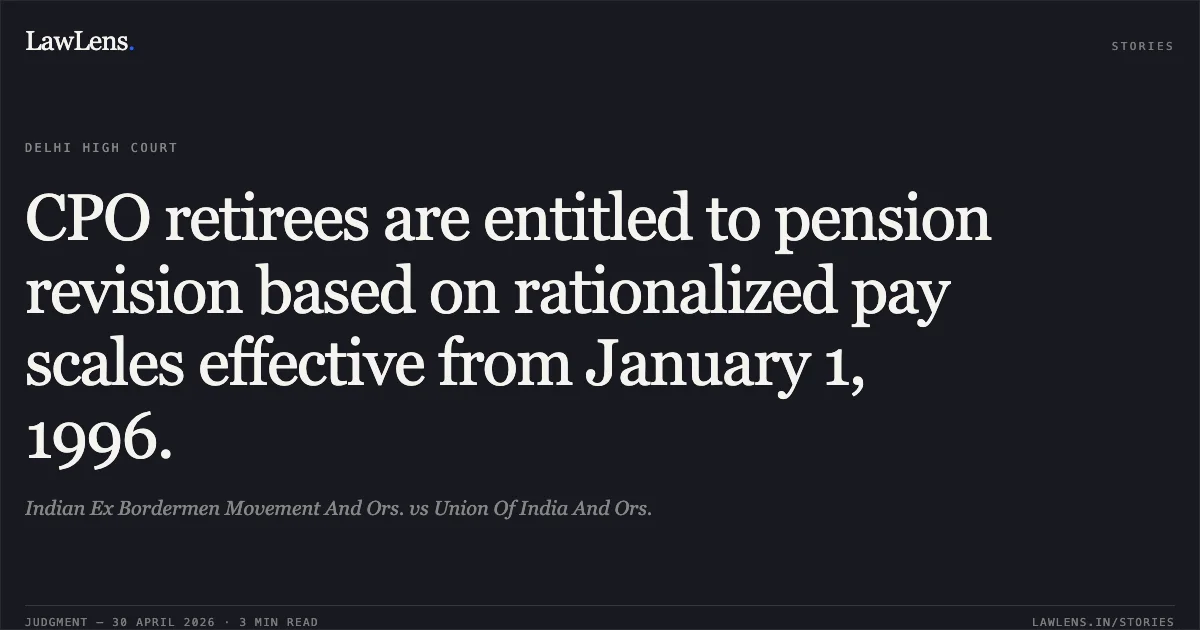
The Court allowed the writ petition, set aside the impugned order of January 6, 2017, and declared the respondents' action as discriminatory
It held that the members of the petitioner association are entitled to revised monthly pensions w.e.f. January 1, 2006: Constables at Rs. 3890; Sub-Inspectors at Rs. 7215; and Inspectors at Rs. 8345
Source reference: para. 34The respondents were directed to calculate and release arrears with simple interest at 6% per annum within three months
Source reference: para. 34-35Original Court PDF
Indian Ex Bordermen Movement And Ors.vsUnion Of India And Ors.
Click to open original judgment
Original judgment, available to read, download and summarize on LawLens.in


