Facts
The petitioner, a works contractor, was awarded a CPWD contract for renovation and furnishing works at Punjab & Sind Bank’s Corporate Office.
Source reference: pp. 1–2Disputes arose after the respondent objected to manufacturer-authorisation documents submitted by the petitioner, issued a show-cause notice, forfeited the performance guarantee and barred the petitioner from participating in the tendering process for the work.
Source reference: pp. 1–2After referring the disputes for conciliation, the petitioner issued a notice invoking arbitration under Section 21 of the Arbitration and Conciliation Act, 1996 (“A&C Act”) and Clause 25 of the agreement.
Source reference: p. 2No tribunal was constituted.
Source reference: p. 2The parties disputed which version of Clause 25 applied: the petitioner relied on one version, while the respondent asserted that Clause 25 of the CPWD General Conditions of Contract, 2023 governed.
Source reference: pp. 3–9The respondent objected that the petitioner had relied on a superseded clause, had not used the prescribed notice proforma and sought reference of “deadwood” disputes.
Source reference: pp. 9–10Issues
1. Whether the objections concerning the applicable version of Clause 25, the prescribed notice proforma and the allegedly “deadwood” nature of the disputes could prevent referral at the Section 11 stage.
Source reference: pp. 9–112. Whether the appointment procedure under the respondent’s version of Clause 25—providing for appointment by a respondent officer and selection from a CPWD-curated panel—was valid, or whether the Court should appoint an independent sole arbitrator.
Source reference: pp. 11–14Law Applied
Section 11(6A) of the A&C Act confines the referral court’s inquiry to the existence of an arbitration agreement; other issues, including jurisdiction and arbitrability, are ordinarily for the tribunal under Section 16, as explained in *In Re: Interplay Between Arbitration Agreements under the Arbitration and Conciliation Act 1996 and the Indian Stamp Act 1899* and *SBI General Insurance Co. Ltd. v. Krish Spinning*.
Source reference: p. 9Under Section 12(5) read with the Seventh Schedule, an interested person who is ineligible to act as arbitrator cannot appoint an arbitrator, including a sole arbitrator, as recognised in *Perkins Eastman Architects DPC v. HSCC (India) Ltd.*
Source reference: pp. 12–13Further, *Central Organisation for Railway Electrification v. ECI SPIC SMO MCML (JV)* establishes that requiring a party to choose an arbitrator from a panel curated exclusively by the opposing party is inconsistent with equal treatment of parties.
Source reference: pp. 13–14The Court also relied on *Kalpataru Projects International Ltd. v. Northern Railway* in applying that principle to an appointment procedure confining a party’s choice to such a panel.
Source reference: p. 14Reasoning
The Court held that the parties’ disagreement over which version of Clause 25 applied did not negate the existence of an arbitration agreement, which was the relevant inquiry at the referral stage.
Source reference: p. 10The petitioner’s notice substantially contained the particulars required by Appendix XVIII, was addressed to the designated appointing authority and was received by that office; the proforma objection therefore did not defeat the arbitration request.
Source reference: pp. 10–11In any event, procedural compliance and the contention that the claims were “deadwood” were not matters for determination at the Section 11 stage.
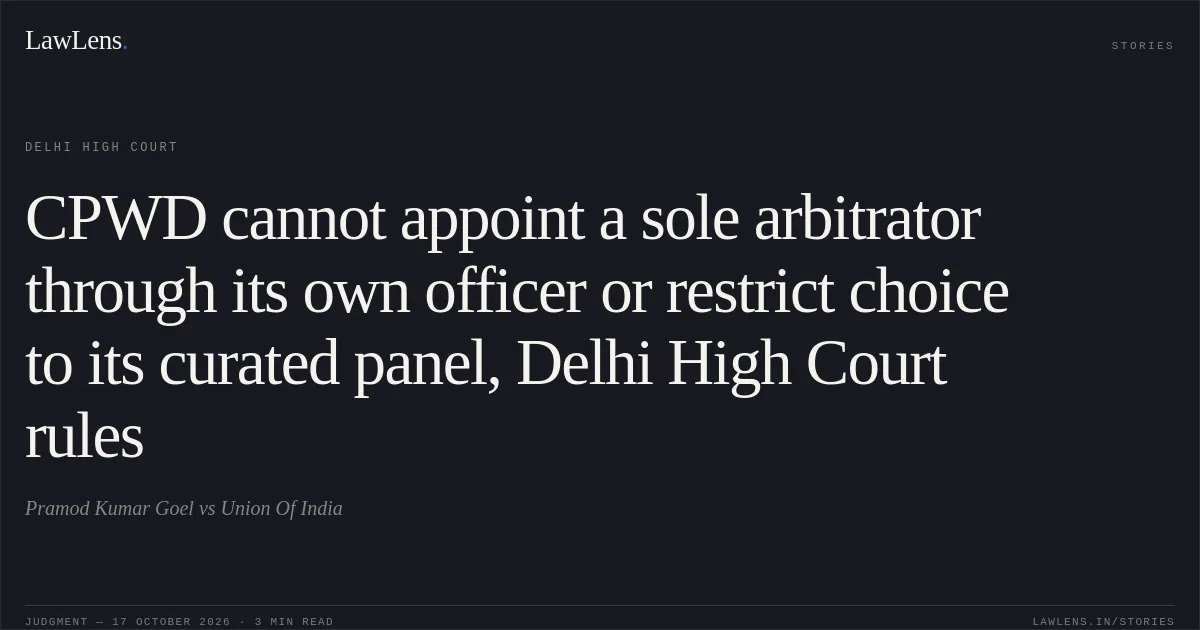
Source reference: pp. 10–11Under the respondent’s own version of Clause 25, the appointing authority was a respondent officer, and the alternative procedure confined the petitioner’s choice to a CPWD panel curated by the respondent, with the appointing authority empowered to appoint from that panel.
Source reference: pp. 11–14Applying *Perkins Eastman* and *Central Organisation for Railway Electrification*, the Court found both features impermissible and held that the appointment mechanism could not be sustained.
Source reference: pp. 11–14Holding
The Court allowed the petition and appointed Ms. Ritika Jhurani, Advocate, as sole arbitrator to adjudicate the parties’ disputes.
The arbitration was directed to proceed under the aegis and rules of the Delhi International Arbitration Centre (DIAC), subject to the arbitrator’s disclosures under Section 12 of the A&C Act.
Source reference: p. 15The respondent remained entitled to raise preliminary objections concerning jurisdiction and arbitrability before the arbitrator, and the parties’ rights on the claims and counterclaims were left open.
Source reference: p. 15Acts & Sections Cited
6 provisions across 1 statute referred to in this judgment. Each provision opens on LawLens.
Arbitration and Conciliation Act, 19966
Original Court PDF
Pramod Kumar GoelvsUnion Of India
Click to open original judgment
Original judgment, available to read, download and summarize on LawLens.in