Facts
The State filed a petition under Section 528 of the BNSS, 2023, seeking to set aside a bail order dated 20.05.2026
Source reference: p. 1-2The case involves a three-year-old victim who alleged sexual assault by a male individual at her school on 30.04.2026
Source reference: p. 2In her Section 183 BNSS statement and subsequent video-recorded identification, the victim identified the respondent (her class teacher) as the "Madam" who assisted in the crime by taking her to the basement, removing her clothes, and cleaning bloodstains
Source reference: p. 2Despite these allegations and medical records showing the child suffered from urinary and bladder infections post-incident, the Trial Court granted the respondent regular bail on 20.05.2026, primarily citing her clean antecedents and the omission of her name in the initial FIR
Source reference: p. 2-5, 8Issues
1. Whether the Trial Court’s order granting bail was perverse or based on extraneous considerations by failing to consider the gravity of the offence under the POCSO Act
Source reference: p. 6, para. 152. Whether the Court should exercise its inherent powers under Section 528 of the BNSS to cancel bail where material considerations and the vulnerability of a child victim were overlooked
Source reference: p. 7, para. 18Law Applied
Section 528 of the Bharatiya Nagarik Suraksha Sanhita (BNSS), 2023, regarding inherent powers
Source reference: p. 1Principles of balancing liberty against the gravity of the offence as per Gurcharan Singh v. State (Delhi Administration) and Prasanta Kumar Sarkar v. Ashis Chatterjee
Source reference: p. 3Victim-centric approach mandated by the Protection of Children from Sexual Offences (POCSO) Act, 2012
Source reference: p. 4, 6Bail can be set aside if the order is illegal, perverse, or premised on irrelevant material as per P v. State of Madhya Pradesh
Source reference: p. 7, para. 19Prohibition of a "mini-trial" or a deep dive into witness credibility at the bail stage as per State of Bihar v. Rajballav Prasad
Source reference: p. 9-10Reasoning
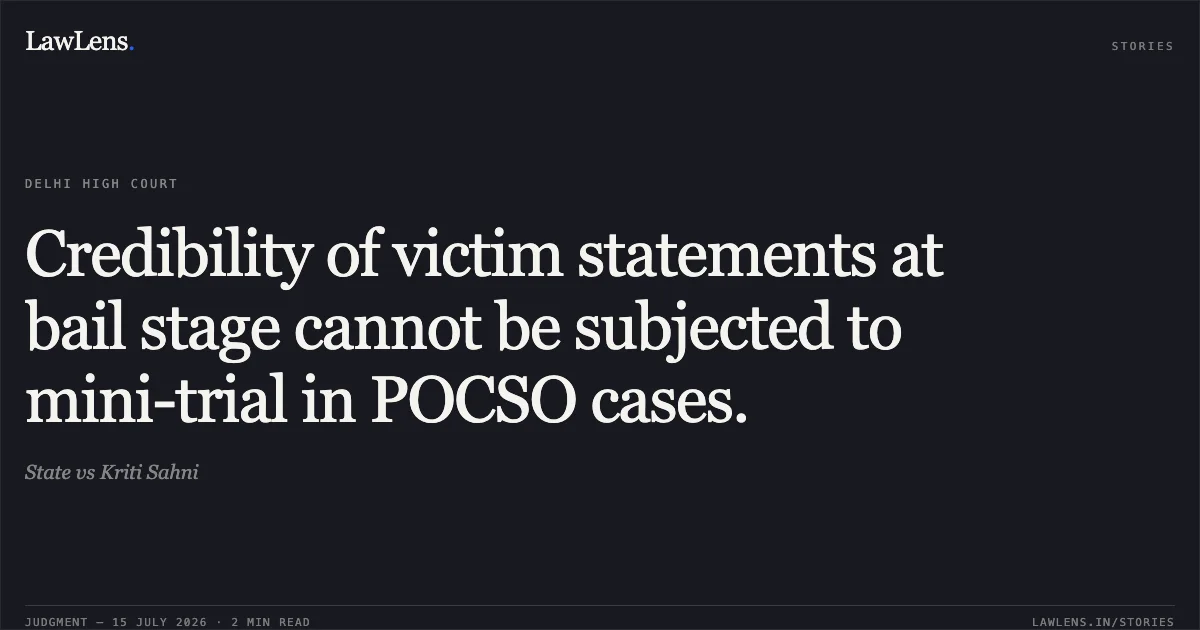
The High Court found the Trial Court’s reasoning flawed, noting it conducted an impermissible "mini-trial" by scrutinizing the victim's credibility
Source reference: p. 3, 9The court observed that the Trial Court erroneously prioritized the absence of the respondent's name in the initial FIR, failing to account for the victim's tender age (three years) and the legal principle that an FIR is not an encyclopedia of every detail
Source reference: p. 8-9, para. 21The High Court highlighted that the respondent held a position of authority as a teacher for 13 years, creating a significant risk of witness intimidation or evidence tampering, which the Trial Court failed to safeguard against
Source reference: p. 4, 10The Trial Court ignored subsequent medical evidence and the victim's positive identification of the respondent during video proceedings
Source reference: p. 3, 9Holding
The High Court held that the Trial Court overlooked material considerations and the statutory rigors of the POCSO Act
The Court set aside the impugned order dated 20.05.2026 and cancelled the respondent's bail; the respondent was directed to surrender before the jurisdictional POCSO Court within three days of the judgment
Source reference: p. 10, para. 27-28Acts & Sections Cited
4 provisions across 2 statutes referred to in this judgment. Each provision opens on LawLens.
Bharatiya Nagarik Suraksha Sanhita, 20232
Bharatiya Nyaya Sanhita, 20232
Original Court PDF
StatevsKriti Sahni
Click to open original judgment
Original judgment, available to read, download and summarize on LawLens.in


