Facts
The appellant was convicted under Section 302 of the IPC for the murder of Sonasher Baghel on the night of July 31, 2022.
Source reference: para 4, 6The prosecution alleged that a long-standing land dispute existed between the appellant and his brother, PW-03, whom the deceased supported.
Source reference: para 5On the night of the incident, PW-01 (an eyewitness) saw the appellant assaulting the deceased with a tangiya (axe) on a cemented platform outside their house.
Source reference: para 6Upon raising an alarm, the appellant fled but was chased and apprehended by PW-06 and PW-08, to whom he allegedly made an extra-judicial confession.
Source reference: para 6, 34The police recovered the weapon and blood-stained clothes following a memorandum statement under Section 27 of the Evidence Act.
Source reference: para 8The Trial Court sentenced the appellant to life imprisonment and a fine of Rs. 100.
Source reference: para 4The appellant challenged the conviction, arguing that PW-01 was an interested witness, the light was insufficient for identification, and the FSL report was inconclusive regarding blood groups.
Source reference: para 14Issues
1. Whether the death of the deceased, Sonasher Baghel, was homicidal in nature?
Source reference: para 212. Whether the appellant is the author of the crime and committed the murder of the deceased?
Source reference: para 21Law Applied
Section 302 of the Indian Penal Code, 1860, regarding the punishment for murder.
Source reference: para 4Section 27 of the Indian Evidence Act, 1872, to validate the recovery of the weapon and clothes pursuant to the accused's disclosure.
Source reference: para 8, 36Section 8 of the Evidence Act regarding the relevancy of the accused's conduct (fleeing the scene).
Source reference: para 40Section 374(2) of the Code of Criminal Procedure, 1973, under which the appeal was considered.
Source reference: para 4Section 313 Cr.P.C. for assessing the evidentiary value of the accused’s statement.
Source reference: para 39Reasoning
The Court affirmed the homicidal nature of the death based on the testimony of PW-09 (Dr. Pradeep Baghel) and the post-mortem report (Ex.P/14), which detailed multiple incised wounds on vital parts (head and face) caused by a sharp-edged weapon, leading to coma and shock.
Source reference: para 26-27Regarding the authorship of the crime, the Court found the testimony of PW-01 (eyewitness) natural and unshaken, despite her relationship with the deceased.
Source reference: para 33This was corroborated by the "res gestae" conduct of the appellant fleeing the scene and being immediately apprehended by PW-06 and PW-08.
Source reference: para 34-35, 40The Court dismissed the defense's challenge to the recovery of the weapon, noting that the Investigating Officer (PW-11) proved the due execution of the memorandum and seizure.
Source reference: para 36Furthermore, the FSL report (Ex.P/22) confirmed human blood on the appellant's clothes, for which the appellant offered no explanation during his Section 313 Cr.P.C. examination.
Source reference: para 39The motive of a land dispute was held to be satisfactorily proved, providing the necessary backdrop for the intentional assault.
Source reference: para 49Holding
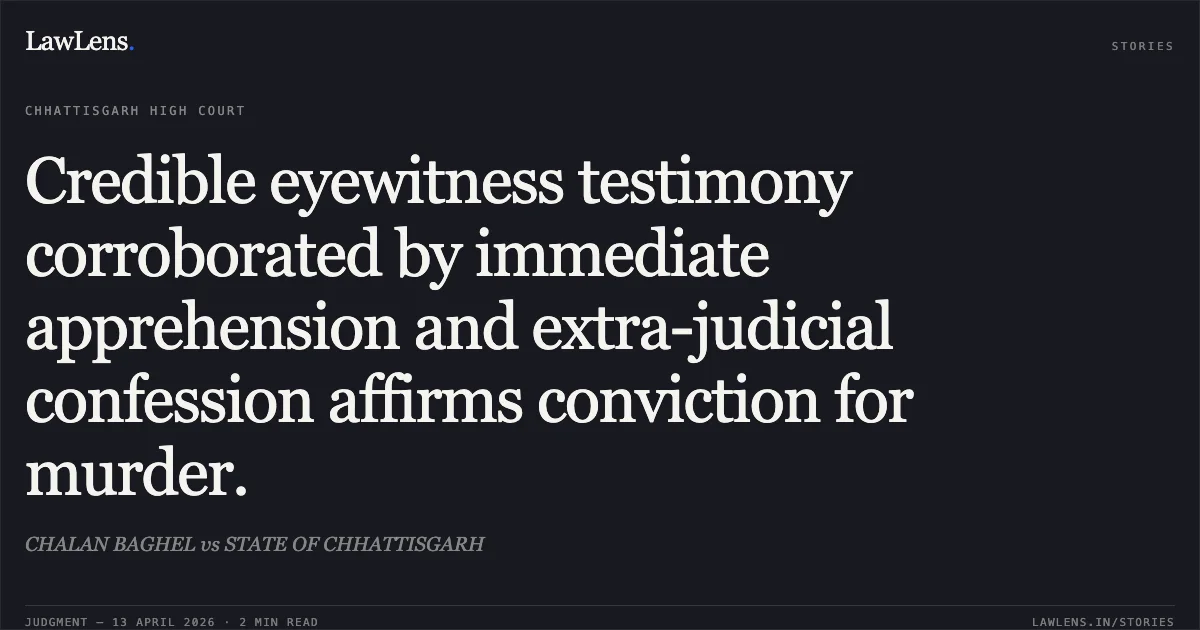
The High Court answered both issues in the affirmative, holding that the death was homicidal and the appellant was the sole author of the crime.
The Court found no infirmity in the Trial Court’s appreciation of evidence, noting that the chain of circumstances—including eyewitness testimony, immediate apprehension, extra-judicial confession, and forensic evidence—was complete and unbroken.
Source reference: para 48, 50The criminal appeal was dismissed, and the conviction and life sentence passed by the Sessions Judge, Bastar, were affirmed.
Source reference: para 51Acts & Sections Cited
4 provisions across 2 statutes referred to in this judgment. Each provision opens on LawLens.
Code of Criminal Procedure, 19733
Indian Penal Code, 18601
Original Court PDF
CHALAN BAGHELvsSTATE OF CHHATTISGARH
Click to open original judgment
Original judgment, available to read, download and summarize on LawLens.in


![Authorities must decide pensionary and retiral-benefit claims through a reasoned order within eight weeks.. Habibullah khan vs HOME DEPARTMENT. CAT - ['Srinagar']. LawLens](/stories/thumbnails/authorities-must-decide-pensionary-and-retiral-benefit-claims-through-a-reasoned-order-wit-d0cbe8a8119c48fbabe7df9f2d353488.webp)