Facts
The complainant, seeking a duplicate driving licence, alleged that Rajinder Singh offered to arrange it for ₹1,300, including the government fee.
Source reference: pp. 2–4, 7–8The complainant reported the matter to the Anti-Corruption Branch, which arranged a trap.
Source reference: pp. 2–4, 7–8During the operation, the treated currency was allegedly handed to co-accused Mukesh Kumar in Rajinder Singh’s presence and was recovered after the raiding party intervened.
Source reference: pp. 2–4, 7–8Receipts relating to licence fees were also recovered from Rajinder Singh’s personal search.
Source reference: pp. 2–4, 7–8The complainant and another prosecution witness did not support the prosecution at trial, but the panch witness testified to the demand and transaction.
Source reference: pp. 4–5The Trial Court convicted Rajinder Singh under Section 8 of the Prevention of Corruption Act, 1988, and sentenced him to 18 months’ rigorous imprisonment and a fine of ₹10,000.
Source reference: pp. 4–5He appealed under Section 374 CrPC, challenging, among other matters, proof of demand and acceptance.
Source reference: pp. 5–6Issues
Whether the prosecution proved the essential ingredients of an offence under Section 8 of the Prevention of Corruption Act, 1988, including the requisite demand or receipt of gratification as a motive or reward for inducing a public servant.
Source reference: pp. 8–9Whether the conviction could be sustained when the complainant and another material witness turned hostile, in light of the panch witness’s testimony and the other evidence.
Source reference: pp. 8–10Law Applied
Section 8 of the Prevention of Corruption Act, 1988, as applied by the Court, required proof that the accused accepted, obtained, agreed to accept, or attempted to obtain gratification for himself or another as a motive or reward for inducing a public servant, by corrupt or illegal means, to perform or refrain from performing an official act or to show favour or render a service.
Source reference: p. 8The Court relied on Sandeep Deshwal @ Sanju v. State Govt. of NCT of Delhi, which, following State through CBI, New Delhi v. Jitender Kumar Singh, recognised that the testimony of a panch witness and raiding officer may sustain a finding against an accused when it is cogent and convincing.
Source reference: p. 10The appellant’s reliance on Bharat Bhushan v. State and Babji v. State concerned the principle that recovery alone, without cogent proof connecting the money to the alleged gratification and inducement, is insufficient.
Source reference: p. 5Reasoning
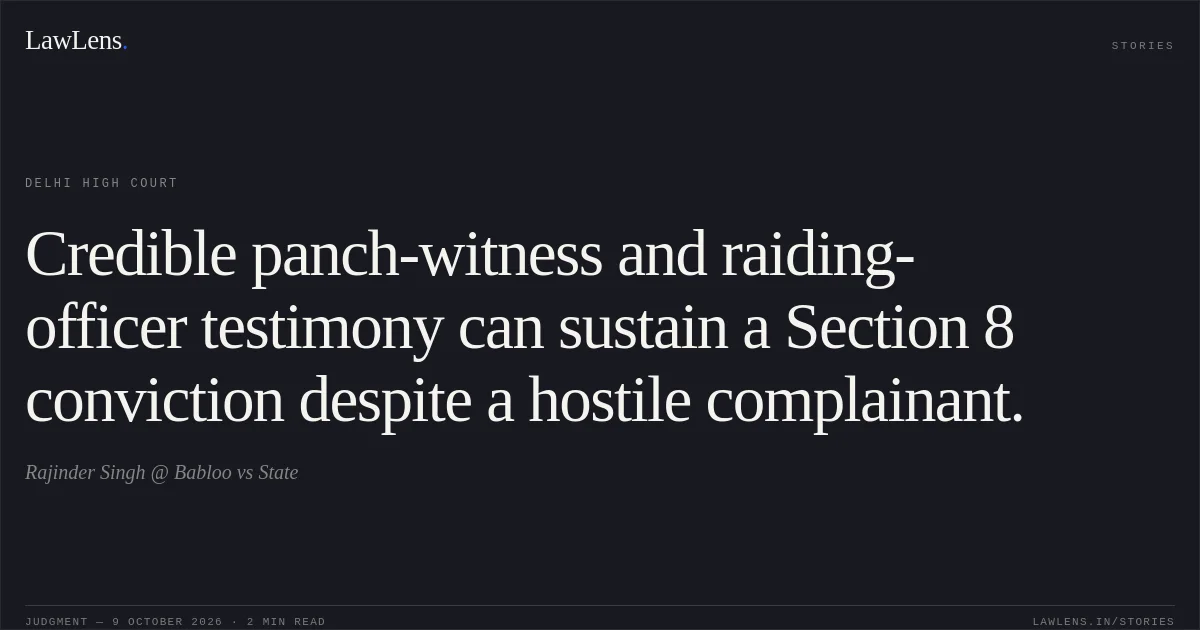
The Court found that, despite the complainant and another witness turning hostile, the panch witness gave a consistent account of the demand and transaction, including the transfer of the treated currency in Rajinder Singh’s presence; the raiding officer and police witnesses provided supporting evidence.
Source reference: pp. 9–10The Court also relied on the recovery of the currency and fee receipts relating to licence applications, which it found Rajinder Singh had not explained.
Source reference: p. 10On that evidence, it concluded that the prosecution had proved the statutory ingredients and that the Trial Court’s conviction was supported by the record.
Source reference: pp. 9–10Holding
The High Court dismissed the appeal and left the sentence undisturbed, noting that no separate argument had been advanced on sentence.
Rajinder Singh was directed to surrender forthwith to serve the sentence and was held entitled to set-off under Section 428 CrPC.
Source reference: p. 11Acts & Sections Cited
5 provisions across 2 statutes referred to in this judgment. Each provision opens on LawLens.
Code of Criminal Procedure, 19734
Prevention of Corruption Act, 19881
Original Court PDF
Rajinder Singh @ BabloovsState
Click to open original judgment
Original judgment, available to read, download and summarize on LawLens.in