Facts
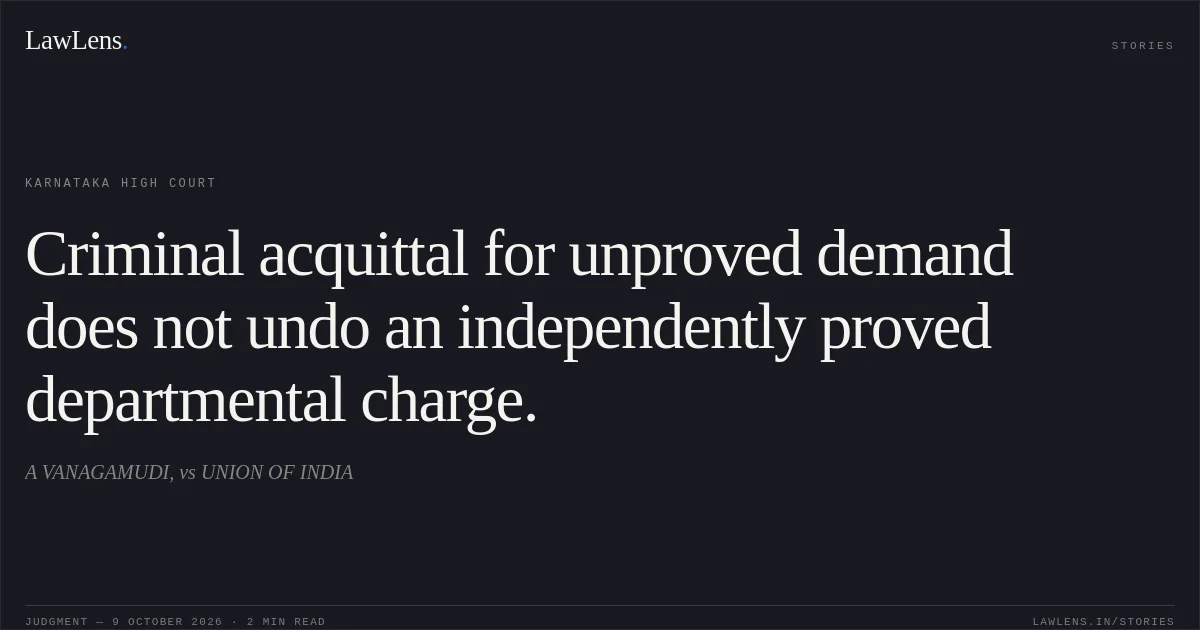
The petitioner, a Superintendent of Service Tax, was charged with demanding and accepting ₹25,000 from a taxpayer in connection with altering an audit enquiry report. Following a departmental enquiry, the charge was held proved and the petitioner was removed from service under Rule 11(viii) of the CCS (CCA) Rules, 1965.
Source reference: para. 2, 9Separately, the petitioner was convicted in a criminal case arising from the same incident, but the High Court later set aside the conviction and acquitted him because demand had not been proved; the recovery of the currency notes was not disputed.
Source reference: para. 3, 15–16He then challenged the Tribunal’s order, arguing, among other things, that the acquittal undermined the departmental finding and entitled him to financial benefits.
Source reference: para. 5–6Issues
1. Whether the departmental finding of misconduct and the removal penalty could stand despite the petitioner’s acquittal in the criminal proceedings arising from the same incident
Source reference: para. 12, 15–162. Whether the Tribunal’s decision or the departmental penalty warranted interference under Articles 226 and 227 of the Constitution, including on the grounds of procedural unfairness, no evidence, or disproportionate punishment
Source reference: para. 10–123. Whether the petitioner was entitled to financial benefits following his acquittal in the criminal case, notwithstanding the independent departmental enquiry
Source reference: para. 5–6, 12Law Applied
The Court applied the limited scope of judicial review in disciplinary matters: interference is warranted where the penalty results from a violation of natural justice, the finding is based on no evidence, or the punishment is disproportionate to the misconduct.
Source reference: para. 11Departmental charges are determined on the preponderance of probabilities, and strict rules of evidence applicable to criminal trials do not govern those proceedings.
Source reference: para. 16An acquittal in a criminal case does not, by itself, invalidate a penalty imposed after an independent departmental enquiry or confer an automatic right to financial benefits.
Source reference: para. 12, 14The Court distinguished Ram Lal v. State of Rajasthan, (2024) 1 SCC 175, on its facts; it also held Raj Narain v. Union of India, (2019) 5 SCC 809, G.M. Tank v. State of Gujarat, (2006) 5 SCC 446, and State Bank of India v. Mohammed Abdul Rahim, (2013) 11 SCC 67, inapplicable to the circumstances before it.
Source reference: para. 17–18Reasoning
The Court found that the departmental enquiry was conducted independently of the criminal case, that witnesses and documents were considered, and that the petitioner had an opportunity to defend himself and cross-examine witnesses.
Source reference: para. 10, 13–14The criminal acquittal rested on the prosecution’s failure to prove demand to the criminal standard; the Court considered that the undisputed recovery of the money could be assessed in the departmental proceeding under the preponderance-of-probabilities standard.
Source reference: para. 15–16The petitioner did not establish a breach of natural justice, absence of evidence, or disproportionality sufficient to warrant judicial interference.
Source reference: para. 10–12The Court therefore rejected the contention that acquittal alone displaced the departmental finding or entitled the petitioner to financial benefits.
Source reference: para. 12Holding
The Court held that the petitioner had shown no ground to interfere with either the removal penalty or the Tribunal’s order.
It dismissed the writ petition, leaving the penalty of removal from service undisturbed.
Source reference: para. 8, 19Acts & Sections Cited
2 provisions across 1 statute referred to in this judgment. Each provision opens on LawLens.
Prevention of Corruption Act, 19882
Original Court PDF
A VANAGAMUDI,vsUNION OF INDIA
Click to open original judgment
Original judgment, available to read, download and summarize on LawLens.in