Facts
The petitioner was accused of house trespass and theft, with property seized from him subsequently identified by the complainant
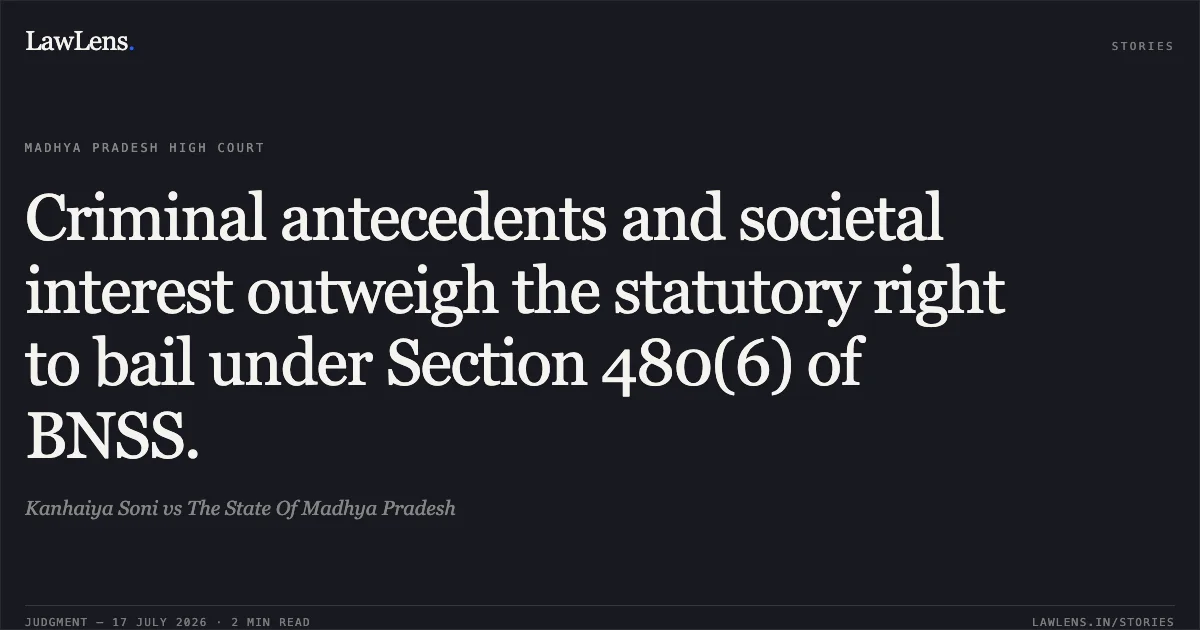
Source reference: para 8He has been in custody since April 28, 2025. After charges were framed, the case was fixed for evidence on February 11, 2026. Claiming that the prosecution failed to complete its evidence within the statutory 60-day period, the petitioner applied for bail under Section 480(6) of the Bharatiya Nagarik Suraksha Sanhita (BNSS)
Source reference: para 2The Trial Court (Narsinghpur) and the Revisional Court dismissed the application on April 13, 2026, and April 25, 2026, respectively. The petitioner subsequently moved the High Court under Section 528 of the BNSS to set aside these orders
Source reference: para 1Issues
1. Whether Section 480(6) of the BNSS confers an absolute and indefeasible right to bail if prosecution evidence is not concluded within 60 days
Source reference: para 72. Whether the petitioner's extensive criminal antecedents and the nature of the evidence against him justify the refusal of bail despite the procedural delay
Source reference: paras 7-8Law Applied
The court applied Section 480(6) of the BNSS, which provides for bail if a trial is not conlcuded within 60 days, though it noted the provision aims for expeditious trials rather than granting an absolute right
Source reference: para 7The court relied on Neeru Yadav v. State of U.P. (2016) to emphasize that criminal history and societal interest are significant factors in bail decisions
Source reference: para 7It further cited Prasanta Kumar Sarkar v. Ashis Chatterjee (2010), establishing that the nature of accusations, severity of punishment, and likelihood of tampering with evidence are essential considerations for the grant or refusal of bail
Source reference: para 7The court distinguished the present case from Subhelal @ Sushil Sahu v. State of Chhattisgarh, noting that bail in the latter was granted due to a massive number of witnesses (189), whereas the witness count here is small
Source reference: para 6Reasoning
The court reasoned that the delay in evidence was not intentional or mala fide, noting that the Presiding Officer was on leave during two scheduled dates
Source reference: paras 6, 8While Section 480(6) BNSS promotes speed, the court held it does not create an automatic right to release, especially when weighed against the "grave nature" of the allegations and the petitioner's status as a habitual offender
Source reference: paras 7-8The court observed that the petitioner has 38 criminal cases, 23 of which are of a similar nature, posing a high risk of recidivism or absconding if released. It concluded that the specific facts—stolen property recovery and identified possession—outweighed the procedural 60-day timeline
Source reference: para 8Holding
The High Court dismissed the petition, holding that no ground was made out to interfere with the lower courts' orders as the petitioner is a habitual offender. The Court answered that the right under Section 480(6) BNSS is subject to judicial discretion based on the facts of each case
The Trial Court was directed to conclude the trial expeditiously, and the Superintendent of Police, Narsinghpur, was ordered to personally monitor witness attendance and trial progress
Source reference: paras 9-10Acts & Sections Cited
2 provisions across 1 statute referred to in this judgment. Each provision opens on LawLens.
Bharatiya Nagarik Suraksha Sanhita, 20232
Original Court PDF
Kanhaiya SonivsThe State Of Madhya Pradesh
Click to open original judgment
Original judgment, available to read, download and summarize on LawLens.in