Facts
The appellant, a Section Forest Officer at Mukkudam, was charged with demanding ₹20,000 as illegal gratification from a timber trader (PW1) to permit the transportation of mango and jackfruit timber
Source reference: para 3Prosecution alleged the appellant accepted ₹10,000 on 11.12.2012 and a further ₹2,000 previously
Source reference: para 3Following a subsequent demand for ₹5,000, PW1 filed a complaint with the Vigilance and Anti-Corruption Bureau (VACB)
Source reference: para 8A trap was laid on 15.12.2012, during which phenolphthalein-smeared currency notes were recovered from the appellant’s person, and his hand wash tested positive
Source reference: para 8, 14The Trial Court convicted the appellant under Sections 7 and 13(1)(d) r/w 13(2) of the Prevention of Corruption (PC) Act, 1988, sentencing him to one year of rigorous imprisonment and a fine
Source reference: para 4The appellant appealed, contending that the money was a voluntary donation for the Aanachaal Ayyappa Temple festival and that PW1 was an unreliable witness due to criminal antecedents
Source reference: para 5Issues
1. Whether the prosecution established the "demand and acceptance" of illegal gratification beyond reasonable doubt
Source reference: para 72. Whether the criminal antecedents of the de facto complainant (PW1) rendered his testimony wholly unreliable
Source reference: para 103. Whether the recovery of money was explained by the defense theory of temple festival donations
Source reference: para 15Law Applied
Section 7 and Section 13(1)(d) read with 13(2) of the PC Act, 1988, regarding the acceptance of illegal gratification and criminal misconduct by a public servant
Source reference: para 17Constitution Bench decision in Neeraj Dutta v. State (Govt. of NCT of Delhi) [AIR 2023 SC 330], which dictates that proof of demand and acceptance is a sine qua non for conviction, but that such demand can be proved through direct or circumstantial evidence
Source reference: para 18The court invoked the mandatory legal presumption under Section 20 of the PC Act, which presumes a motive or reward once the acceptance of gratification is proved
Source reference: para 19Section 140 of the Evidence Act (and Section 145 of the Bharatiya Sakshya Adhiniyam, 2023) regarding the cross-examination of character witnesses
Source reference: para 11Reasoning
The court found PW1’s testimony regarding the demand and acceptance "wholly reliable," noting that his evidence remained consistent and unshaken despite rigorous cross-examination
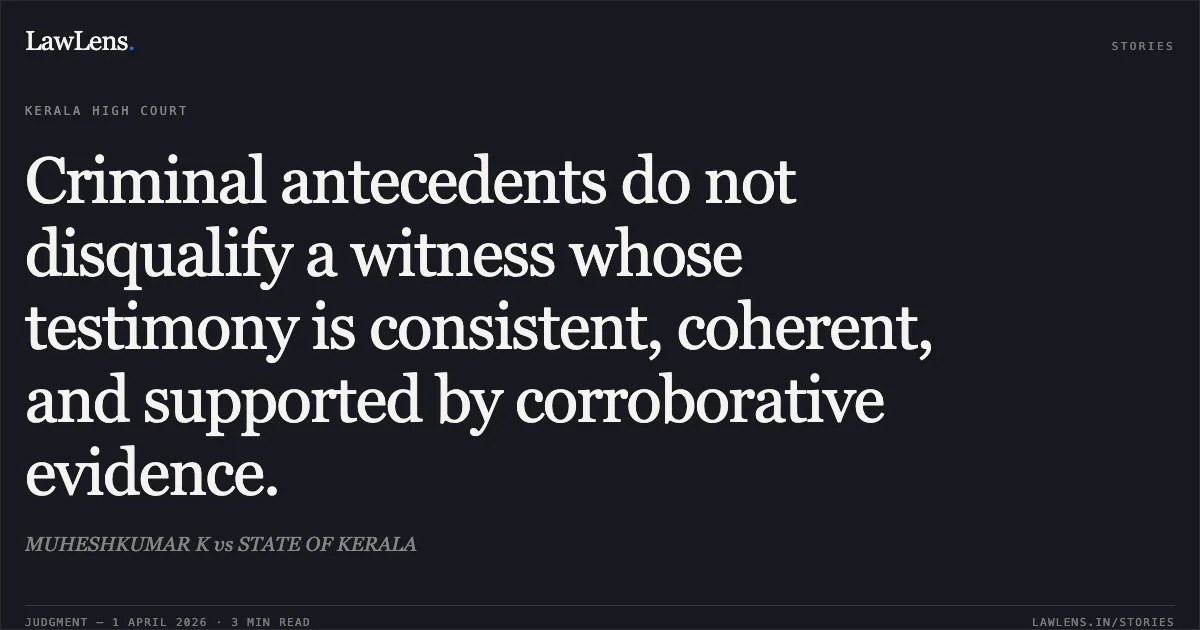
Source reference: para 12The court rejected the argument that PW1's criminal antecedents disqualified his testimony, stating that evidence from a witness with a criminal history must be scrutinized for coherence and corroboration rather than rejected outright, especially when corroborated by a successful trap recovery
Source reference: para 11-12The court observed that the temple was located in the Pallivasal Forest Section, not the appellant’s Mukkudam Section, making his collection of funds from merchants in his own jurisdiction suspicious
Source reference: para 15The court further noted that it is illegal for public servants to collect donations from the public for sponsoring festivals
Source reference: para 15Consequently, the court held that the appellant failed to rebut the statutory presumption under Section 20 of the PC Act once the foundational facts of acceptance and recovery (corroborated by the positive phenolphthalein test) were established
Source reference: para 15, 19Holding
The High Court dismissed the appeal and confirmed the conviction and sentence imposed by the Trial Court
The prosecution successfully proved both the demand and acceptance of the bribe
Source reference: para 14, 21The court upheld the sentence of one year rigorous imprisonment and a total fine of ₹50,000, noting that this was the statutory minimum for the offences charged
Source reference: para 4, 22The appellant was directed to surrender immediately to undergo the sentence
Source reference: para 24Acts & Sections Cited
4 provisions across 2 statutes referred to in this judgment. Each provision opens on LawLens.
Prevention of Corruption Act, 19883
Bharatiya Sakshya Adhiniyam, 20231
Original Court PDF
MUHESHKUMAR KvsSTATE OF KERALA
Click to open original judgment
Original judgment, available to read, download and summarize on LawLens.in


