Facts
The Appellant, who worked in Dubai, returned to Solapur on November 26, 2010.
Source reference: p. 6, 10He summoned his wife (the deceased, Fatima) from Almatti. Following a suspected quarrel regarding her character in the afternoon, the couple retired to a bedroom in the informant’s house that night.
Source reference: p. 6, 10Around 4:30 a.m., the Appellant knocked from inside the locked room, confessing he had strangled Fatima and requested the police be called.
Source reference: p. 10Upon the arrival of the police (PW-8), the Appellant opened the door; Fatima was found dead on the bed.
Source reference: p. 15The trial court convicted the Appellant under Section 302 of the IPC on May 24, 2012.
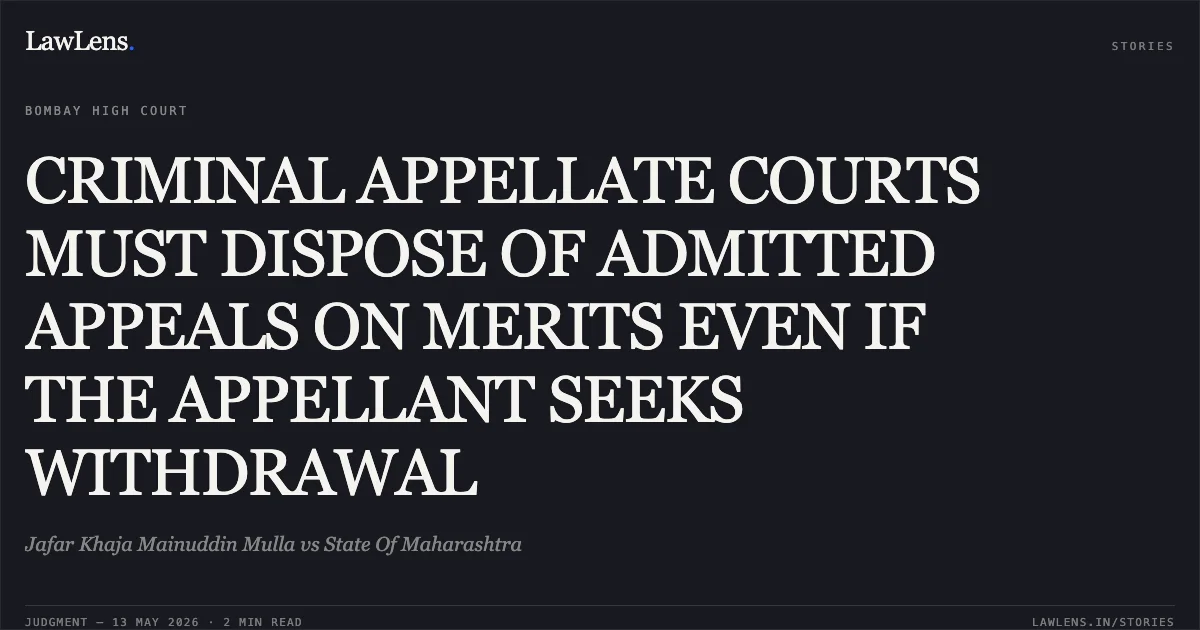
Source reference: p. 2-5The Appellant sought to withdraw the appeal as his sentence was nearing completion, but the High Court proceeded to hear the matter on merits.
Source reference: p. 2-5Issues
1. Whether a criminal appeal can be dismissed for non-prosecution or withdrawal without a merits-based review of the record.
Source reference: p. 4 / para. 52. Whether the circumstantial evidence, including the "last seen together" theory and the cause of death, is sufficient to sustain a conviction under Section 302 of the IPC.
Source reference: p. 16 / para. 25Law Applied
The Court applied Section 385 and 386 of the Code of Criminal Procedure, 1973, which mandate that an admitted appeal must be decided on merits after perusing the record, even if the appellant or counsel is absent.
Source reference: p. 3-4It relied on the precedent of Bani Singh v. State of UP (1996) to hold that an appeal cannot be dismissed for non-prosecution simpliciter.
Source reference: p. 4Substantively, the court applied Section 302 of the IPC regarding murder.
Source reference: p. 2The court applied the five-fold test for circumstantial evidence established in Sharad Birdhichand Sarda v. State of Maharashtra, requiring a complete chain of evidence excluding any hypothesis of innocence.
Source reference: p. 18-19Reasoning
The Court determined that the prosecution successfully established a complete chain of circumstances. Although there were minor contradictions in the testimonies of PW-1 and PW-3 regarding financial transactions, the core facts remained unshaken: the Appellant and the deceased were alone in a room latched from the inside.
Source reference: p. 15, 17Under the "last seen together" principle, and given that the Appellant opened the door to the police while the body was present, the burden shifted to him to provide an explanation, which he failed to do in his Section 313 statement.
Source reference: p. 17The medical evidence from PW-5 confirmed death by asphyxia due to strangulation with multiple ante-mortem neck injuries, ruling out natural causes.
Source reference: p. 13The Court found that the absence of "struggle marks" did not negate the homicide, as the compression of the neck was sufficient to cause death.
Source reference: p. 13, 16Holding
The Court answered the first issue in the negative, holding that criminal appeals must be decided on merits regardless of the appellant's desire to withdraw.
On the second issue, it held that the chain of circumstantial evidence was conclusive and inconsistent with the Appellant's innocence.
Source reference: p. 19The High Court maintained the conviction under Section 302 IPC and the sentence of life imprisonment, dismissing the appeal. The Court also quantified the legal aid fees for the appointed counsel at Rs. 25,000/-.
Source reference: p. 20Acts & Sections Cited
1 provisions across 1 statute referred to in this judgment. Each provision opens on LawLens.
Indian Penal Code, 18601
Original Court PDF
Jafar Khaja Mainuddin MullavsState Of Maharashtra
Click to open original judgment
Original judgment, available to read, download and summarize on LawLens.in


![Subsequent exoneration does not retrospectively invalidate a finalized promotion select list.. UNNIKRISHNAN M vs M/o Environment And Forests. CAT - ['Ernakulam']. LawLens](/stories/thumbnails/subsequent-exoneration-does-not-retrospectively-invalidate-a-finalized-promotion-select-li-ce80a0e84f2f4887857271e8b4341c42.webp)