Facts
The petitioners, original plaintiffs, filed Special Civil Suit No. 442 of 2014 seeking recovery of ₹31,22,659, including amounts due under cheques that had been dishonoured.
Source reference: para. 3–4; p. 2–3In related proceedings under Section 138 of the Negotiable Instruments Act, 1881, the High Court set aside the accused’s acquittals and directed payment of compensation; the accused’s appeals to the Supreme Court were dismissed as abated following his death.
Source reference: para. 4–5; p. 3–4The plaintiffs then sought to amend their plaint to claim the compensation, interest and legal expenses, increasing their total claim to ₹78,85,659.
Source reference: para. 6; p. 4–5The trial court rejected the amendment application, and the plaintiffs challenged that order under Article 227 of the Constitution.
Source reference: para. 6; p. 4–5Issues
1. Whether the plaintiffs could amend the pending recovery suit to claim compensation awarded in the criminal proceedings, where that compensation was recoverable under the criminal-procedure provisions.
Source reference: para. 11–12; p. 9–102. Whether the proposed claims for compensation and legal expenses arose from the same cause of action as the original suit and were permissible amendments under Order VI Rule 17 of the Code of Civil Procedure, 1908.
Source reference: para. 13–17; p. 10–15Law Applied
Order VI Rule 17 CPC permits amendments necessary to determine the real questions in controversy, subject to considerations including prejudice, a change in the nature of the suit, and the introduction of an entirely new cause of action.
Source reference: para. 14; p. 10–12In Life Insurance Corporation of India v. Sanjeev Builders Private Limited, (2022) 16 SCC 1, the Supreme Court summarised these principles, including that amendments are generally allowed when they aid effective adjudication, but not where they set up an entirely new case foreign to the original pleadings.
Source reference: para. 14; p. 10–12The Court also relied on the statutory procedure for recovering criminal-court compensation: Section 395 BNSS (corresponding to Section 357 CrPC) governs compensation, while Sections 471 and 461 BNSS (corresponding to Sections 431 and 421 CrPC) provide for recovery of amounts payable under a criminal-court order.
Source reference: para. 11; p. 9Reasoning
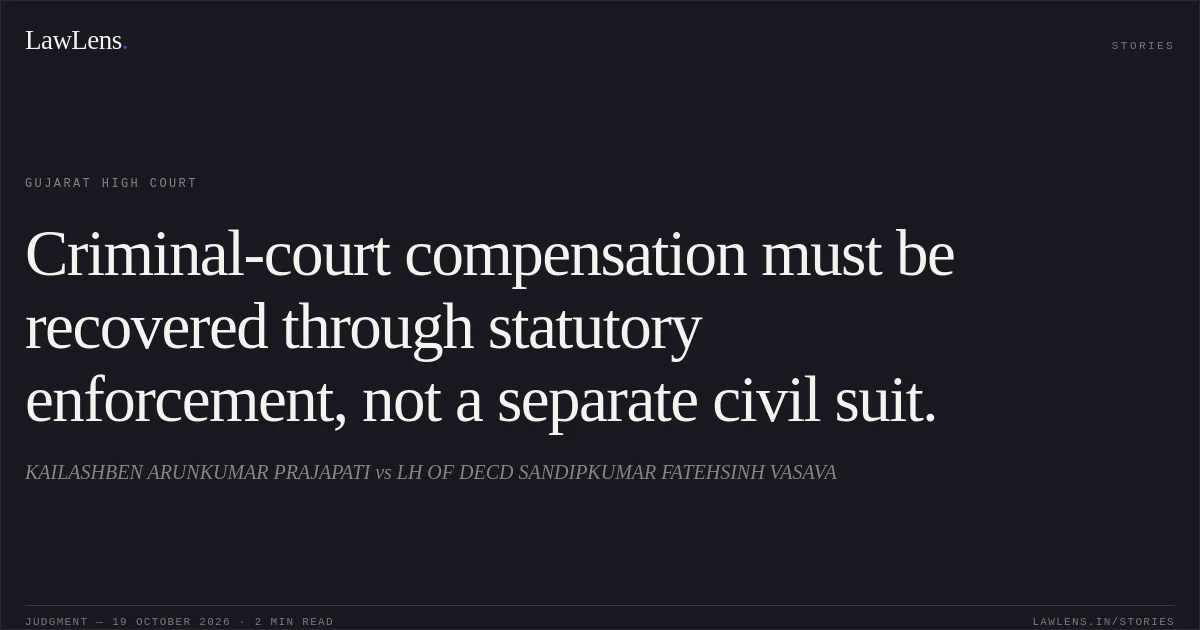
The Court held that the compensation had already been determined by the High Court in the criminal proceedings and was recoverable through the procedure prescribed by the BNSS/CrPC; the plaintiffs therefore had no basis to recover that amount by amending the civil suit.
Source reference: para. 11–12; p. 9–10It further found that the compensation claim rested on the criminal-court order, not on the cause of action pleaded in the original suit, and that legal expenses incurred in prosecuting the criminal proceedings likewise arose from a distinct cause of action.
Source reference: para. 13, 16–17; p. 10, 14–15The proposed amendments consequently did not assist in resolving the original dispute and sought to introduce separate claims.
Source reference: para. 15–16; p. 13–14Holding
The High Court found no error in the trial court’s rejection of the amendment application.
It held that the criminal compensation was not recoverable through the pending civil suit and that the legal-expense claim arose from a separate cause of action.
Source reference: para. 17–18; p. 15The petition was dismissed, notice discharged and no order as to costs made.
Source reference: para. 17–18; p. 15Acts & Sections Cited
7 provisions across 3 statutes referred to in this judgment. Each provision opens on LawLens.
Negotiable Instruments Act, 18811
Bharatiya Nagarik Suraksha Sanhita, 20233
Code of Criminal Procedure, 19733
Original Court PDF
KAILASHBEN ARUNKUMAR PRAJAPATIvsLH OF DECD SANDIPKUMAR FATEHSINH VASAVA
Click to open original judgment
Original judgment, available to read, download and summarize on LawLens.in