Facts
The Appellant, an Indian Air Force officer, was posted in the Thar desert in 1987
Source reference: para. 2(b)On March 29, 1987, following orders from his superior (Wing Commander), the Appellant removed an inebriated GREF driver—who had allegedly damaged a radar—from the camp and left him at a secluded location
Source reference: para. 2(e)-(f)The driver’s remains were found later
Source reference: para. 2(e)Although disciplinary proceedings were initiated in 1989, the Air Force opted for a criminal trial under Section 124 of the Air Force (AF) Act
Source reference: para. 2(g)On January 12, 1990, the Sessions Court discharged the Appellant for lack of a prima facie case and absence of sanction under Section 197 CrPC
Source reference: para. 2(h)After the three-year limitation for a Court Martial under Section 121 of the AF Act expired, the Government initiated administrative action under Section 19 read with Rule 16 of the AF Rules
Source reference: para. 2(j)-(k)The Appellant was dismissed from service on September 22, 1993
Source reference: para. 2(m)While a Single Judge of the Delhi High Court quashed the dismissal as time-barred, a Division Bench reversed this, restoring the dismissal based on case records indicating "morally convincing evidence"
Source reference: para. 1, 7Issues
1. Whether the initiation of administrative action against the Appellant was proper and justified after he had been discharged by a criminal court in respect of the same alleged offence?
Source reference: para. 15(a)2. Whether the reasons recorded for dismissal in the administrative proceedings were sustainable in law or vitiated by perversity?
Source reference: para. 15(b)3. To what relief is the Appellant entitled if the termination is found illegal?
Source reference: para. 15(c)Law Applied
Section 19 (Termination of service) and Section 124 (Choice between criminal court and court-martial) of the Air Force Act, 1950, alongside Rule 16 of the Air Force Rules, 1969
Source reference: para. 2(k)Union of India v. Harjeet Singh Sandhu (2001) 5 SCC 593, which establishes that while the limitation for a court-martial does not bar administrative action, the election by authorities to try an officer in a criminal court makes a subsequent judicial verdict (acquittal/discharge) final, precluding independent disciplinary action on the same facts
Source reference: para. 21, 24Yuvraj Laxmilal Kanther v. State of Maharashtra (2025) to hold that a "discharge" stands on a higher pedestal than "acquittal" as it signifies a total lack of material to even initiate a trial
Source reference: para. 19Principle of parity in punishment from Sengara Singh v. State of Punjab (1983)
Source reference: para. 37Reasoning
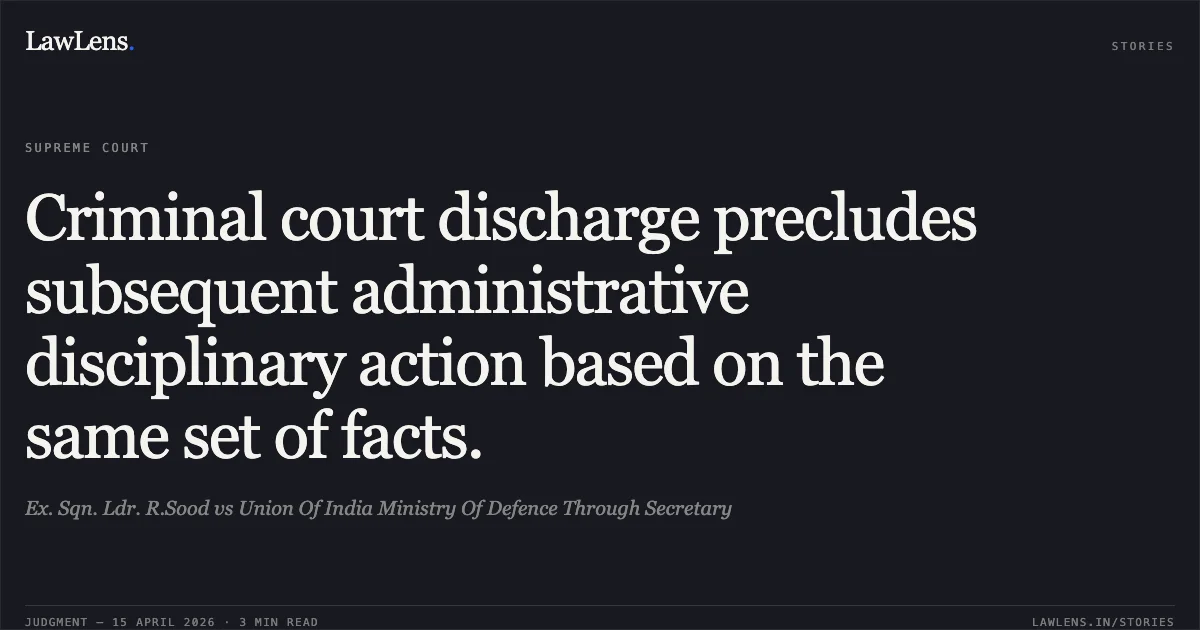
The Supreme Court held that the Air Force's decision to initiate administrative action was legally "non-est" because they had already exercised their discretion under Section 124 to opt for a criminal court trial
Source reference: para. 27-28Per Harjeet Singh Sandhu, once that "road is chosen," the judicial outcome (discharge) marks the end of the matter for those same facts
Source reference: para. 26-27The Court found the discharge significant, noting that it means there was insufficient evidence to even frame charges
Source reference: para. 18Regarding the dismissal process, the Court observed that the authorities relied on vague "morally convincing evidence" without addressing the Appellant's detailed defense, violating principles of natural justice
Source reference: para. 31-33The punishment was deemed arbitrary and discriminatory; the Appellant’s superior (who issued the orders) received only "severe displeasure," while the Appellant, who merely obeyed orders to avoid insubordination, was dismissed
Source reference: para. 36-37The Court concluded that the disparity in punishment for the same transaction, especially after a criminal discharge, was unsustainable
Source reference: para. 37Holding
The Supreme Court allowed the appeal and set aside the dismissal order dated September 22, 1993
Administrative action cannot be used to circumvent a judicial discharge where the employer initially elected the criminal forum
Source reference: para. 28Since the Appellant had crossed the age of superannuation, reinstatement was not possible
Source reference: para. 39The Court directed: (i) payment of 50% back wages from the date of dismissal until retirement; (ii) consideration for notional promotion; and (iii) payment of pensionary benefits, all with 9% interest per annum
Source reference: para. 40The Court also ordered the "restoration of honour" by directing the Air Force to formally "sign off" the Appellant as if he had retired in the normal course
Source reference: para. 41Acts & Sections Cited
12 provisions across 4 statutes referred to in this judgment. Each provision opens on LawLens.
Air Force Act, 19503
Code of Criminal Procedure, 19732
Indian Penal Code, 18604
Army Act, 19503
Original Court PDF
Ex. Sqn. Ldr. R.SoodvsUnion Of India Ministry Of Defence Through Secretary
Click to open original judgment
Original judgment, available to read, download and summarize on LawLens.in


![Subsequent exoneration does not retrospectively invalidate a finalized promotion select list.. UNNIKRISHNAN M vs M/o Environment And Forests. CAT - ['Ernakulam']. LawLens](/stories/thumbnails/subsequent-exoneration-does-not-retrospectively-invalidate-a-finalized-promotion-select-li-ce80a0e84f2f4887857271e8b4341c42.webp)