Facts
Respondent No. 2 alleged that the petitioners relied on a forged agreement of sale dated 27 September 2014 to seek specific performance of a sale of his property in O.S. No. 1157 of 2018.
Source reference: para. 2–4After learning of that suit, he filed a private complaint under Section 200 CrPC; following the Magistrate’s reference for investigation, Attibele Police registered Crime No. 507 of 2024 for offences under Sections 34, 120B, 420, 467, 468, 470, 471 and 463 IPC.
Source reference: para. 2–4The petitioners sought to quash the criminal proceedings.
Source reference: para. 2–4The agreement’s genuineness was also directly in issue in the pending civil suit.
Source reference: para. 9–11Issues
Whether criminal proceedings alleging forgery of an agreement of sale should be permitted to proceed while the same agreement’s genuineness is in issue in a pending specific-performance suit.
Source reference: para. 11–14Whether the complaint and reference order were liable to be set aside for the asserted defects concerning the supporting affidavit under Priyanka Srivastava and the absence of detailed reasons in the reference order.
Source reference: para. 5.1, 5.4, 16–18Whether the alleged offences could be prosecuted under the IPC although the private complaint was filed after the Bharatiya Nyaya Sanhita, 2023 came into force.
Source reference: para. 5.2, 15Law Applied
The Court recognised that the existence of a civil remedy does not, by itself, bar criminal proceedings, and that the same facts may give rise to both civil and criminal remedies.
Source reference: para. 12It referred to Section 358 of the Bharatiya Nyaya Sanhita, 2023, which saves the previous operation of the IPC and proceedings and remedies concerning offences committed under it; accordingly, the date of the complaint did not prevent reliance on the IPC for alleged conduct relating to the 2014 agreement.
Source reference: para. 15It also noted Priyanka Srivastava v. State of Uttar Pradesh, (2015) 6 SCC 287, and its requirement that an application invoking Section 156(3) CrPC be supported by a duly sworn affidavit, but did not decide the affidavit challenge separately.
Source reference: para. 16–17Reasoning
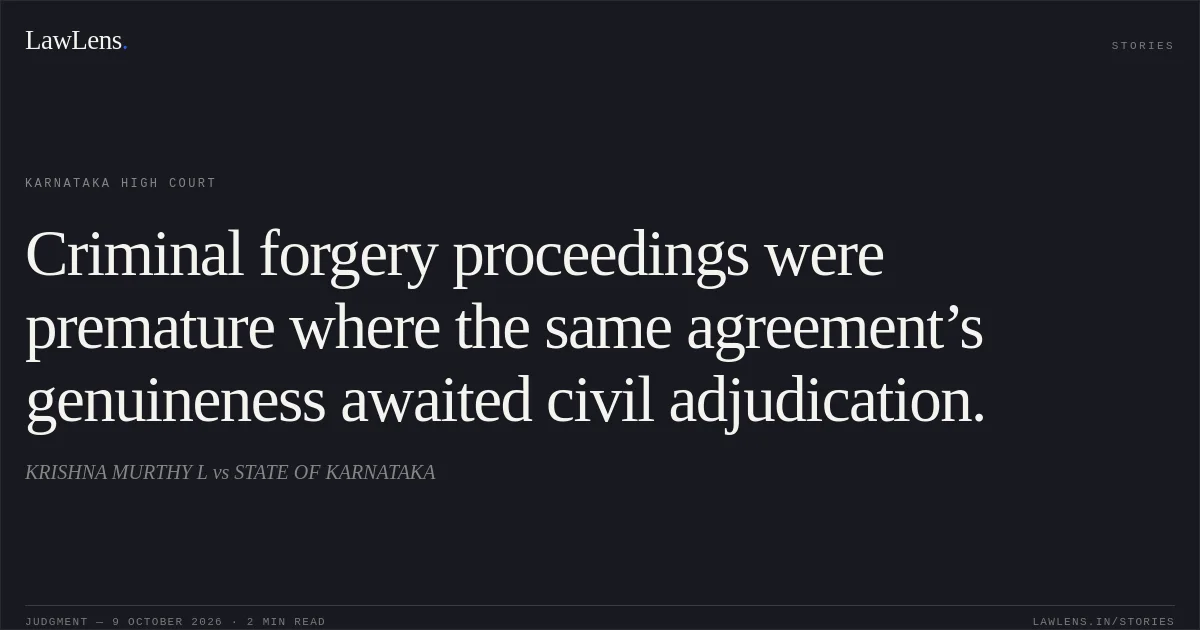
The Court treated the agreement as the foundational document in both proceedings: the petitioners relied on it in the specific-performance suit, while respondent No. 2 alleged it was forged.
Source reference: para. 10–11Although parallel civil and criminal remedies are not categorically barred, the Court considered criminal proceedings premature on these particular facts because the pending civil suit would determine whether the agreement had been executed by respondent No. 2.
Source reference: para. 12–14, 17The Court did not decide whether the agreement was genuine or forged, and found it unnecessary to separately determine the affidavit and reference-order objections.
Source reference: para. 17–19It rejected the IPC-repeal contention because Section 358 BNS saved proceedings concerning alleged offences committed while the IPC was in force.
Source reference: para. 15Holding
The Karnataka High Court allowed the petition and quashed the proceedings arising from PCR No. 375 of 2024 and Crime No. 507 of 2024 insofar as the petitioners were concerned.
The order expressed no view on the agreement’s genuineness or on the merits of the civil suit; the civil court was directed to decide independently.
Source reference: para. 19, 21(iv)If that court finds the agreement forged or fabricated, respondent No. 2 may pursue remedies available in law.
Source reference: para. 20, 21(iii)Acts & Sections Cited
12 provisions across 4 statutes referred to in this judgment. Each provision opens on LawLens.
Code of Criminal Procedure, 19733
Bharatiya Nagarik Suraksha Sanhita, 20231
Indian Penal Code, 18607
Bharatiya Nyaya Sanhita, 20231
Original Court PDF
KRISHNA MURTHY LvsSTATE OF KARNATAKA
Click to open original judgment
Original judgment, available to read, download and summarize on LawLens.in