Facts
The petitioner’s history sheet was originally opened in 1986 following six criminal cases. In 2005, as these matters were compromised or resulted in acquittal, the history sheet was moved to the "silent bag"
Source reference: p. 1-2On 24.04.2014, the Superintendent of Police, Sirohi, ordered the reopening of the history sheet and placed the petitioner under active surveillance following two new FIRs (Nos. 101/2012 and 103/2012) involving charges of attempted murder and communal rioting
Source reference: p. 2Though the petitioner was subsequently acquitted in FIR No. 101/2012 and discharged in FIR No. 103/2012 by 2019/2025, the history sheet remained active, leading to recurring preventive summons. The petitioner challenged the 2014 reopening order in this 2026 writ petition, claiming reformation and social welfare involvement
Source reference: p. 2-3Issues
1. Whether the definition of "habitual offender" under the Rajasthan Habitual Offenders Act, 1953 (requiring three convictions) applies to the opening of a history sheet under the Rajasthan Police Rules, 1965
Source reference: p. 52. Whether the reopening of the petitioner’s history sheet in 2014 was legally sustainable despite the absence of convictions
Source reference: p. 9-103. Whether the petitioner is entitled to the closure or transfer of his history sheet to the personal file due to the passage of time and subsequent acquittals
Source reference: p. 10Law Applied
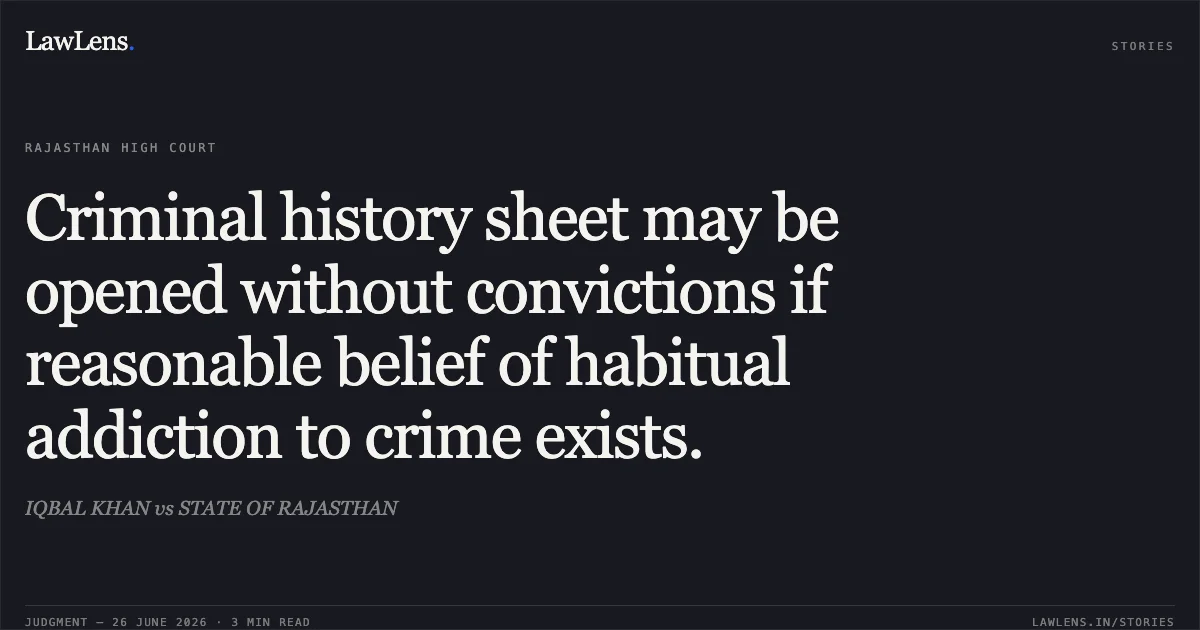
Rule 4.4(3)(b) and Rule 4.9(2) of the Rajasthan Police Rules, 1965, allow opening a history sheet for persons "reasonably believed to be habitually addicted to crime" regardless of whether they have been convicted
Source reference: p. 5, 7Supreme Court precedents in Dhanji Ram Sharma v. Superintendent of Police [AIR 1966 SC 1766] and Malak Singh v. State of P & H [AIR 1981 SC 760] establish that "reasonable belief" of a police officer based on reasonable grounds is sufficient to justify surveillance
Source reference: p. 6, 8Laxmi Narayan Meena v. State of Rajasthan clarifies that the restrictive definition of "habitual offender" in the Act of 1953 (requiring three convictions) does not apply to the Rules of 1965
Source reference: p. 5-6Procedural safeguards for closure are governed by Rules 4.12 and 4.13 of the 1965 Rules and the uniform criteria for sustenance of history sheets laid down in Sanjay v. State of Rajasthan
Source reference: p. 10-11Reasoning
The Court reasoned that the 2014 order to reopen the history sheet was valid at the time because the petitioner, previously a suspect, became involved in fresh criminal activities (communal riots and serious offences under the IPC) in 2012
Source reference: p. 10The Court rejected the petitioner's argument that three convictions were mandatory, noting that Rule 4.4(3)(b) explicitly includes those "whether they have been convicted or not". The "reasonable belief" formed by the SP in 2014 was deemed justified to prevent further offences
Source reference: p. 10As of 2026, the petitioner had been acquitted or discharged in the 2012 cases and no further criminal involvement was reported. Under Rule 4.12, a history sheet should be transferred to a personal file if a person is no longer addicted to crime, and under Rule 4.13, files may be destroyed after seven years of good behavior. The case met the "10-year rule" established in Sanjay v. State, where entries 10 years old without subsequent convictions merit reconsideration
Source reference: p. 11Holding
The Court declined to quash the 2014 impugned order, holding that it was legally justified when passed
The writ petition was disposed of with a direction to the Superintendent of Police, Sirohi, to consider the petitioner’s case in light of Rules 4.12 and 4.13 and the criteria in Sanjay v. State, and to pass appropriate orders regarding the closure or continuance of the history sheet
Source reference: p. 11Acts & Sections Cited
18 provisions across 6 statutes referred to in this judgment. Each provision opens on LawLens.
Indian Penal Code, 1860
Scheduled Castes and the Scheduled Tribes (Prevention of Atrocities) Act, 19891
Prevention of Damage to Public Property Act, 19841
Code of Criminal Procedure, 19733
Bharatiya Nagarik Suraksha Sanhita, 20232
Police Act, 18611
Original Court PDF
IQBAL KHANvsSTATE OF RAJASTHAN
Click to open original judgment
Original judgment, available to read, download and summarize on LawLens.in


