Facts
The respondent filed a criminal complaint under Section 138 of the Negotiable Instruments Act, 1881, against the petitioner and her son.
Source reference: para. 2The respondent alleged that after paying Rs. 10,00,000 as an advance for a property purchase, the petitioner declined the sale.
Source reference: para. 2Consequently, the petitioner’s son issued a cheque for the refund, which was returned unpaid due to "insufficient funds".
Source reference: para. 2Despite a legal notice, the amount remained unpaid, leading the Trial Court to issue a summoning order dated 15.12.2021 against both the son and the petitioner.
Source reference: para. 2The petitioner moved the High Court under Section 482 of the CrPC to quash the proceedings, contending she was neither a signatory to the cheque nor the owner of the bank account from which it was drawn.
Source reference: para. 1, 3Issues
1. Whether a person who is neither the signatory of the cheque nor the holder of the bank account from which the cheque is issued can be held criminally liable under Section 138 of the NI Act.
Source reference: para. 6, 7Law Applied
Section 138 of the Negotiable Instruments Act, 1881, which mandates that a cheque must be drawn by a person on an account maintained by them for the discharge of a debt.
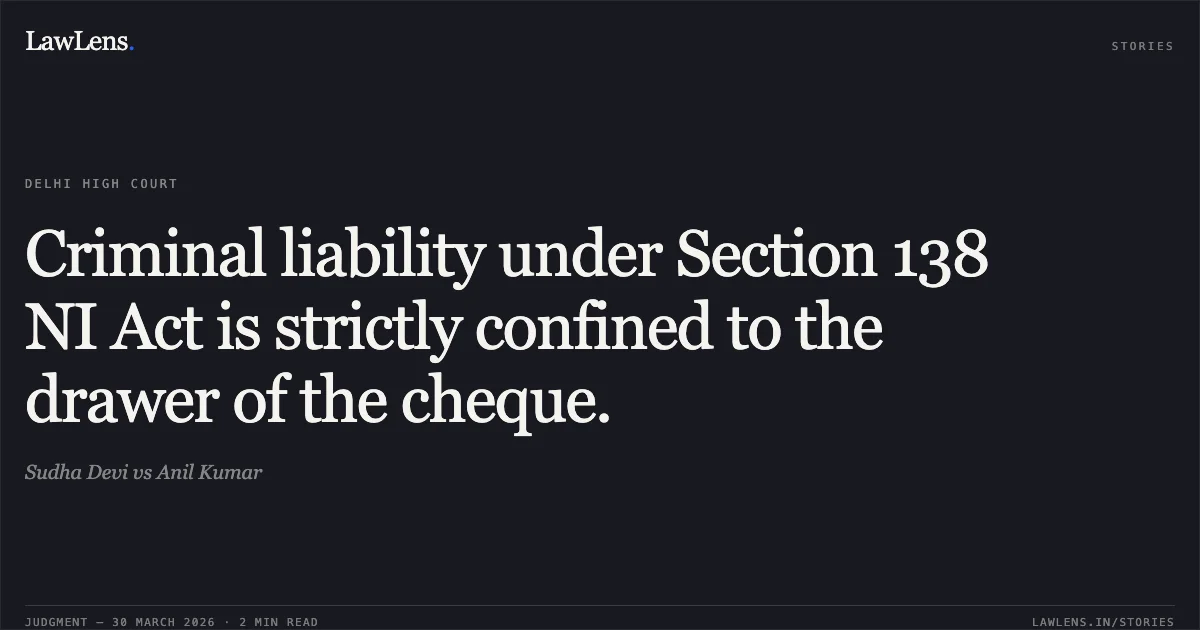
Source reference: para. 6Alka Khandu Avhad v. Amar Syamprasad Mishra (2021) 4 SCC 675, which established that criminal liability under Section 138 is strictly confined to the "drawer" of the cheque; even in cases of joint liability, a person cannot be prosecuted unless they are a signatory and the account is maintained by them.
Source reference: para. 8Reasoning
The Court observed that the essential ingredients of Section 138 were not satisfied regarding the petitioner.
Source reference: para. 6It noted that the respondent’s own case admitted the cheque was issued by the petitioner's son from his individual account to discharge the liability.
Source reference: para. 7The petitioner was neither a signatory nor a joint account holder.
Source reference: para. 7The Court reasoned that criminal liability is personal and strictly restricted to the drawer of the instrument.
Source reference: para. 7Applying the ratio from Alka Khandu Avhad, the Court determined that the Trial Court acted in a mechanical manner by summoning the petitioner, as she had no legal role in the issuance or dishonor of the cheque.
Source reference: para. 3, 8Holding
The Court held that a non-signatory who does not maintain the account in question cannot be prosecuted under Section 138 of the NI Act, regardless of any underlying joint financial liability.
The High Court allowed the petition and quashed the criminal complaint (CC NI Act No. 26009/2021) and the summoning order dated 15.12.2021 insofar as they pertained to the petitioner.
Source reference: para. 9All subsequent proceedings emanating from the complaint against the petitioner were set aside.
Source reference: para. 9, 10Acts & Sections Cited
2 provisions across 2 statutes referred to in this judgment. Each provision opens on LawLens.
Code of Criminal Procedure, 19731
Negotiable Instruments Act, 18811
Original Court PDF
Sudha DevivsAnil Kumar
Click to open original judgment
Original judgment, available to read, download and summarize on LawLens.in


![Subsequent exoneration does not retrospectively invalidate a finalized promotion select list.. UNNIKRISHNAN M vs M/o Environment And Forests. CAT - ['Ernakulam']. LawLens](/stories/thumbnails/subsequent-exoneration-does-not-retrospectively-invalidate-a-finalized-promotion-select-li-ce80a0e84f2f4887857271e8b4341c42.webp)