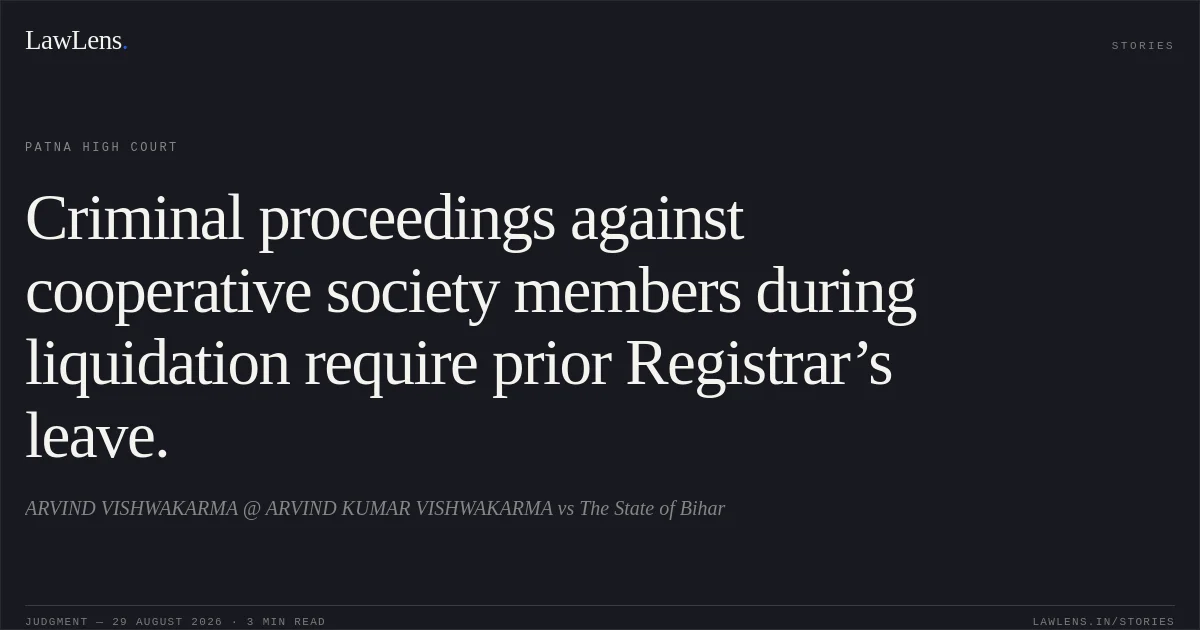
Facts
The petitioner, Branch Manager of the Central Bank of India, sought quashing of Saharsa P.S. Case No. 49 of 2008, arising from Complaint Case No. 414 of 2007 and registered under Sections 420, 406, 409 and 120-B of the Indian Penal Code pursuant to an order under Section 156(3) Cr.P.C.
Source reference: para. 2The prosecution alleged that the petitioner and other accused, acting in connivance, had embezzled ₹34,400 plus interest deposited by the informant between 19 February 2005 and 31 January 2006 with the Central Bank Employees Saving and Credit Self-Supported Co-operative Society Ltd., Saharsa.
Source reference: para. 3The petitioner argued that the Society was in liquidation and that the prosecution was barred under the Bihar Self-Supporting Co-operative Society Act, 1996 because leave of the Registrar had not been obtained.
Source reference: para. 4He further submitted that the informant had received payment from the liquidator and had acknowledged such settlement in the tasfiyanama.
Source reference: para. 5The informant did not dispute the payment or settlement and stated that he did not wish to pursue the case.
Source reference: para. 6By the time of consideration, the matter had progressed from registration of the FIR to cognizance.
Source reference: para. 7Issues
Whether the FIR and ensuing criminal proceedings were legally maintainable in view of the statutory bar under the Bihar Self-Supporting Co-operative Society Act, 1996, where the Society was in liquidation and prior leave of the Registrar had not been obtained.
Source reference: para. 4Whether, in light of the repayment and settlement between the petitioner and the informant, the High Court should exercise its inherent jurisdiction under Section 482 Cr.P.C. to quash the criminal proceedings involving allegations under Sections 420, 406, 409 and 120-B IPC.
Source reference: paras. 5–7Law Applied
The Court considered Sections 45, 50(2) and 52(2) of the Bihar Self-Supporting Co-operative Society Act, 1996, particularly the principle that, during liquidation, legal proceedings against the liquidator or a member of the Society cannot be instituted or continued without the leave of the Registrar.
Source reference: para. 4It exercised its inherent jurisdiction under Section 482 Cr.P.C. to prevent continuation of proceedings that were legally untenable or amounted to an abuse of process.
Source reference: para. 7The Court applied category (6) of State of Haryana v. Bhajan Lal, 1992 Supp (1) SCC 335, concerning proceedings barred by law or where continuation would be unjustified.
Source reference: para. 7It also relied on Parbatbhai Aahir @ Parbatbhai Bhimsinbhai Karmur v. State of Gujarat, (2017) 9 SCC 641, which recognises that criminal proceedings arising from predominantly private disputes may be quashed after settlement, provided the offences are not heinous or against public interest.
Source reference: para. 7Reasoning
The Court accepted the petitioner’s contention that the prosecution was not maintainable because the Co-operative Society was in liquidation and the requisite leave of the Registrar had not been obtained, bringing the case within the relevant statutory bar and category (6) of Bhajan Lal.
Source reference: paras. 4, 7Independently, the informant had received the alleged dues from the liquidator, acknowledged the payment, and expressly stated that he did not wish to continue the proceedings.
Source reference: paras. 5–6Since the dispute was essentially private in character and the alleged offences, in the circumstances presented, did not require continuation in the public interest, the Court held that the settlement further justified exercise of its inherent jurisdiction under Section 482 Cr.P.C., consistent with Parbatbhai Aahir.
Source reference: para. 7Holding
The High Court held that the FIR was legally unsustainable in view of the statutory bar applicable to proceedings concerning the Society in liquidation and that the subsequent settlement and repayment provided an additional justification for quashing the case.
Accordingly, Saharsa P.S. Case No. 49 of 2008, arising out of Complaint Case No. 414 of 2007, together with all subsequent proceedings, including those arising after cognizance, was quashed.
Source reference: para. 8–9The criminal miscellaneous application was allowed.
Source reference: para. 8–9Acts & Sections Cited
5 provisions across 2 statutes referred to in this judgment. Each provision opens on LawLens.
Code of Criminal Procedure, 19732
Indian Penal Code, 18603
Original Court PDF
ARVIND VISHWAKARMA @ ARVIND KUMAR VISHWAKARMAvsThe State of Bihar
Click to open original judgment
Original judgment, available to read, download and summarize on LawLens.in
![A police constable cannot be removed for unauthorized absence without a Rule 359-compliant inquiry.. Mohammad Sidiq Khan vs D/o Home Ut Of Jammu & Kashmir. CAT - ['Srinagar']. LawLens](/stories/thumbnails/a-police-constable-cannot-be-removed-for-unauthorized-absence-without-a-rule-359-compliant-7b43fc316bd94f22a62676153bbc9d54.webp)
![A Review DPC lacks authority to determine or alter inter se seniority.. SAURABH KUMAR vs REVENUE. CAT - ['Patna']. LawLens](/stories/thumbnails/a-review-dpc-lacks-authority-to-determine-or-alter-inter-se-seniority-4b21640f20af46fcabdfc8273d2ce959.webp)