Facts
The informant alleged that she married Rakesh Singh on 28 November 2012 and that substantial cash, jewellery, and household articles were given as dowry.
Source reference: p. 2, para. 2She alleged that, after being taken to Navi Mumbai, her husband and his relatives—petitioners 1 to 4—demanded a Honda City car and ₹10 lakh, subjected her to cruelty, confined her, and retained her jewellery.
Source reference: p. 2, para. 2She ultimately returned to her parental home on 11 April 2017.
Source reference: pp. 2–3, para. 4On her complaint, Chapra Mufassil P.S. Case No. 144 of 2017 was registered under Sections 498-A, 504, 506, 406 and 34 IPC and Sections 3/4 of the Dowry Prohibition Act.
Source reference: pp. 2–3, para. 4The petitioners sought quashing of the cognizance order dated 19 December 2017.
Source reference: p. 2, para. 3The prayer concerning petitioner 5, Rakesh Singh, the husband, had earlier been withdrawn.
Source reference: p. 2, para. 3The remaining petitioners contended that they were the married sister-in-law, brother-in-law, father-in-law and mother-in-law of the informant, and that the allegations against them were general and omnibus.
Source reference: p. 3, para. 5Issues
1. Whether the cognizance order dated 19 December 2017 and the consequential prosecution against petitioners 1 to 4 were liable to be quashed because the allegations primarily concerned acts allegedly committed in Mumbai, outside the territorial jurisdiction of the Chapra court, having regard to Sections 177–179 CrPC?
Source reference: p. 3, para. 5; p. 7, para. 82. Whether continuation of the prosecution against the husband’s relatives was an abuse of the process of law where the allegations were general and omnibus and did not attribute specific individual acts to petitioners 1 to 4?
Source reference: pp. 3–6, paras. 5–5.4; p. 7, para. 83. Whether the Magistrate had applied the requisite judicial mind before taking cognizance and issuing process against each petitioner?
Source reference: pp. 5–6, paras. 5.2–5.4Law Applied
The Court considered the offences alleged under Sections 498-A, 504, 506, 406 and 34 IPC and Sections 3/4 of the Dowry Prohibition Act.
Source reference: p. 2, para. 2It applied Sections 177, 178 and 179 CrPC, which govern territorial jurisdiction over criminal offences and permit inquiry or trial at the place where the offence was committed, where part of the offence occurred, or where the consequence ensued.
Source reference: p. 3, para. 5Relying on Dara Lakshmi Narayana v. State of Telangana, (2025) 3 SCC 735, Preeti Gupta v. State of Jharkhand, (2010) 7 SCC 667, Achin Gupta v. State of Haryana, [2024] 6 SCR 129, and K. Subba Rao v. State of Telangana, (2018) 14 SCC 452, the Court reaffirmed that distant relatives should not be subjected to criminal prosecution on vague and omnibus allegations arising from matrimonial discord.
Source reference: pp. 4–6, paras. 5.1–5.3Under Pepsi Foods Ltd. v. Special Judicial Magistrate, (1998) 5 SCC 749, issuance of process is a serious judicial act requiring application of mind to the allegations and materials against each accused.
Source reference: pp. 4–6, paras. 5.1–5.3The Court also relied on Ramesh Kumar v. State of Chhattisgarh, (2001) 9 SCC 618, for the principle that criminal liability is individual and cannot rest on collective naming without attribution of specific conduct.
Source reference: p. 6, para. 5.4Reasoning
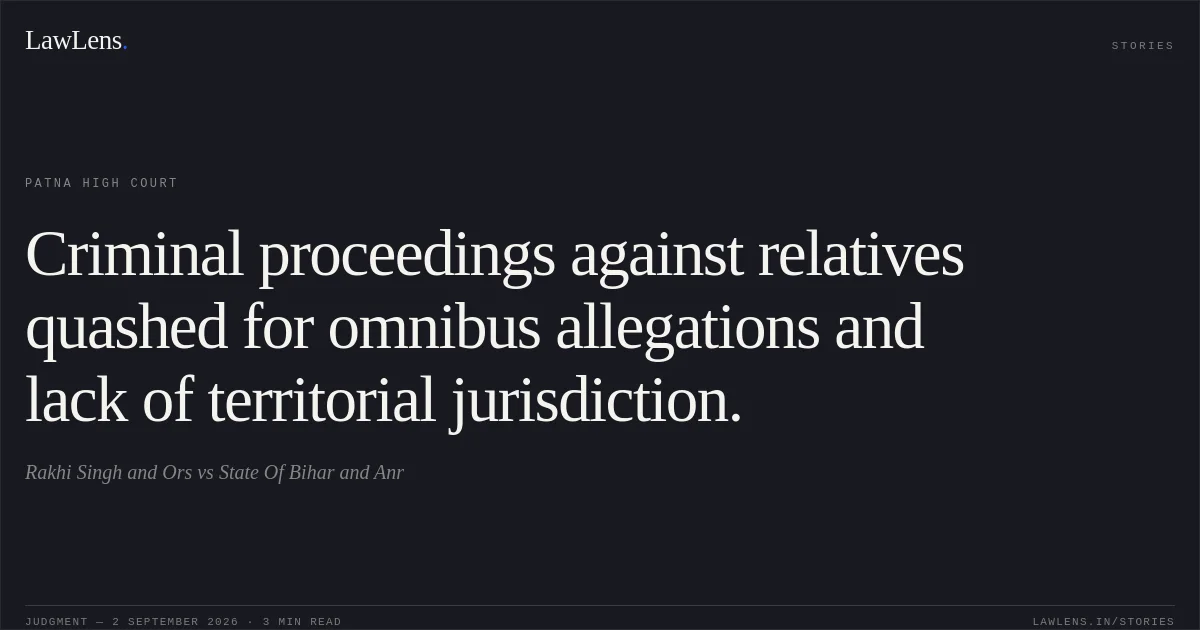
The Court found that the principal allegations of dowry-related cruelty and confinement concerned events allegedly occurring in Navi Mumbai, while the material connecting the Chapra jurisdiction was limited and insufficient to sustain prosecution against petitioners 1 to 4.
Source reference: pp. 3–4, para. 5; p. 7, para. 8It further held that the allegations against the married sister-in-law, brother-in-law, father-in-law and mother-in-law were general and omnibus, without sufficiently specific acts establishing their individual criminal liability.
Source reference: pp. 4–6, paras. 5.1–5.4Applying the principles against indiscriminate implication of the husband’s relatives in matrimonial disputes, and the requirement that the Magistrate independently assess the role of each accused before issuing process, the Court concluded that continuation of the prosecution against petitioners 1 to 4 would amount to abuse of the process of court.
Source reference: pp. 4–6, paras. 5.1–5.4; p. 7, para. 8The Court did not extend this relief to Rakesh Singh, whose prosecution remained unaffected by the order.
Source reference: p. 7, para. 8Holding
The Court answered the jurisdictional and abuse-of-process issues in favour of petitioners 1 to 4.
It quashed the cognizance order dated 19 December 2017 in Chapra Mufassil P.S. Case No. 144 of 2017 insofar as it concerned petitioners 1 to 4, on the grounds of lack of jurisdiction and the general and omnibus nature of the allegations.
Source reference: p. 7, para. 8Proceedings against co-accused Rakesh Singh were permitted to continue.
Source reference: p. 7, para. 8The application was accordingly allowed.
Source reference: p. 7, para. 10Acts & Sections Cited
9 provisions across 3 statutes referred to in this judgment. Each provision opens on LawLens.
Indian Penal Code, 18604
Code of Criminal Procedure, 19733
Original Court PDF
Rakhi Singh and OrsvsState Of Bihar and Anr
Click to open original judgment
Original judgment, available to read, download and summarize on LawLens.in