Facts
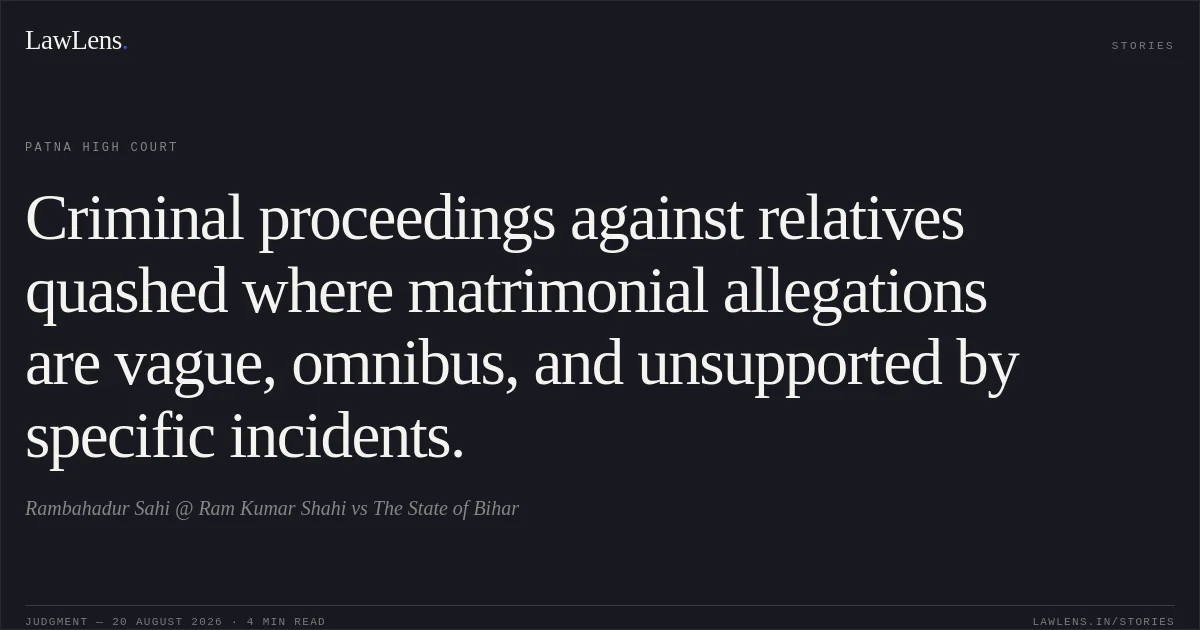
Opposite Party No. 2 lodged Mahila P.S. Case No. 86 of 2022 alleging dowry-related cruelty and other offences against her husband and his family members, including the present petitioners—her father-in-law, mother-in-law, brother-in-law, sister-in-law, and the sister-in-law’s husband.
Source reference: para. 2–3The petitioners contended that the allegations against them were general and omnibus, that the principal matrimonial dispute was with the husband, and that the FIR was lodged approximately one year after the alleged ouster from the matrimonial home and two months after the husband instituted divorce proceedings on 9 May 2022.
Source reference: para. 4–6, 17The FIR was lodged on 6 July 2022.
Source reference: para. 17The Judicial Magistrate, First Class, Patna, took cognizance on 22 November 2023 under Sections 498A, 323, 379, 307, 504 and 506/34 of the IPC; the judgment also refers to cognizance under Sections 3/4 of the Dowry Prohibition Act.
Source reference: para. 2, 12The petitioners sought quashing of the cognizance order and the criminal proceedings against them.
Source reference: no citationIssues
Whether the criminal proceedings and order taking cognizance against the petitioners were liable to be quashed under Section 482 CrPC because the allegations against the relatives of the husband were general, vague, and omnibus, without specific dates or instances of criminal conduct?
Source reference: para. 9, 13–18Whether the allegations disclosed a prima facie case under Sections 307, 379, 323, 504, 506/34 IPC and Sections 3/4 of the Dowry Prohibition Act against the petitioners?
Source reference: para. 11–12Whether the timing of the FIR, following the institution of the husband’s divorce proceeding, indicated mala fide prosecution and abuse of the process of law?
Source reference: para. 17Law Applied
The Court exercised its inherent jurisdiction under Section 482 of the Code of Criminal Procedure to prevent abuse of the process of court and secure the ends of justice, consistent with the categories recognised in State of Haryana v. Bhajan Lal, 1992 Supp (1) SCC 335.
Source reference: para. 16It relied on Preeti Gupta v. State of Jharkhand, (2010) 7 SCC 667, and Kahkashan Kausar v. State of Bihar, (2022) 6 SCC 599, for the principle that relatives of the husband should not be prosecuted under Section 498A IPC on the basis of vague and omnibus allegations arising from a matrimonial dispute.
Source reference: para. 14The Court also referred to Dara Lakshmi Narayana v. State of Telangana, (2025) 3 SCC 735, supporting a cautious and liberal approach where domestic relatives are implicated without specific allegations.
Source reference: para. 15Salib v. State of Uttar Pradesh, (2023) 20 SCC 194, holding that the Court may examine attending circumstances, including possible vengeance, while considering a petition for quashing.
Source reference: para. 16Although the Court acknowledged that it ordinarily should not conduct a mini-trial or assess the truth of allegations at the quashing stage, it held that proceedings may be quashed where the allegations, even if accepted on their face, do not prima facie constitute the alleged offences or continuation of the prosecution would be oppressive.
Source reference: para. 8, 13Reasoning
The Court found that the gravamen of the allegations was directed against the husband, while the allegations against the petitioners—who included a married sister-in-law and her husband—were largely ornamental, general, and sweeping, with no specific dates or incidents.
Source reference: para. 9, 11The alleged attempt to kill the informant by the father-in-law and brother-in-law was unsupported by any date, particulars, or injury, and therefore did not prima facie substantiate Section 307 IPC.
Source reference: para. 11The allegations also did not disclose any injury or concrete facts supporting Sections 323, 379, 504 or 506/34 IPC, and the Magistrate’s order appeared to have mechanically adopted the offences mentioned in the FIR and charge-sheet without independent judicial application of mind.
Source reference: para. 12The Court further treated the approximately one-year delay after the alleged ouster and the lodging of the FIR shortly after the husband’s divorce petition as circumstances indicating mala fide implication of the husband’s family.
Source reference: para. 5, 17Applying the Supreme Court’s caution against over-implication of relatives in matrimonial prosecutions, the Court held that continuation of the proceedings against these petitioners would amount to abuse of the process of court.
Source reference: para. 14–18Holding
The Court held that the allegations against the petitioners did not, prima facie, establish the offences alleged and that their implication was a general and sweeping over-implication arising from the matrimonial discord between the informant and her husband.
The order dated 22 November 2023 taking cognizance in Mahila P.S. Case No. 86 of 2022 was quashed insofar as it related to the present petitioners.
Source reference: para. 19The application under Section 482 CrPC was accordingly allowed.
Source reference: para. 20Acts & Sections Cited
9 provisions across 3 statutes referred to in this judgment. Each provision opens on LawLens.
Indian Penal Code, 18606
Code of Criminal Procedure, 19731
Original Court PDF
Rambahadur Sahi @ Ram Kumar ShahivsThe State of Bihar
Click to open original judgment
Original judgment, available to read, download and summarize on LawLens.in