Facts
The complainant alleged that, in 2021, he advanced approximately ₹60 lakh to Tapan Kumar Acharya, the petitioner’s deceased husband, after representations that the amount would be repaid with compensation and that a Salt Lake flat would be offered as security.
Source reference: para. 5–12He alleged that the petitioner was involved in those representations and later assured repayment from the proceeds of the property’s sale.
Source reference: para. 5–12After learning that the property had been sold, the complainant initiated proceedings under Section 156(3) CrPC, resulting in an FIR under Sections 420, 406, 467, 468, 471 and 120B IPC.
Source reference: para. 5–12The petitioner sought quashing, contending that she had no role in her husband’s business or the alleged transactions.
Source reference: para. 13–15The case diary referred to bank-account transactions involving the deceased’s business and accounts in the petitioner’s name.
Source reference: para. 13–15The petitioner applied to quash the proceedings pending before the Chief Judicial Magistrate, Calcutta.
Source reference: para. 1Issues
1. Whether the complaint and materials collected during investigation disclosed the ingredients of the alleged offences against the petitioner.
Source reference: para. 16, 23–242. Whether the proceedings were essentially civil in nature and should be quashed under the High Court’s inherent jurisdiction to prevent abuse of process.
Source reference: para. 19–24Law Applied
The Court considered the alleged offences under Sections 420, 406, 467, 468, 471 and 120B IPC, and the High Court’s inherent power under Section 482 CrPC to prevent abuse of process and secure the ends of justice.
Source reference: para. 1, 20–21Relying on State of Haryana v. Bhajan Lal, it noted that proceedings may be quashed where the allegations, taken at face value, do not disclose an offence, while disputed facts ordinarily remain for trial.
Source reference: para. 21Paramjeet Batra v. State of Uttarakhand, Indian Oil Corporation v. NEPC India Ltd., and the other authorities cited in the judgment establish that a civil or contractual dispute should not be given a criminal colour where the necessary criminal ingredients are absent, but that the availability of a civil remedy alone does not justify quashing.
Source reference: para. 20–21For cheating, Vesa Holdings (P) Ltd. v. State of Kerala and Shailesh Kumar Singh v. State of Uttar Pradesh require material indicating dishonest or fraudulent intent at the inception; Delhi Race Club (1940) Ltd. v. State of Uttar Pradesh addresses the distinct ingredients of cheating and criminal breach of trust.
Source reference: para. 20–22Reasoning
The Court considered the complaint, the case diary and the circumstances of the alleged advance.
Source reference: para. 17, 19It noted that the complaint disclosed no written agreement, receipt or memorandum explaining the basis on which the money was advanced, and that the circumstances indicated a connection with the proposed transfer of the Salt Lake property.
Source reference: para. 17, 19The bank transactions identified in the investigation related to the deceased’s business and did not establish that the petitioner had dishonestly obtained the complainant’s money; the Court also found no prima facie illegality in the transfer to her of funds standing in the relevant account after her husband’s death.
Source reference: para. 13–15, 18–19On the material before it, the Court found no prima facie criminal intent or ingredients of the alleged offences against the petitioner and treated the dispute as essentially civil.
Source reference: para. 23–24Holding
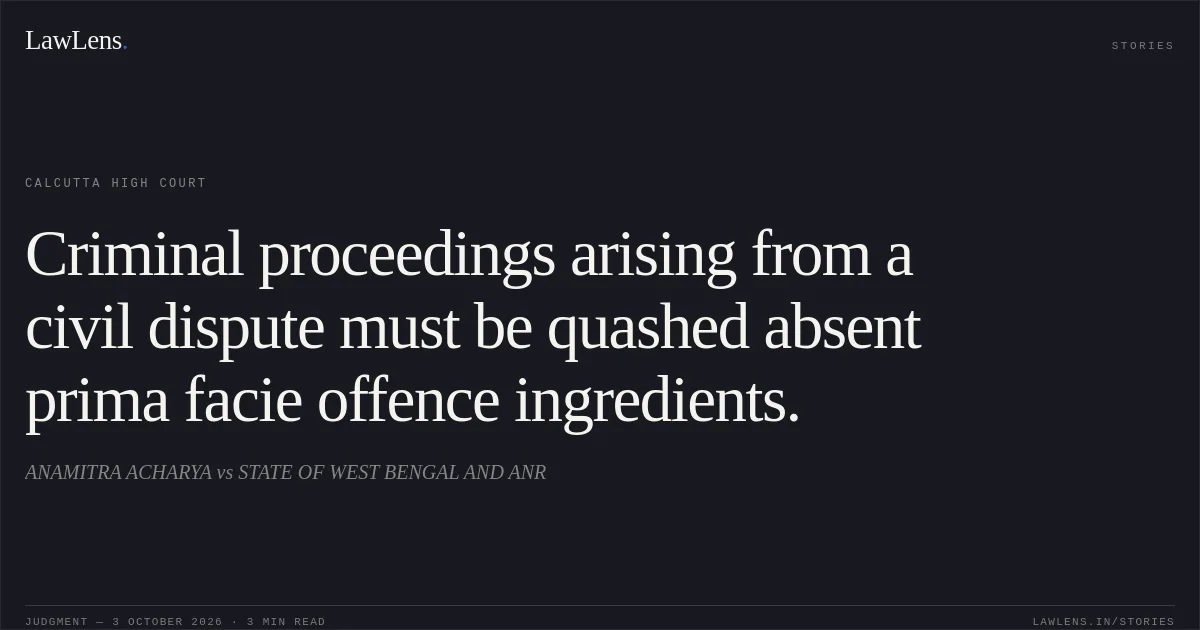
The Court held that the materials did not prima facie disclose the alleged offences against the petitioner and that continuation of the prosecution would amount to an abuse of process.
It allowed the revision and quashed the proceedings in G.R. (S) No. 230 of 2024, arising from Hare Street Police Station Case No. 70 of 2024, in respect of Anamitra Acharya.
Source reference: para. 25–26Acts & Sections Cited
10 provisions across 2 statutes referred to in this judgment. Each provision opens on LawLens.
Indian Penal Code, 18607
Code of Criminal Procedure, 19733
Original Court PDF
ANAMITRA ACHARYAvsSTATE OF WEST BENGAL AND ANR
Click to open original judgment
Original judgment, available to read, download and summarize on LawLens.in