Facts
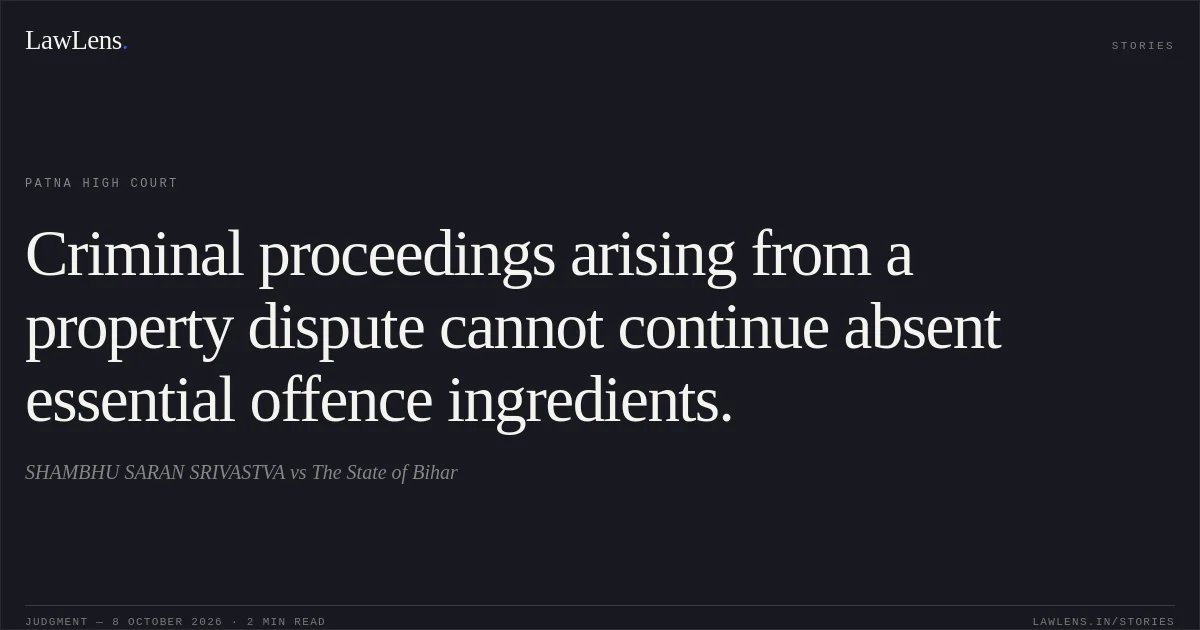
Opposite Party No. 2 filed a complaint alleging, among other things, that the petitioners had abused and threatened him in the course of a family dispute concerning partition of ancestral property and the institution of Title Suit No. 727 of 2017. The complaint also alleged that the suit had been filed using forged signatures; however, the Magistrate took cognizance only under Sections 504 and 506 read with Section 34 of the IPC.
Source reference: p. 2–4, paras. 4–7The petitioners sought quashing of the cognizance order and consequential proceedings. Petitioner No. 1 died during the proceedings, leaving the petition to continue for petitioners Nos. 2–4.
Source reference: p. 1, paras. 2–3Issues
1. Whether the complaint, taken at face value, disclosed the essential ingredients of offences under Sections 504 and 506 read with Section 34 of the IPC against petitioners Nos. 2–4
Source reference: pp. 5–6, paras. 10–122. Whether continuation of the criminal proceedings, arising from the parties’ ancestral-property dispute and related partition suit, would amount to an abuse of the process of the court
Source reference: pp. 4–6, paras. 8–13Law Applied
The Court considered Sections 504 and 506 read with Section 34 of the IPC, under which criminal liability requires allegations disclosing the essential ingredients of the respective offences.
Source reference: pp. 5–6, paras. 10–12It applied the High Court’s inherent jurisdiction under Section 482 of the CrPC to prevent abuse of the process of the court.
Source reference: p. 4, para. 9Relying on Rikhab Birani & Anr. v. State of Uttar Pradesh & Anr., 2025 SCC OnLine SC 823, the Court reiterated that criminal proceedings should not be used to give a criminal colour to a dispute that is essentially civil in nature, particularly where the alleged offences’ ingredients are not made out.
Source reference: p. 4, para. 9Reasoning
The Court found that the complaint’s foundation was the dispute over ancestral property and the institution of the partition suit. The allegations of abuse and threats were made in that context and, in the Court’s view, lacked specific and convincing particulars establishing the essential ingredients of Sections 504 and 506 against the surviving petitioners.
Source reference: pp. 5–6, paras. 8–11Although the Court acknowledged that evidence is not to be minutely assessed at the cognizance stage, it held that proceedings may be quashed where the allegations, even taken at face value, do not disclose the alleged offences and their continuation would constitute an abuse of process.
Source reference: p. 6, para. 12Holding
The Court allowed the application and quashed the order dated 18 October 2018 taking cognizance under Sections 504 and 506 read with Section 34 of the IPC, together with all consequential proceedings, qua petitioners Nos. 2–4, in Complaint Case No. 1401 of 2017.
It directed that the trial-court record, if any, be returned with a copy of the judgment.
Source reference: p. 7, para. 15Acts & Sections Cited
8 provisions across 2 statutes referred to in this judgment. Each provision opens on LawLens.
Indian Penal Code, 18607
Code of Criminal Procedure, 19731
Original Court PDF
SHAMBHU SARAN SRIVASTVAvsThe State of Bihar
Click to open original judgment
Original judgment, available to read, download and summarize on LawLens.in