Facts
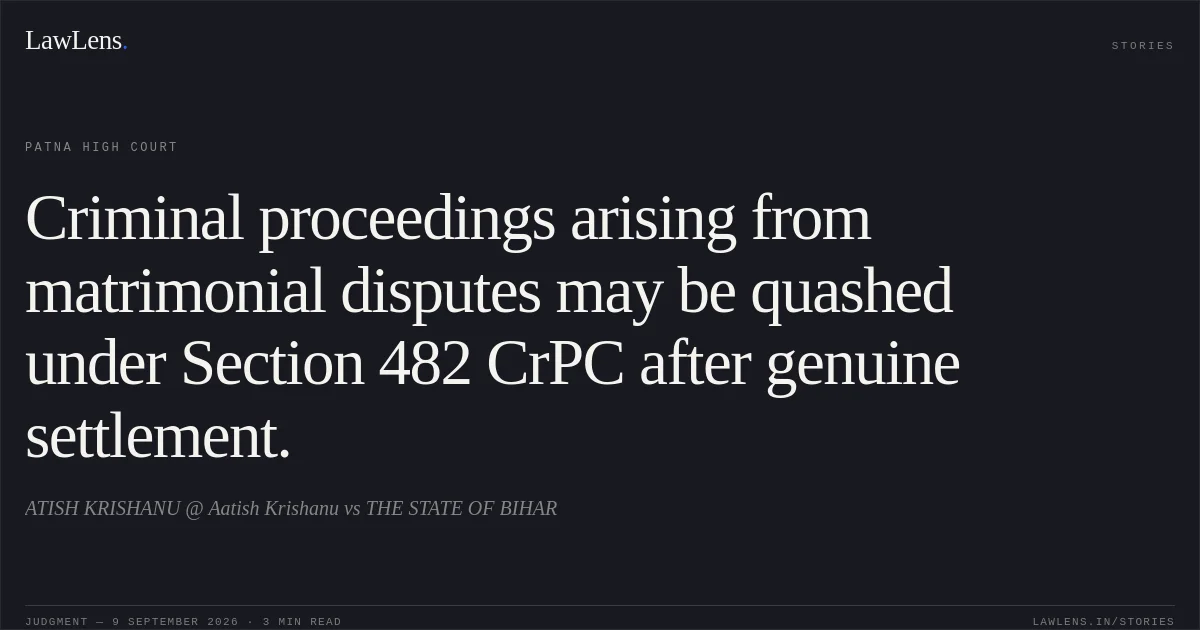
The petitioners—husband, father-in-law and mother-in-law of opposite party no. 2—challenged the order dated 18 December 2023 by which the learned Sub-Divisional Judicial Magistrate, Patna, took cognizance in Complaint Case No. 7148(C) of 2023 for offences under Section 498A of the Indian Penal Code and Section 4 of the Dowry Prohibition Act.
Source reference: para. 2, p. 1During the proceedings, the parties informed the Court that they had amicably resolved their matrimonial dispute and had initiated mutual-consent divorce proceedings under Section 13B of the Hindu Marriage Act.
Source reference: para. 3, p. 2Under the settlement deed dated 27 August 2026, petitioner no. 1 paid Rs. 7,50,000 to opposite party no. 2 towards permanent alimony by demand draft, and a receipt was obtained.
Source reference: paras. 4–5, p. 2The settlement further required the parties to cooperate in obtaining mutual-consent divorce, including waiver of the statutory cooling-off period, and to withdraw all pending proceedings, including the criminal and maintenance cases.
Source reference: para. 6, pp. 2–3Issues
Whether the High Court should exercise its inherent jurisdiction under Section 482 of the Code of Criminal Procedure to quash criminal proceedings under Section 498A IPC and Section 4 of the Dowry Prohibition Act after the parties have amicably settled their matrimonial dispute.
Source reference: paras. 8–10, pp. 3–4Whether, in view of the settlement, payment of permanent alimony and pending mutual-consent divorce proceedings, continuation of the criminal case would serve any legitimate purpose.
Source reference: paras. 4–8, pp. 2–3Law Applied
The Court applied Section 482 of the Code of Criminal Procedure, which preserves the High Court’s inherent power to prevent abuse of the process of court and secure the ends of justice.
Source reference: para. 8, p. 3Although offences under Section 498A IPC and Section 4 of the Dowry Prohibition Act are not ordinarily compoundable merely by consent, criminal proceedings arising out of a matrimonial dispute may be quashed where the parties have genuinely settled their differences and continuation of the proceedings would serve no useful purpose.
Source reference: para. 9, pp. 3–4The Court relied on Naushey Ali v. State of Uttar Pradesh, (2025) 4 SCC 78, and Mange Ram v. State of Madhya Pradesh, 2025 SCC OnLine SC 1681, for the principle that, particularly in matrimonial matters, criminal proceedings may be quashed following a valid compromise to give a peaceful quietus to the litigation.
Source reference: para. 9, pp. 3–4The Court also considered Section 13B of the Hindu Marriage Act concerning dissolution of marriage by mutual consent and waiver of the statutory cooling-off period.
Source reference: paras. 6–7, p. 3Reasoning
The Court found that the dispute arose from matrimonial discord and that the parties had voluntarily entered into a settlement covering permanent alimony, mutual-consent divorce and withdrawal of pending cases.
Source reference: paras. 3–7, pp. 2–3The payment of Rs. 7,50,000 by the husband to opposite party no. 2 demonstrated compliance with an important term of the settlement.
Source reference: paras. 4–5, p. 2Since the complainant’s counsel assured the Court of cooperation in the mutual-consent divorce proceedings, including the request for waiver of the cooling-off period, the Court concluded that continuing the criminal case would serve no legitimate purpose.
Source reference: para. 7, p. 3Applying its inherent jurisdiction under Section 482 CrPC and the Supreme Court’s approach to settled matrimonial disputes, the Court held that quashing was necessary to secure the ends of justice and bring the litigation to an end.
Source reference: para. 8, p. 3Holding
The High Court allowed the application and quashed the order dated 18 December 2023 taking cognizance, along with all proceedings arising from it, in Complaint Case No. 7148(C) of 2023.
The Court further observed that the Family Court, Patna, could consider waiver of the statutory cooling-off period in the mutual-consent divorce proceedings in the interests of justice.
Source reference: para. 12, p. 4Acts & Sections Cited
2 provisions across 2 statutes referred to in this judgment. Each provision opens on LawLens.
Dowry Prohibition Act, 19611
Code of Criminal Procedure, 19731
Original Court PDF
ATISH KRISHANU @ Aatish KrishanuvsTHE STATE OF BIHAR
Click to open original judgment
Original judgment, available to read, download and summarize on LawLens.in