Facts
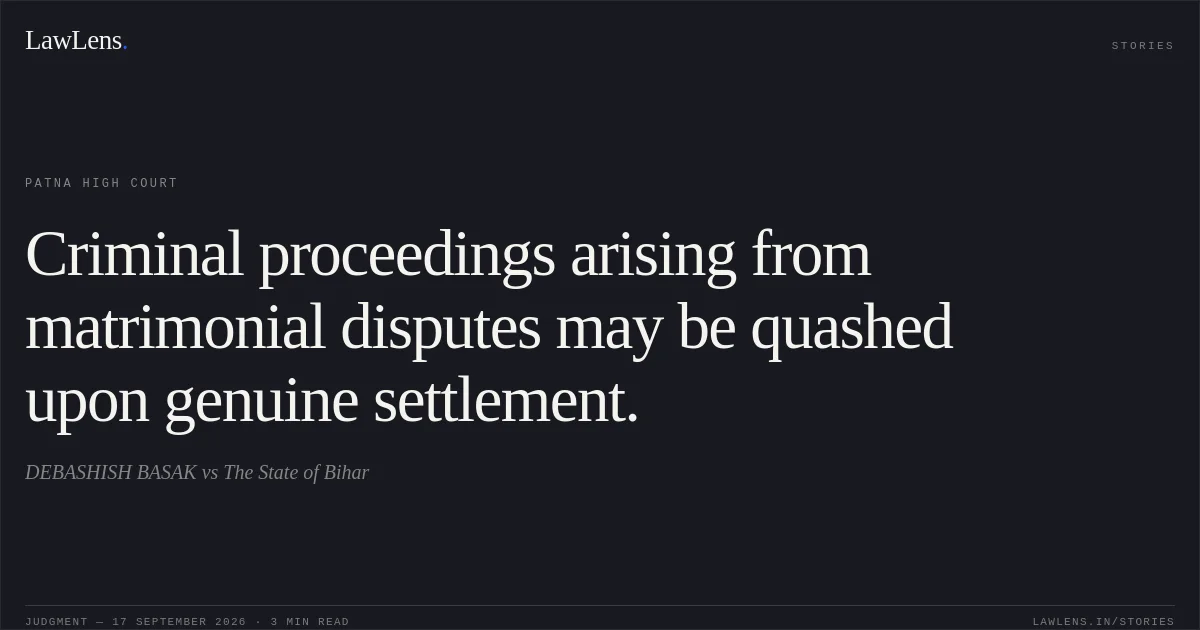
The petitioners—Petitioner No. 1 being the husband of Opposite Party No. 2 and Petitioners Nos. 2 and 3 being her father-in-law and mother-in-law—sought quashing of Mahila P.S. Case No. 86 of 2020, dated 11 August 2020, and the order taking cognizance for offences under Sections 498A, 506 and 34 of the Indian Penal Code and Sections 3/4 of the Dowry Prohibition Act.
Source reference: p. 2, para. 2During the proceedings, Petitioner No. 1 and Opposite Party No. 2 initiated divorce proceedings by mutual consent under Section 13B of the Hindu Marriage Act in Matrimonial Case No. 730 of 2022. They stated that they had settled their disputes and would not raise any future claims against each other.
Source reference: p. 2, para. 5; p. 3, para. 8A compromise petition was also filed, in which Opposite Party No. 2 expressed that she did not wish to pursue the criminal case.
Source reference: p. 3, para. 5; p. 4, para. 9Notice was served upon the mother of Opposite Party No. 2, and a jointness affidavit was filed treating such service as valid; however, Opposite Party No. 2 did not appear before the Court.
Source reference: p. 1, para. 1Issues
Whether the FIR and consequential criminal proceedings arising from allegations under Sections 498A, 506 and 34 IPC and Sections 3/4 of the Dowry Prohibition Act should be quashed in view of the parties’ settlement and mutual-consent divorce proceedings?
Source reference: p. 2, paras. 2–3; p. 5, para. 11Whether continuation of the criminal proceedings would serve any legitimate purpose after the matrimonial dispute had been amicably settled and the complainant had expressed unwillingness to pursue the case?
Source reference: p. 4, paras. 8–10; p. 5, para. 11Law Applied
The Court considered the offences alleged under Sections 498A, 506 and 34 of the Indian Penal Code and Sections 3/4 of the Dowry Prohibition Act.
Source reference: p. 2, para. 2Exercising its jurisdiction to quash criminal proceedings, the Court applied the principle that criminal proceedings arising out of matrimonial disputes may be quashed where the parties have genuinely compromised, particularly when continuation would serve no useful or legitimate purpose.
Source reference: p. 4, para. 10The Court relied on Naushey Ali & Ors. v. State of Uttar Pradesh & Anr., (2025) 4 SCC 78, and Mange Ram v. State of Madhya Pradesh & Anr., 2025 SCC OnLine 1681, for the principle that matrimonial criminal proceedings may be brought to an end following a bona fide compromise in order to give quietus to the dispute.
Source reference: p. 4, para. 10Reasoning
The Court examined the mutual-consent divorce proceedings, the statements of Petitioner No. 1 and Opposite Party No. 2, and the compromise petition. It found that both parties had voluntarily agreed to dissolve their marriage, refrain from interfering in each other’s lives, and abandon future claims.
Source reference: p. 3, para. 8Opposite Party No. 2 had specifically stated that she did not wish to pursue the criminal case.
Source reference: p. 4, para. 9In light of the settlement and the complainant’s non-appearance despite service, the Court held that continuation of the prosecution would unnecessarily consume judicial time and would not advance any legitimate purpose.
Source reference: p. 5, para. 11Applying the cited Supreme Court principles concerning settlement of matrimonial disputes, the Court concluded that quashing was warranted.
Source reference: p. 5, para. 11Holding
The Court allowed the application and quashed the impugned order taking cognizance and all criminal proceedings arising from Mahila P.S. Case No. 86 of 2020.
The relief was granted on the basis of the parties’ compromise, their mutual-consent divorce proceedings, and the complainant’s decision not to pursue the criminal case.
Source reference: p. 5, paras. 11–12Acts & Sections Cited
4 provisions across 2 statutes referred to in this judgment. Each provision opens on LawLens.
Indian Penal Code, 18602
Original Court PDF
DEBASHISH BASAKvsThe State of Bihar
Click to open original judgment
Original judgment, available to read, download and summarize on LawLens.in