Facts
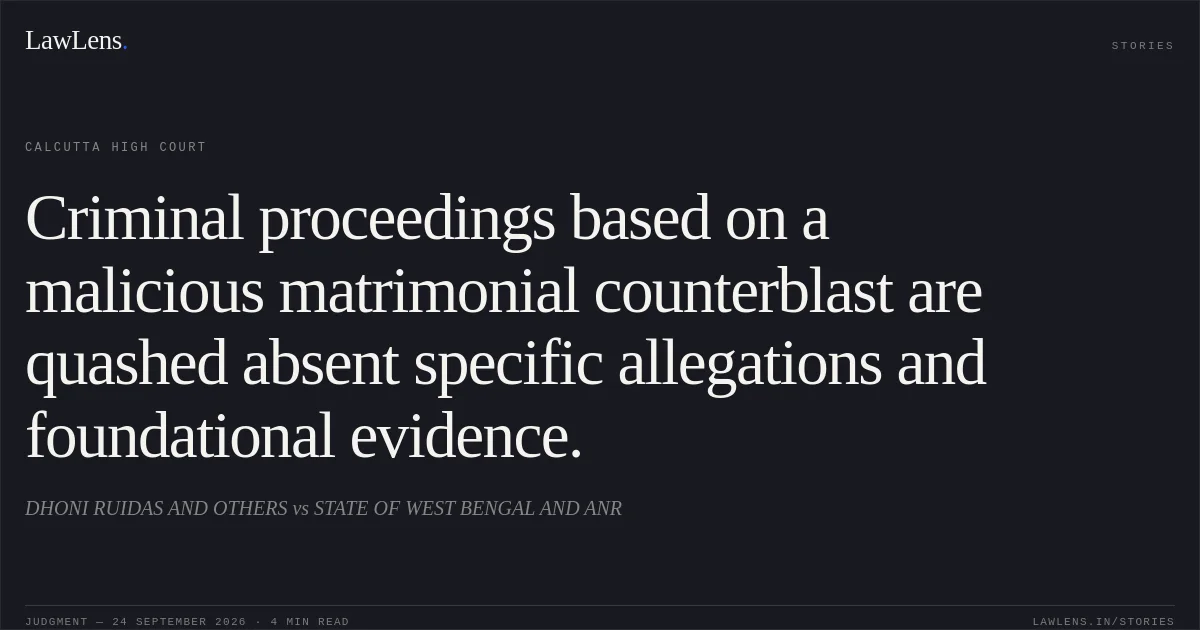
Petitioner No. 1 was married to the son of Opposite Party No. 2 on 4 February 2020, and they had a daughter born on 16 May 2021. Alleging matrimonial cruelty, dowry demands and physical abuse, Petitioner No. 1 initiated Jamuria Police Station Case No. 22 of 2022 under Sections 498A/406/377/506 IPC and Sections 3/4 of the Dowry Prohibition Act on 14 January 2022.
Source reference: para. 2–3The petitioners alleged that, on 20 February 2022, they visited the matrimonial home to collect Petitioner No. 1’s stridhan articles, but were prevented from entering and threatened by Opposite Party No. 2 and his family members. Thereafter, Opposite Party No. 2 moved an application under Section 156(3) CrPC, resulting in Dubrajpur Police Station Case No. 54 of 2022 dated 1 April 2022 under Sections 448/323/506/379/34 IPC. The police subsequently filed Charge-Sheet No. 87 of 2022 dated 30 April 2022 under Sections 448/323/506/34 IPC, omitting Section 379 IPC.
Source reference: para. 3–4, 6The petitioners invoked Sections 482 and 401 CrPC before the High Court, seeking quashing of the criminal proceeding pending before the Judicial Magistrate, Dubrajpur, Birbhum.
Source reference: para. 1Issues
Whether the prosecution initiated by Opposite Party No. 2 was a malicious counter-blast and retaliatory proceeding arising from the matrimonial and dowry-related case instituted by Petitioner No. 1.
Source reference: para. 5(I)Whether the allegations in the FIR and charge-sheet, even if accepted in their entirety, disclosed the essential ingredients of offences under Sections 448, 323 and 506 read with Section 34 IPC.
Source reference: para. 5(II)Whether the police investigation was perfunctory and mechanically conducted, particularly in the absence of medical evidence supporting the allegation of physical assault.
Source reference: para. 5(III)Whether continuation of the prosecution amounted to an abuse of the process of court warranting exercise of the High Court’s inherent jurisdiction under Section 482 CrPC.
Source reference: para. 5(IV)Law Applied
The Court exercised its inherent jurisdiction under Section 482 read with Section 401 CrPC to prevent abuse of the process of court and secure the ends of justice.
Source reference: para. 1, 16It applied the ingredients of Sections 448, 323 and 506 IPC: house-trespass requires entry into or remaining upon property in another’s possession with the requisite criminal intent; Section 323 requires voluntary causing of hurt; and Section 506 requires criminal intimidation involving a threat capable of causing alarm.
Source reference: para. 10–11Relying on State of Haryana v. Bhajan Lal, 1992 Supp (1) SCC 335, and Mahmood Ali v. State of Uttar Pradesh, (2023) 15 SCC 488, the Court held that proceedings manifestly attended by mala fides or instituted with an ulterior motive to wreak vengeance may be quashed.
Source reference: para. 8It further relied on Sujit Biswas v. State of Assam, (2013) 12 SCC 406, and Geeta Mehrotra v. State of Uttar Pradesh, (2012) 10 SCC 741, for the principle that vague and omnibus allegations without specific overt acts cannot sustain criminal prosecution.
Source reference: para. 12Vineet Kumar v. State of Uttar Pradesh, (2017) 13 SCC 369, and Abhishek v. State of Madhya Pradesh, (2023) 16 SCC 666, were relied upon for the proposition that criminal proceedings should not be permitted to become instruments of harassment or persecution.
Source reference: para. 16Reasoning
The Court treated the temporal sequence—Petitioner No. 1’s earlier matrimonial prosecution, the subsequent visit to recover stridhan, and Opposite Party No. 2’s later complaint—as indicative of a retaliatory counter-blast.
Source reference: para. 6–8It held that Petitioner No. 1’s visit to the matrimonial home was for the lawful purpose of recovering her stridhan and was not shown, on the materials relied upon, to involve unlawful entry with the criminal intent required for Section 448 IPC.
Source reference: para. 10The allegation under Section 323 IPC was found unsupported by any medical examination report or injury record, while the allegations of intimidation under Section 506 IPC were considered vague, general and lacking specific threats or individual attribution.
Source reference: para. 11, 13–14The Court also criticised the investigation for being completed mechanically within a short period and for failing to consider the prior matrimonial litigation and collect objective evidence concerning the alleged assault.
Source reference: para. 13–14In these circumstances, the Court concluded that the FIR and charge-sheet did not disclose a sustainable prima facie case and that continuation of the prosecution would constitute abuse of process.
Source reference: para. 15–16Holding
The Court answered all four issues in favour of the petitioners.
It allowed the criminal revision and quashed the entire proceeding arising from Dubrajpur Police Station Case No. 54 of 2022, including Charge-Sheet No. 87 of 2022 and G.R. Case No. 121 of 2022, under Sections 448/323/506/34 IPC, as against all the petitioners.
Source reference: para. 17–18Any interim order was vacated, with no order as to costs; the judgment and trial court records were directed to be transmitted to the trial court for necessary compliance.
Source reference: para. 19–22Acts & Sections Cited
12 provisions across 3 statutes referred to in this judgment. Each provision opens on LawLens.
Code of Criminal Procedure, 19733
Indian Penal Code, 18607
Original Court PDF
DHONI RUIDAS AND OTHERSvsSTATE OF WEST BENGAL AND ANR
Click to open original judgment
Original judgment, available to read, download and summarize on LawLens.in