Facts
The dispute concerned property bearing Khasra No. 235 Kha, Mauza Kuanwala, Dehradun, owned by co-accused Amrish Kumar Oberai and mortgaged with Union Bank of India. The first informant and others agreed to purchase the property for ₹1,26,50,000 and purchased it through a registered sale deed dated 15 March 2018. The prosecution alleged that, despite the subsisting mortgage, the vendors falsely represented in the sale deed that the property was free from all encumbrances, thereby inducing payment of the sale consideration, and that forged revenue records were prepared and used in the transaction
Source reference: para. 2; p. 2The mortgaged property was subsequently auctioned by the Bank on 26 July 2019 and purchased by Udit Goenka, from whom the informant and another purchaser acquired it by a registered sale deed dated 15 June 2020. Pursuant to an application under Section 175(3) of the Bharatiya Nagarik Suraksha Sanhita, 2023, FIR No. 510 of 2024 was registered under Sections 420, 467, 468, 471 and 120-B IPC. The investigation culminated in a charge-sheet dated 13 September 2025 and a supplementary charge-sheet dated 10 November 2025. The Chief Judicial Magistrate, Dehradun, took cognizance and summoned the applicant on 12 June 2026
Source reference: para. 3; p. 2The applicant invoked Section 528 BNSS seeking quashing of the charge-sheets, the cognizance/summoning order and the consequential criminal proceedings. He contended that the dispute was essentially civil, that the purchasers knew of the mortgage and One Time Settlement proceedings, that there was no dishonest intention at the inception, and that no material connected him with the alleged forged revenue record
Source reference: paras. 4–7; pp. 2–4The State and respondent no. 2 opposed the application, maintaining that the sale deed expressly represented the property as free from mortgage and encumbrances and that the investigation disclosed a prima facie case
Source reference: para. 8; p. 4Issues
1. Whether the allegations in the FIR and charge-sheet, taken at face value, prima facie disclose the ingredients of cheating, forgery, use of a forged document and criminal conspiracy under Sections 420, 467, 468, 471 and 120-B IPC against the applicant?
Source reference: paras. 9–12; pp. 5–62. Whether the High Court should exercise its inherent jurisdiction under Section 528 BNSS to quash the charge-sheets, cognizance order and criminal proceedings on the basis of the applicant’s defence that the purchasers knew of the mortgage and that the dispute was civil in nature?
Source reference: paras. 9, 12–13; pp. 5–6Law Applied
The Court applied Section 528 BNSS, which confers inherent jurisdiction to prevent abuse of the process of court and secure the ends of justice. At the stage of considering quashing, the Court is not required to appreciate evidence or finally adjudicate disputed questions of fact; it must examine whether the allegations, taken at their face value, disclose the ingredients of the offences alleged
Source reference: para. 9; p. 5The Court considered Sections 420, 467, 468, 471 and 120-B IPC concerning cheating, forgery of valuable security or specified documents, forgery for the purpose of cheating, using a forged document as genuine, and criminal conspiracy. It further held that the existence of civil remedies or proceedings under Section 138 of the Negotiable Instruments Act does not by itself justify quashing where the allegations prima facie disclose criminal offences
Source reference: para. 12; p. 6Reasoning
The registered sale deed dated 15 March 2018 categorically represented that the property was free from mortgage, encumbrance, debt and litigation, whereas the prosecution alleged that the property was in fact mortgaged with Union Bank of India and that the representation induced the purchasers to pay ₹1,26,50,000
Source reference: para. 10; p. 5These allegations, if accepted at face value, prima facie established the foundational elements of cheating. The applicant’s reliance on the purchasers’ subsequent acquisition of knowledge through the Bank’s auction and their later purchase of the property did not conclusively establish that they knew of the mortgage when the original sale took place
Source reference: para. 10; p. 5The statements of the purchasers attributed the subsequent discovery of the mortgage to events after the original transaction, while the statement of the mediator relied upon by the applicant was contrary to the recital in the sale deed. Determining which version was correct required appreciation of evidence at trial and could not be undertaken under Section 528 BNSS
Source reference: para. 11; p. 5Similarly, whether the revenue record was forged, whether it was knowingly used as genuine, and what role the applicant played were disputed factual matters requiring evidence
Source reference: para. 12; p. 6Accordingly, the applicant was seeking adjudication of his defence, which fell outside the limited scope of the Court’s quashing jurisdiction
Source reference: para. 13; p. 6Holding
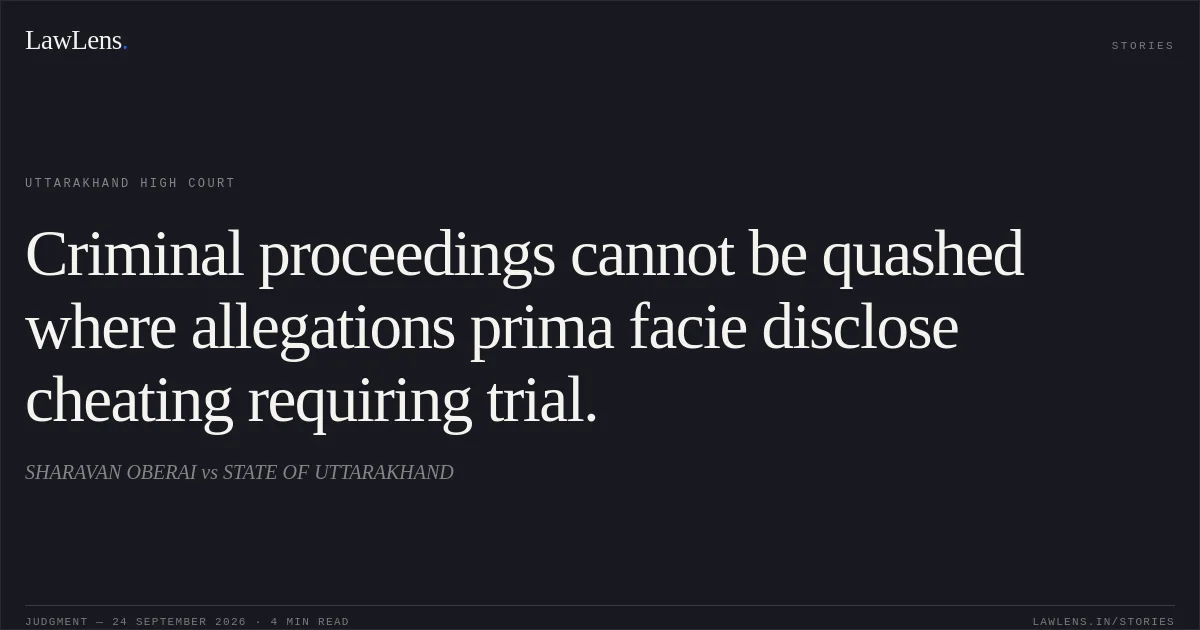
The Court held that the prosecution allegations, particularly the contrary representation in the sale deed concerning the mortgage and encumbrances, prima facie disclosed the alleged criminal offences.
The applicant’s defences regarding the purchasers’ knowledge, the civil nature of the dispute, the absence of dishonest intention and the alleged forged revenue record involved disputed questions of fact that could be tested only at trial
Source reference: paras. 10–13; pp. 5–6The application under Section 528 BNSS was therefore dismissed, and the charge-sheets, cognizance/summoning order dated 12 June 2026 and consequential criminal proceedings were not quashed
Source reference: para. 14; p. 6Acts & Sections Cited
8 provisions across 3 statutes referred to in this judgment. Each provision opens on LawLens.
Bharatiya Nagarik Suraksha Sanhita, 20233
Indian Penal Code, 18604
Negotiable Instruments Act, 18811
Original Court PDF
SHARAVAN OBERAIvsSTATE OF UTTARAKHAND
Click to open original judgment
Original judgment, available to read, download and summarize on LawLens.in