Facts
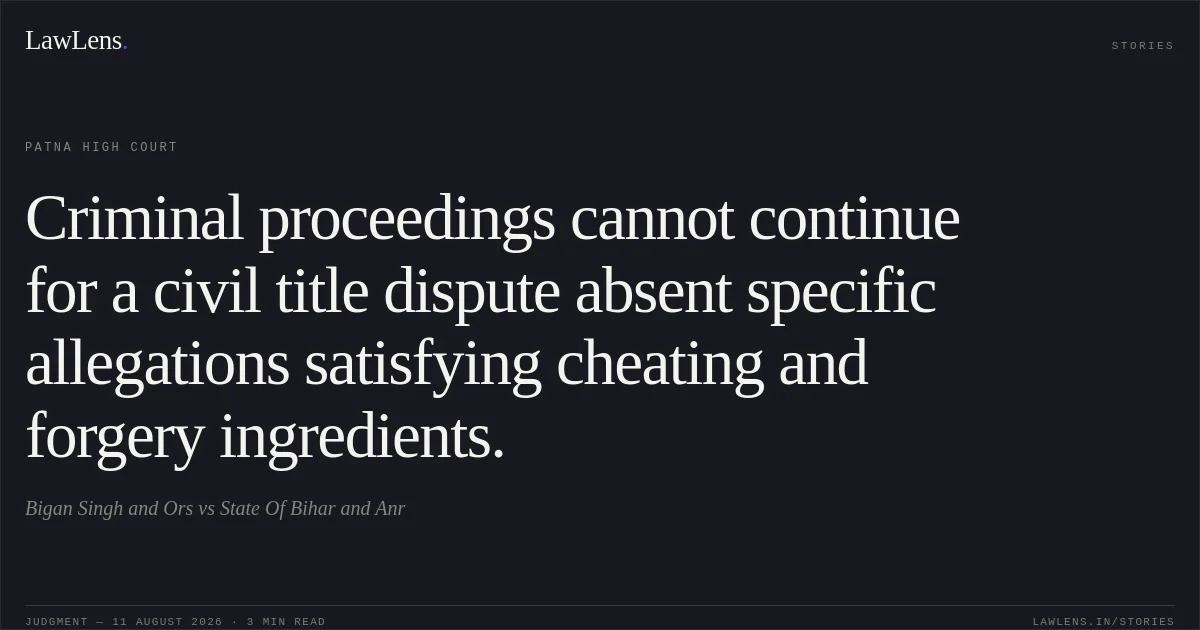
Opposite Party No. 2 filed Complaint Case No. 388 of 2014 alleging that the petitioners and 18 other accused persons had, in connivance, created forged and fabricated sale deeds concerning the complainant’s ancestral lands at Lahiyarpur, Aurangabad, and thereafter claimed title and possession over those lands.
Source reference: p.2, paras. 2–3The complainant’s solemn affirmation and the statements of four inquiry witnesses were recorded, following which the Judicial Magistrate, First Class, Aurangabad took cognizance of offences under Sections 420, 468 and 471 of the Indian Penal Code against all 25 accused persons.
Source reference: p.2, para. 3The petitioners sought quashing of the cognizance order, contending that the dispute was purely civil, that the complaint contained vague and omnibus allegations, and that the complainant had already instituted Title Suit No. 182 of 2014 seeking declaration of his title and invalidation of the sale deeds.
Source reference: pp. 3–4, paras. 4–6The complainant opposed the application, asserting that the accused had fabricated documents to grab his land and that the allegations were supported by the inquiry evidence.
Source reference: p.5, para. 7Issues
1. Whether the allegations in the complaint and the materials collected during inquiry disclosed the ingredients of cheating under Sections 415 and 420 IPC against the petitioners?
Source reference: pp. 7–9, paras. 13–162. Whether the allegations disclosed the commission of offences under Sections 468 and 471 IPC relating to the making and use of forged documents?
Source reference: pp. 9–10, paras. 17–183. Whether continuation of the criminal proceedings, in the context of the pending title suit and the allegedly vague allegations, amounted to an abuse of the process of court?
Source reference: pp. 6–11, paras. 10–12, 19–20Law Applied
The Court applied Sections 415 and 420 IPC, holding that cheating requires fraudulent or dishonest inducement of a person and, under Section 420, consequent delivery of property or making, alteration or destruction of a valuable security.
Source reference: pp. 7–9, para. 14Section 468 IPC requires the making of a false document within the meaning of Section 464 IPC with the intention that it be used for cheating, while Section 471 IPC requires use of a forged document as genuine with knowledge or reason to believe that it is forged.
Source reference: p. 9, para. 17The Court relied on Mohammed Ibrahim v. State of Bihar, (2009) 8 SCC 751; Prof. R.K. Vijayasarathy v. Sudha Seetharam, (2019) 16 SCC 739; A.M. Mohan v. State, (2024) 12 SCC 181; and Sarabjit Kaur v. State of Punjab, (2023) 5 SCC 360, for the principles governing cheating, forgery and the distinction between civil disputes and criminal offences.
Source reference: p. 9, para. 15It further applied the settled principle that criminal proceedings cannot be used to settle scores or exert pressure in essentially civil disputes.
Source reference: p. 11, para. 20Reasoning
The Court found that the complaint did not identify the alleged sale deeds with sufficient particulars and did not attribute any specific act to any individual petitioner; instead, it contained vague, omnibus and sweeping allegations against all accused persons.
Source reference: pp. 6–7, para. 10The essential element of dishonest or fraudulent inducement was absent because no person was alleged to have been deceived or induced to deliver property to the petitioners, thereby failing to satisfy Sections 415 and 420 IPC.
Source reference: p. 9, para. 16Similarly, the complainant furnished no details or supporting documents demonstrating that the petitioners had made a false document, intended to cheat, or knowingly used a forged document as genuine, as required under Sections 468 and 471 IPC.
Source reference: p. 10, paras. 17–18The existence of Title Suit No. 182 of 2014, filed before the criminal complaint and seeking declaration of the complainant’s title and cancellation of the disputed sale deeds, showed that the central controversy concerned title and possession over immovable property.
Source reference: p. 7, paras. 11–12In these circumstances, the Court concluded that the criminal complaint appeared intended to convert a civil dispute into a criminal proceeding and exert pressure upon the petitioners.
Source reference: p. 10, para. 19Holding
The Court held that the complaint and inquiry materials did not disclose the necessary ingredients of offences under Sections 420, 468 or 471 IPC against the petitioners.
Since the dispute was essentially civil and the allegations were vague and unsupported by specific particulars of forgery or cheating, continuation of the criminal proceedings would constitute an abuse of the process of court.
Source reference: pp. 9–11, paras. 16–20Accordingly, the cognizance order dated 4 July 2016 in Complaint Case No. 388 of 2014 was set aside and quashed qua the seven petitioners only; the pending interlocutory applications were also disposed of.
Source reference: p. 11, paras. 20–21Acts & Sections Cited
5 provisions across 1 statute referred to in this judgment. Each provision opens on LawLens.
Indian Penal Code, 18605
Original Court PDF
Bigan Singh and OrsvsState Of Bihar and Anr
Click to open original judgment
Original judgment, available to read, download and summarize on LawLens.in