Facts
The petitioners—father and son—were involved in the development of two plots of land at Adiganga Road, Kolkata. The owners executed development agreements dated 26 December 2005 and a General Power of Attorney dated 27 December 2005 in favour of Petitioner No. 1. Plot No. 3 was subsequently sold to Petitioner No. 2 under an Indenture of Sale dated 13 April 2011. In respect of Plot No. 43, the earlier authority was revoked and fresh development arrangements and powers of attorney were executed in 2011 in favour of Petitioner No. 1 and local developers
Source reference: paras. 2–5The opposite party alleged that 45% of the constructed area reserved for the owners had been fraudulently sold by Petitioner No. 1 to Petitioner No. 2, and that an authorization document shown to him on 23 September 2022 contained forged signatures. The complaint resulted in Bansdroni Police Station Case No. 172 of 2022 under Sections 120B, 420 and 406 of the IPC. The police subsequently filed Charge Sheet No. 94 of 2023 under the same provisions, although the allegations of forgery were not retained
Source reference: paras. 6–7The opposite party had also instituted consumer proceedings concerning the same property dispute. The petitioners therefore invoked the High Court’s inherent jurisdiction seeking quashing of ACGR Case No. 4235 of 2022, contending that the dispute was contractual and civil in nature, that there was no dishonest intention from inception or entrustment, and that the criminal case had been instituted to exert pressure upon them
Source reference: para. 8Issues
Whether the allegations and materials on record prima facie disclosed the ingredients of offences under Sections 406, 420 and 120B of the IPC against the petitioners?
Source reference: paras. 14–15Whether the criminal proceeding was essentially a civil dispute arising from a property-development arrangement, given a criminal colour, and therefore liable to be quashed under the High Court’s inherent jurisdiction?
Source reference: paras. 11–15Whether continuation of the criminal proceeding would amount to an abuse of the process of law warranting interference under the principles in State of Haryana v. Bhajan Lal?
Source reference: paras. 11–12, 15Law Applied
The Court applied the inherent jurisdiction under Section 482 of the Code of Criminal Procedure to prevent abuse of process and secure the ends of justice.
Source reference: para. 12It relied on State of Haryana v. Bhajan Lal, which permits quashing where the allegations, even if accepted in their entirety, do not constitute an offence, or where the proceeding is manifestly mala fide and instituted to wreak vengeance
Source reference: para. 12Relying on Paramjeet Batra v. State of Uttarakhand, Naresh Kumar v. State of Karnataka, and Indian Oil Corporation v. NEPC India Ltd., the Court reiterated that essentially civil disputes cannot be given a criminal cloak, although the mere availability or pursuit of a civil remedy is not by itself sufficient to quash a prosecution
Source reference: paras. 11–12Under Vesa Holdings (P) Ltd. v. State of Kerala, cheating requires fraudulent or dishonest intention at the inception of the transaction, and a mere breach of contract does not constitute cheating
Source reference: para. 11The Court further relied on Delhi Race Club (1940) Ltd. v. State of Uttar Pradesh, which distinguished cheating under Section 420 from criminal breach of trust under Section 406 and held that the essential statutory ingredients must be disclosed by the complaint
Source reference: para. 13The Court also recognised that, under Anukul Singh v. State of Uttar Pradesh, disputed factual matters ordinarily cannot be assessed in a Section 482 proceeding, but proceedings may be quashed where the allegations and unimpeachable material disclose no criminal offence
Source reference: para. 12Reasoning
The Court found that the parties’ relationship arose from development agreements, powers of attorney, sale arrangements and construction of the concerned properties, demonstrating a business and contractual arrangement
Source reference: para. 14The existence of consumer proceedings concerning the same subject matter further supported the conclusion that the dispute was predominantly civil. On the materials in the case diary, the Court found no prima facie evidence of the dishonest intention required for cheating under Section 420, nor of entrustment followed by dishonest misappropriation necessary for criminal breach of trust under Section 406
Source reference: paras. 8, 14–15The alleged sale of the owners’ share and the competing interpretation of the development documents constituted matters arising from the parties’ contractual and property dealings.
Source reference: para. 15Since the investigating material did not disclose the essential ingredients of the alleged offences or criminal intent, the prosecution was treated as an abuse of the criminal process. Consequently, the allegation of conspiracy under Section 120B also could not independently survive in the absence of a prima facie substantive offence
Source reference: para. 15Holding
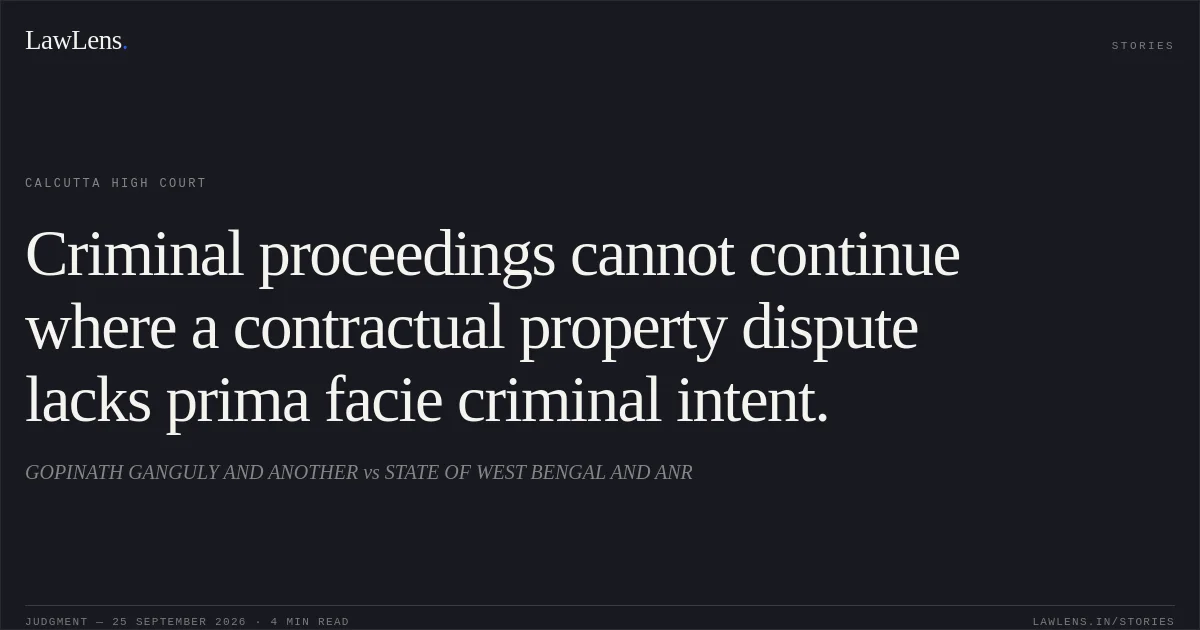
The High Court held that the materials on record did not prima facie establish the ingredients of Sections 406, 420 or 120B of the IPC and that the dispute was essentially civil in nature, arising from a property-development arrangement
Applying the principles governing quashing under Section 482 CrPC, the Court allowed CRR 4719 of 2024 and quashed ACGR Case No. 4235 of 2022 arising from Bansdroni Police Station Case No. 172 of 2022, including the charge sheet, insofar as it concerned Gopinath Ganguly and Rajesh Ganguly
Source reference: paras. 16–17All connected applications were disposed of, and any interim order was vacated
Source reference: paras. 18–19Acts & Sections Cited
7 provisions across 2 statutes referred to in this judgment. Each provision opens on LawLens.
Indian Penal Code, 18604
Code of Criminal Procedure, 19733
Original Court PDF
GOPINATH GANGULY AND ANOTHERvsSTATE OF WEST BENGAL AND ANR
Click to open original judgment
Original judgment, available to read, download and summarize on LawLens.in