Facts
The complainant, Rani Kumari, married petitioner no. 1, Sandeep Kumar, on 12 June 2014. She alleged that her husband and other accused persons, including petitioner no. 2, her mother-in-law, subjected her to physical and mental cruelty in connection with a dowry demand of ₹5 lakhs, forcibly took her ornaments and one-year-old son, and ousted her from the matrimonial home.
Source reference: para. 3The learned S.D.J.M., Nawada, took cognizance in Complaint Case No. 1171 of 2016 under Section 498A of the IPC and Sections 3 and 4 of the Dowry Prohibition Act by order dated 27 April 2018.
Source reference: para. 2During the pendency of the quashing proceedings, the parties entered into a Memorandum of Agreement dated 18 June 2025 before the Patna High Court Mediation and Conciliation Centre.
Source reference: para. 4The husband and complainant thereafter instituted a mutual-consent divorce proceeding under Section 13B of the Hindu Marriage Act, which was allowed on 16 July 2026.
Source reference: para. 5The complainant supported the compromise and the petition for quashing.
Source reference: para. 6Issues
Whether the criminal proceedings arising from the complaint under Section 498A of the IPC and Sections 3 and 4 of the Dowry Prohibition Act should be quashed in view of the parties’ compromise and mutual-consent divorce.
Source reference: paras. 2, 7–9Whether continuation of the criminal prosecution would serve any legitimate purpose after settlement of the matrimonial dispute and performance of the settlement terms.
Source reference: paras. 7–8Law Applied
The Court considered the allegations under Section 498A of the Indian Penal Code and Sections 3 and 4 of the Dowry Prohibition Act.
Source reference: para. 2It applied the principle that, in appropriate matrimonial disputes, criminal proceedings may be quashed where the parties have voluntarily settled their disputes and continuation of the prosecution would serve no legitimate purpose.
Source reference: no citationThe Court relied on Naushey Ali v. State of Uttar Pradesh, (2025) 4 SCC 78, and Mange Ram v. State of Madhya Pradesh, 2025 SCC OnLine SC 1681, for the proposition that criminal proceedings arising out of matrimonial disputes may be quashed following a genuine compromise to provide a quietus to the litigation.
Source reference: para. 8The power to quash was exercised in the context of the Court’s jurisdiction in the criminal miscellaneous proceeding.
Source reference: no citationReasoning
The alleged offences arose out of the matrimonial relationship between the complainant and petitioner no. 1 and involved petitioner no. 2 as the mother-in-law.
Source reference: paras. 3–4During the proceedings, the parties entered into a mediated settlement, followed by dissolution of the marriage by mutual consent under Section 13B of the Hindu Marriage Act.
Source reference: paras. 4–6The complainant expressly supported the compromise and the quashing application.
Source reference: para. 6Taking into account the settlement, the payment of ₹48 lakhs and delivery of other articles as agreed in the Memorandum of Agreement, and the mutual-consent divorce, the Court held that continuation of the prosecution would unnecessarily consume judicial time and would serve no legitimate purpose.
Source reference: para. 7Applying the principles in Naushey Ali and Mange Ram, the Court found the case appropriate for quashing.
Source reference: para. 8Holding
The Court answered the issues in favour of the petitioners.
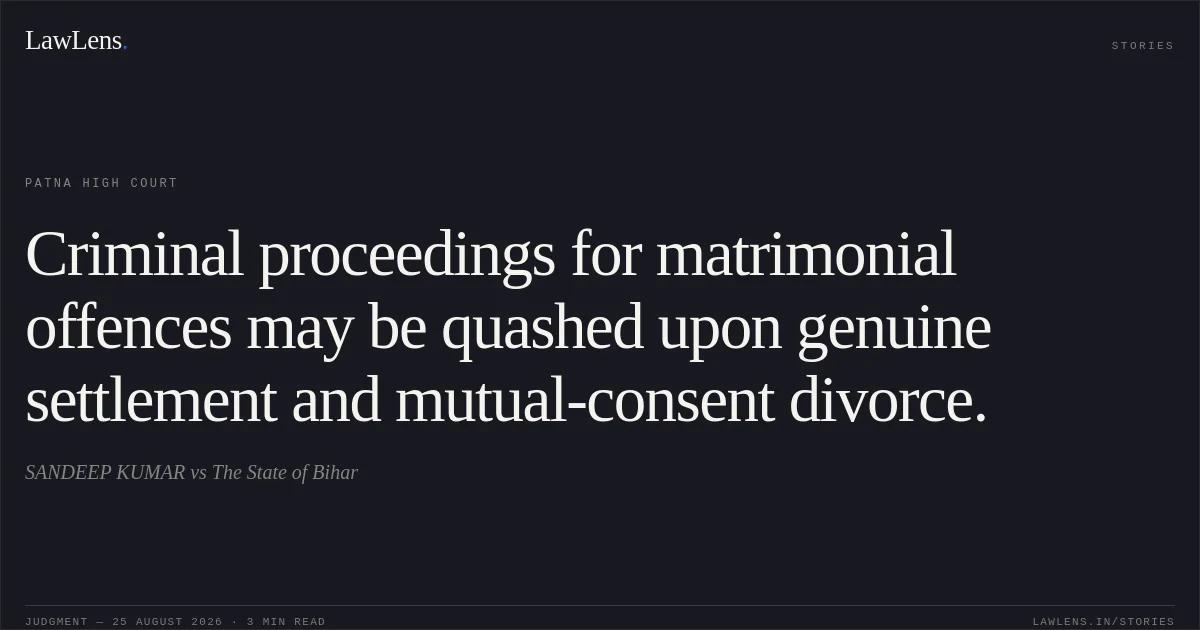
It held that, in view of the compromise, settlement terms, and mutual-consent divorce, continuation of the criminal case was unjustified.
Source reference: paras. 9–10Accordingly, the order dated 27 April 2018 taking cognizance in Complaint Case No. 1171 of 2016 was quashed, and the criminal miscellaneous application was allowed.
Source reference: paras. 9–10Acts & Sections Cited
2 provisions across 1 statute referred to in this judgment. Each provision opens on LawLens.
Original Court PDF
SANDEEP KUMARvsThe State of Bihar
Click to open original judgment
Original judgment, available to read, download and summarize on LawLens.in
![Courts will not interfere with transfers absent mala fides or violation of statutory rules.. M Ramya vs EMPLOYEES STATE INSURANCE CORPORATION (ESIC). CAT - ['Chennai']. LawLens](/stories/thumbnails/courts-will-not-interfere-with-transfers-absent-mala-fides-or-violation-of-statutory-rules-a6845e9ca6f548fca284c51c8351957f.webp)
![Courts cannot direct one-time recruitment age relaxation absent authority in the governing rules or advertisement.. UT OF PUDUCHERRY vs M ANDAL. CAT - ['Chennai']. LawLens](/stories/thumbnails/courts-cannot-direct-one-time-recruitment-age-relaxation-absent-authority-in-the-governing-895d78fde47143e2a8ed0207c4b6a44f.webp)
![A review cannot correct an allegedly erroneous decision absent an error apparent on the record.. Ajit Kumar Jha vs RAILWAY BOARD. CAT - ['Delhi']. LawLens](/stories/thumbnails/a-review-cannot-correct-an-allegedly-erroneous-decision-absent-an-error-apparent-on-the-re-8ac952fd4eba470c92f7da20af72a220.webp)