Facts
The informant alleged that his son, a member of the Scheduled Caste community, was taken by co-accused Radha Kishun Choubey on 21 November 2011 to work as a labourer.
Source reference: p.2, para.3After a dispute regarding payment of wages, the accused allegedly killed him by electrocution or other means and covered his body with a quilt.
Source reference: p.2, para.3The FIR was initially registered under Section 302 IPC.
Source reference: p.6, para.7Following investigation, the police filed a charge-sheet under Sections 304A/34 IPC and Section 3(1)(x) of the Scheduled Castes and the Scheduled Tribes (Prevention of Atrocities) Act, 1989 (“SC/ST Act”), and the Magistrate took cognizance of those offences on 17 November 2016.
Source reference: p.6, para.7The petitioners sought quashing of the cognizance order, contending that the deceased’s death was an accidental electrocution caused by non-insulated wires used by co-accused Md. Sarfuddin for supplying generator electricity, and that no offence was made out against them.
Source reference: pp.2–5, paras.4.1–4.9Issues
1. Whether the materials collected during investigation disclosed a prima facie case against the petitioners under Section 304A read with Section 34 IPC for causing death by a negligent act.
Source reference: pp.2–3, para.4.1; p.6, para.72. Whether the ingredients of Section 3(1)(x) of the SC/ST Act were satisfied in the absence of any allegation that the petitioners intentionally insulted or intimidated the deceased or his family members by caste-based abuse in a public place.
Source reference: p.5, para.4.73. Whether continuation of the criminal proceedings and the order taking cognizance amounted to an abuse of the process of the Court warranting quashing.
Source reference: p.6, paras.8–9Law Applied
Section 304A IPC criminalises causing death by a rash or negligent act not amounting to culpable homicide; Section 34 IPC requires participation in a criminal act pursuant to a common intention.
Source reference: no citationSection 3(1)(x) of the SC/ST Act, as applicable to the case, required intentional insult or intimidation of a member of a Scheduled Caste or Scheduled Tribe with intent to humiliate in a place within public view.
Source reference: no citationThe High Court applied the principles governing exercise of its inherent jurisdiction to prevent abuse of process, including the categories identified in State of Haryana v. Bhajan Lal, 1992 Supp (1) SCC 335.
Source reference: p.4, para.4.5It also referred to Pepsi Foods Ltd. v. Special Judicial Magistrate, (1998) 5 SCC 749, for the principle that summoning an accused is a serious matter and requires judicial application of mind to the materials on record.
Source reference: p.4, para.4.6Reasoning
The investigation indicated that Md. Sarfuddin was supplying electricity through generator sets using non-insulated wires, and the deceased’s fellow labourers stated that the death resulted from accidental electrocution caused by those wires.
Source reference: p.6, para.7Since the petitioners had no connection with the generation or transmission of electricity, the Court held that any negligence leading to the death could not be attributed to them.
Source reference: p.6, para.7Consequently, the essential basis for proceeding against them under Section 304A/34 IPC was absent.
Source reference: p.6, para.7The Court also noted the absence of any allegation that the petitioners had used caste-based insults or otherwise committed the specific acts required under Section 3(1)(x) of the SC/ST Act.
Source reference: p.5, para.4.7In these circumstances, continuation of the proceedings was held to constitute an abuse of the process of the Court.
Source reference: p.6, para.8Holding
The High Court answered the issues in favour of the petitioners.
It held that the investigation did not disclose their involvement in any negligent act causing the deceased’s electrocution and that the ingredients of the alleged SC/ST Act offence were not established.
Source reference: p.7, paras.9–10Accordingly, the order dated 17 November 2016 taking cognizance under Sections 304A/34 IPC and Section 3(1)(x) of the SC/ST Act was quashed, and the criminal miscellaneous application was allowed.
Source reference: p.7, paras.9–10Acts & Sections Cited
4 provisions across 2 statutes referred to in this judgment. Each provision opens on LawLens.
Indian Penal Code, 18602
Scheduled Castes and the Scheduled Tribes (Prevention of Atrocities) Act, 19892
Original Court PDF
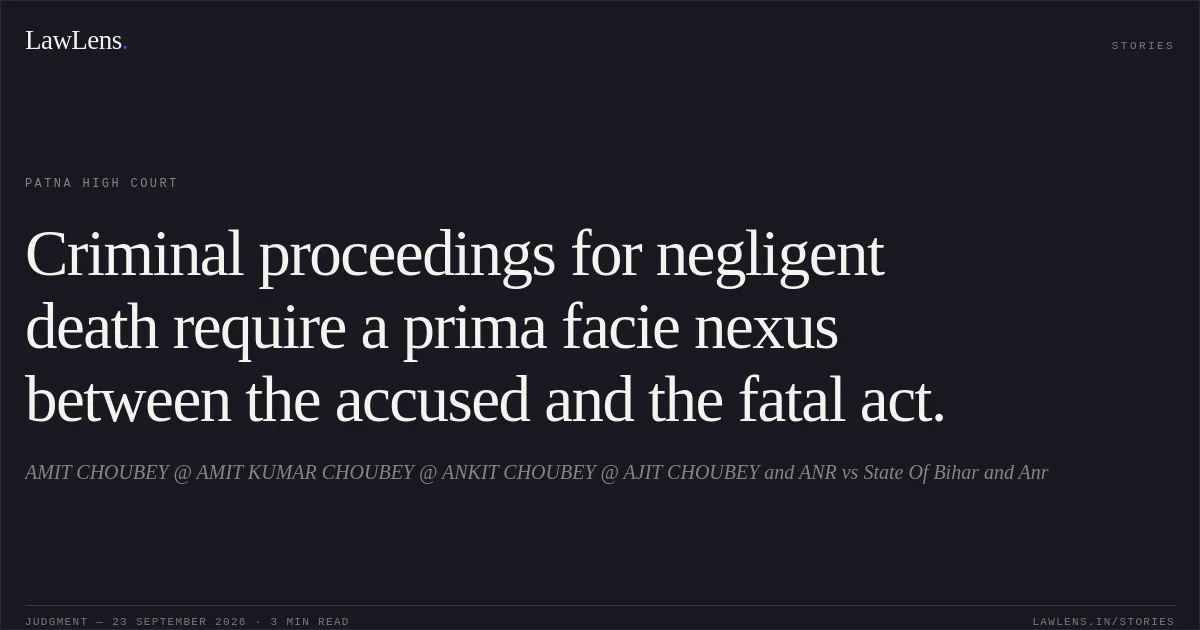
AMIT CHOUBEY @ AMIT KUMAR CHOUBEY @ ANKIT CHOUBEY @ AJIT CHOUBEY and ANRvsState Of Bihar and Anr
Click to open original judgment
Original judgment, available to read, download and summarize on LawLens.in